
Advanced Molybdenum-Copper Co-Catalysis for Scalable 3-Trifluoromethyl-1,2,4-Triazole Production
Advanced Molybdenum-Copper Co-Catalysis for Scalable 3-Trifluoromethyl-1,2,4-Triazole Production
The pharmaceutical industry continuously seeks robust and efficient synthetic routes for nitrogen-containing heterocycles, particularly those incorporating fluorine motifs which are pivotal for enhancing metabolic stability and bioavailability. A significant breakthrough in this domain is detailed in Chinese Patent CN113307778A, which discloses a novel preparation method for 3-trifluoromethyl substituted 1,2,4-triazole compounds. These structural scaffolds are ubiquitous in modern medicinal chemistry, serving as core components in blockbuster drugs such as Sitagliptin and various antifungal agents. The disclosed methodology leverages a synergistic molybdenum and copper co-catalytic system to facilitate the cycloaddition of trifluoroethylimidoyl chloride with functionalized isonitriles. This approach represents a paradigm shift from classical multi-step syntheses, offering a streamlined, one-pot protocol that operates under remarkably mild thermal conditions. For R&D directors and process chemists, this innovation provides a powerful tool for rapidly accessing diverse chemical space with high atom economy.
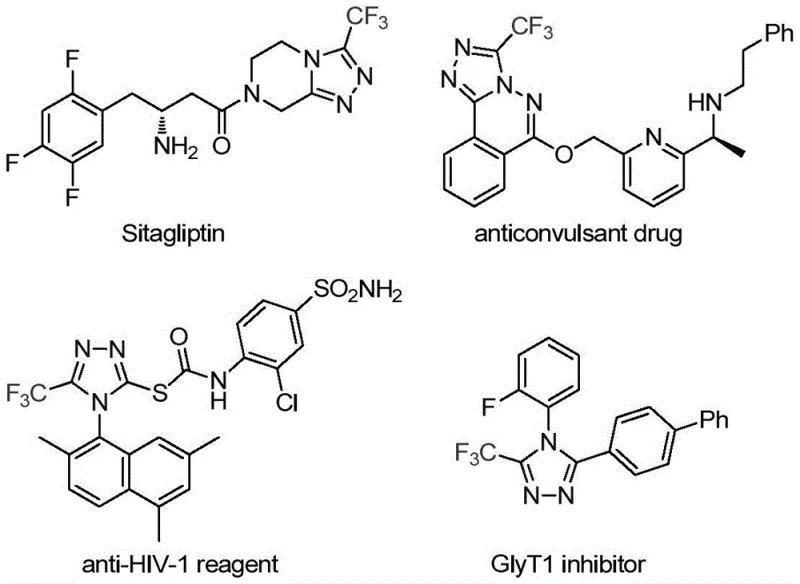
The Limitations of Conventional Methods vs. The Novel Approach
The Limitations of Conventional Methods
Historically, the construction of trifluoromethyl-substituted 1,2,4-triazoles has been fraught with synthetic challenges that hinder efficient scale-up and library generation. Traditional literature methods often rely on the cyclization of trifluoroacetyl hydrazine with amidine compounds or the hydrazinolysis of trifluoromethyl-substituted 1,2,4-oxazolinones. These pathways frequently necessitate harsh reaction conditions, expensive or unstable starting materials, and complex purification procedures to remove hazardous byproducts. Furthermore, alternative copper-catalyzed multi-component reactions involving diazonium salts and trifluorodiazoethane pose significant safety risks due to the explosive nature of diazo compounds, making them less attractive for industrial manufacturing environments. The limited reports on synthesizing 3,4-disubstituted variants specifically highlight a gap in reliable methodologies for generating these specific substitution patterns efficiently.
The Novel Approach
In stark contrast to these legacy techniques, the method described in CN113307778A utilizes a sophisticated yet operationally simple strategy involving the co-catalysis of molybdenum hexacarbonyl and cuprous acetate. By employing trifluoroethylimidoyl chloride and a functionalized isonitrile (specifically Ph3P=N-NC) as the primary building blocks, the reaction proceeds smoothly in organic solvents like THF at temperatures ranging from 70°C to 90°C. This novel route eliminates the need for dangerous diazo reagents and avoids the rigorous conditions associated with hydrazine chemistry. The use of readily available starting materials not only reduces the raw material costs but also simplifies the supply chain logistics for procurement teams. The reaction efficiency is notably high, with yields varying significantly based on the electronic nature of the substituents, demonstrating the versatility of this catalytic system for producing high-purity pharmaceutical intermediates.
Mechanistic Insights into Mo/Cu Co-Catalyzed Cycloaddition
The success of this transformation lies in the intricate interplay between the molybdenum and copper species, which orchestrate the formation of the five-membered triazole ring through a concerted mechanism. Initially, the molybdenum hexacarbonyl acts as a metal activator, likely coordinating with the functionalized isonitrile to form a reactive metal-isocyanide complex. This activation lowers the energy barrier for the subsequent nucleophilic attack or cycloaddition step. Concurrently, the cuprous acetate serves as a Lewis acid catalyst, promoting the [3+2] cycloaddition between the activated isonitrile species and the trifluoroethylimidoyl chloride. This dual-catalyst system ensures that the reaction proceeds with high regioselectivity to form the desired 1,2,4-triazole core rather than other isomeric byproducts.
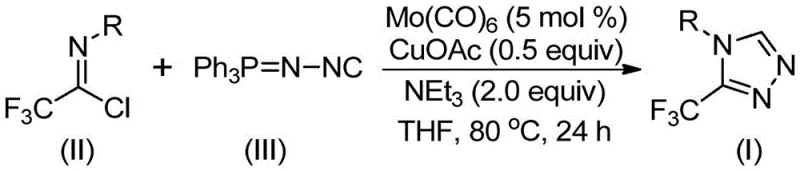
Following the initial ring closure, the intermediate undergoes a critical elimination step where triphenylphosphine oxide is removed, driven by the presence of water within the system or during workup, to yield the final aromatic triazole product. Understanding this mechanism is crucial for impurity control, as deviations in catalyst loading or temperature could lead to incomplete conversion or the formation of phosphine-containing side products. The patent data indicates that maintaining the molar ratio of trifluoroethylimidoyl chloride to functionalized isonitrile at approximately 1:1.5, along with precise catalyst loading (5 mol% Mo and 0.5 equiv Cu), is essential for maximizing yield. This mechanistic clarity allows process chemists to fine-tune reaction parameters to minimize impurities, ensuring the final API intermediate meets stringent quality specifications required by global regulatory bodies.
How to Synthesize 3-Trifluoromethyl-1,2,4-Triazole Efficiently
The experimental procedure outlined in the patent provides a robust framework for executing this synthesis in a laboratory or pilot plant setting. The process begins by combining the catalysts, base, and solvent in a Schlenk tube under an inert atmosphere to prevent oxidation of the sensitive metal centers. The specific order of addition and the use of molecular sieves to maintain anhydrous conditions are critical factors that influence the reaction outcome. While the patent details specific examples for various substrates, the general protocol remains consistent, highlighting the reproducibility of the method across different electronic environments.
- Charge a reaction vessel with molybdenum hexacarbonyl (5 mol %), cuprous acetate (0.5 equiv), triethylamine (2.0 equiv), and molecular sieves in anhydrous THF.
- Add trifluoroethylimidoyl chloride and the functionalized isonitrile (Ph3P=N-NC) to the mixture under inert atmosphere.
- Heat the reaction mixture to 80°C for 24 hours, then filter and purify via column chromatography to isolate the target triazole.
Commercial Advantages for Procurement and Supply Chain Teams
For procurement managers and supply chain heads, the adoption of this synthetic route offers tangible benefits that extend beyond mere chemical elegance. The primary advantage lies in the substantial cost reduction in pharmaceutical intermediate manufacturing achieved by utilizing cheap and easily obtainable starting materials. Trifluoroethylimidoyl chloride and the requisite isonitriles are commercially available commodities, reducing the dependency on custom-synthesized precursors that often carry long lead times and high price tags. Furthermore, the elimination of hazardous reagents like diazonium salts simplifies waste disposal protocols and reduces the environmental compliance burden, translating into lower operational expenditures for the facility.
- Cost Reduction in Manufacturing: The use of inexpensive catalysts such as cuprous acetate and molybdenum hexacarbonyl, combined with the high atom economy of the cycloaddition reaction, drastically lowers the cost of goods sold (COGS). Unlike precious metal catalysts that require expensive recovery processes, the copper and molybdenum residues can be managed with standard waste treatment procedures. Additionally, the high reaction efficiency observed in many examples minimizes the loss of valuable starting materials, ensuring that every kilogram of input translates effectively into output, thereby optimizing the overall material balance and financial performance of the production campaign.
- Enhanced Supply Chain Reliability: The reliance on stable, shelf-stable reagents significantly mitigates supply chain risks associated with the transportation and storage of volatile or explosive chemicals. Since the key building blocks are widely sourced from the global chemical market, procurement teams can secure multiple supply sources, preventing bottlenecks that could disrupt production schedules. The mild reaction conditions (70-90°C) also reduce the energy consumption compared to high-temperature processes, contributing to a more sustainable and resilient manufacturing footprint that is less susceptible to energy price fluctuations.
- Scalability and Environmental Compliance: The patent explicitly mentions that the method can be expanded to gram-level reactions, indicating a clear pathway for commercial scale-up of complex pharmaceutical intermediates. The simplicity of the post-processing, which involves filtration and standard column chromatography, suggests that the process can be adapted for continuous flow chemistry or large-batch reactors with minimal engineering modifications. This scalability ensures that the supply chain can respond rapidly to increased demand without compromising on the purity or quality of the final product, aligning perfectly with the just-in-time delivery models preferred by modern pharmaceutical clients.
Frequently Asked Questions (FAQ)
The following questions address common technical inquiries regarding the implementation and scope of this patented technology. These insights are derived directly from the experimental data and beneficial effects described in the patent documentation, providing clarity for technical teams evaluating this route for their own pipelines. Understanding these nuances is essential for making informed decisions about process adoption and resource allocation.
Q: What are the key advantages of this Mo/Cu co-catalytic method over traditional triazole synthesis?
A: Unlike traditional methods requiring harsh conditions or unstable diazonium salts, this patent describes a mild one-pot reaction at 70-90°C using commercially available imidoyl chlorides and isonitriles, significantly simplifying the operational workflow.
Q: What is the substrate scope for the R-group in this trifluoromethyl triazole synthesis?
A: The method demonstrates excellent tolerance for various substituents including alkyl, alkoxy, halogens, and nitro groups on the phenyl ring, as well as phenethyl groups, allowing for diverse library generation for SAR studies.
Q: Is this process suitable for large-scale manufacturing of API intermediates?
A: Yes, the patent explicitly states the reaction can be expanded to gram-level scales with simple post-processing (filtration and chromatography), indicating strong potential for kilogram-scale production upon further optimization.
Partnering with NINGBO INNO PHARMCHEM: Your Reliable 3-Trifluoromethyl-1,2,4-Triazole Supplier
At NINGBO INNO PHARMCHEM, we recognize the critical role that advanced heterocyclic intermediates play in the development of next-generation therapeutics. Our team of expert chemists has extensively analyzed the Mo/Cu co-catalytic pathway described in CN113307778A and possesses the extensive experience scaling diverse pathways from 100 kgs to 100 MT/annual commercial production. We are committed to delivering high-purity 3-trifluoromethyl-1,2,4-triazole derivatives that meet the rigorous demands of the global pharmaceutical industry. Our state-of-the-art facilities are equipped with stringent purity specifications and rigorous QC labs to ensure that every batch we produce adheres to the highest international standards, providing our partners with the confidence they need to advance their drug candidates.
We invite you to collaborate with us to leverage this innovative synthetic technology for your specific project needs. Whether you require custom synthesis of novel analogs or large-scale supply of established intermediates, our technical procurement team is ready to provide a Customized Cost-Saving Analysis tailored to your volume requirements. Please contact us today to request specific COA data and route feasibility assessments, and let us demonstrate how our expertise can accelerate your timeline to market while optimizing your production costs.