
Efficient Copper-Catalyzed Oxidative Amination for High-Purity Pharmaceutical Intermediates
Introduction to Advanced Oxidative Amination Technology
The landscape of fine chemical synthesis is constantly evolving, driven by the need for more efficient, sustainable, and cost-effective pathways to critical molecular scaffolds. A significant breakthrough in this domain is documented in Chinese Patent CN112047925B, which discloses a robust preparation method for N-(aryl/heteroaryl) alkyl-diamides. These compounds serve as pivotal intermediates for the one-step synthesis of primary and tertiary amines, which are foundational building blocks in the pharmaceutical, agrochemical, and materials science industries. The patent outlines a transition metal-catalyzed oxidative coupling strategy that operates under nitrogen protection, utilizing readily available alkyl-aromatic or alkyl-heteroaromatic compounds and N-halogenated cyclic diamides. This technology represents a paradigm shift from traditional multi-step protocols, offering a streamlined route that enhances atom economy and reduces environmental impact while maintaining high yields and purity standards essential for downstream drug development.
The Limitations of Conventional Methods vs. The Novel Approach
The Limitations of Conventional Methods
Historically, the synthesis of N-(aryl/heteroaryl) alkyl-diamide compounds has been fraught with significant operational and economic challenges. Traditional methodologies often rely on cumbersome multi-step sequences, such as the three-step reaction involving elemental bromine and diamide potassium salts, or two-step processes requiring halogenated aromatic hydrocarbons and strong alkali bases. These conventional routes are frequently limited by the necessity for noble metal catalysts, which drive up raw material costs, and the use of equivalent amounts of strong acids or organic halides that generate substantial hazardous waste. Furthermore, existing methods often suffer from poor substrate adaptability, being restricted primarily to specific N-heteroaromatic hydrocarbon compounds, thereby limiting their utility in synthesizing diverse chemical libraries. The reliance on photocatalysis or specialized ligands in some prior art further complicates the process, making scale-up difficult and increasing the overall cost of goods for high-value amine intermediates.
The Novel Approach
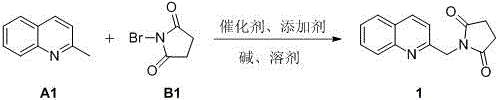
In stark contrast to these legacy methods, the novel approach detailed in the patent introduces a direct oxidative coupling reaction that significantly simplifies the synthetic workflow. By employing a transition metal catalyst system in conjunction with N-halogenated cyclic diamides, this method achieves the formation of the C-N bond in a single operational step. The process is remarkably versatile, accommodating a wide array of substrates including quinolines, pyridines, and even simple alkyl-benzenes like toluene, which expands the accessible chemical space for medicinal chemists. The reaction conditions are mild, typically ranging from 80°C to 140°C, and utilize common organic solvents such as 1,4-dioxane or toluene. This innovation not only improves step economy but also drastically reduces the consumption of expensive reagents and the generation of toxic byproducts, aligning perfectly with the principles of green chemistry and modern sustainable manufacturing practices.

Mechanistic Insights into Cu-Catalyzed Oxidative Amination
The core of this technological advancement lies in the sophisticated interplay between the transition metal catalyst, the ligand system, and the oxidant. The mechanism likely proceeds through a radical pathway initiated by the transition metal, such as Copper Iodide (CuI) or Copper Acetylacetonate, which activates the C-H bond of the alkyl-aromatic substrate. The presence of additives like AIBN (Azobisisobutyronitrile) or TEMPO suggests a radical-mediated process where the benzylic position is functionalized. The N-halogenated cyclic diamide acts as both the nitrogen source and the oxidant, facilitating the formation of the new C-N bond while regenerating the active catalytic species. The choice of ligand, whether it be a phosphine like Triphenylphosphine (PPh3) or a nitrogen-based ligand like 1,10-phenanthroline, is critical for stabilizing the metal center and tuning its electronic properties to favor the desired oxidative amination over competing side reactions. This precise control over the catalytic cycle ensures high selectivity and minimizes the formation of impurities, which is a crucial factor for R&D teams focused on purity specifications.
Impurity control is further enhanced by the mild reaction conditions and the specific choice of base and solvent. The use of inorganic bases like potassium carbonate or cesium carbonate helps to neutralize acidic byproducts without promoting degradation of the sensitive diamide structure. Additionally, the broad tolerance for functional groups—such as halogens (fluorine, chlorine, bromine), methoxy groups, and cyano groups on the aromatic ring—demonstrates the robustness of the catalytic system. For instance, the successful synthesis of 1-(6-fluoroquinoline-2-methyl) pyrrolidine-2,5-dione with a yield of 53% and 1-(6-chloroquinoline-2-methyl) pyrrolidine-2,5-dione with a yield of 27% highlights the method's ability to handle electron-deficient substrates. This level of chemoselectivity ensures that the final product profile is clean, reducing the burden on downstream purification processes and ensuring consistent quality for commercial batches.
How to Synthesize N-(Aryl/Heteroaryl) Alkyl-Diamides Efficiently
Implementing this synthesis route requires careful attention to the stoichiometry of the catalyst system and the reaction environment to maximize yield and reproducibility. The patent provides a detailed framework where the molar ratio of the transition metal to the ligand is optimized between 1:1 and 1:3, ensuring sufficient coordination saturation. The substrate-to-oxidant ratio is also critical, with the alkyl-aromatic compound typically used in excess (20 to 3000 parts relative to 1 part metal) to drive the reaction to completion. The process begins under an inert nitrogen atmosphere to prevent unwanted oxidation of the catalyst or substrates by atmospheric oxygen. Following the reaction period of 6 to 48 hours at elevated temperatures, the workup is straightforward, involving solvent evaporation and standard column chromatography. For a comprehensive breakdown of the specific experimental parameters and safety considerations, please refer to the standardized synthesis steps outlined below.
- Under nitrogen protection, sequentially add transition metal catalyst (e.g., CuI), phosphine or nitrogen ligand, cocatalyst, base, solvent, N-halogenated cyclic diamide, and the alkyl-aromatic or alkyl-heteroaromatic substrate into a reaction vessel.
- Heat the reaction mixture to a temperature range of 80-140°C and maintain stirring for 6 to 48 hours to allow the oxidative amination reaction to proceed to completion.
- Upon completion, evaporate the solvent to dryness and purify the crude residue via column chromatography separation to isolate the target N-(aryl/heteroaryl) alkyl-diamide compound.
Commercial Advantages for Procurement and Supply Chain Teams
From a procurement and supply chain perspective, this patented methodology offers transformative benefits that directly impact the bottom line and operational resilience. The shift from multi-step, noble-metal-dependent processes to a single-step, copper-catalyzed route fundamentally alters the cost structure of producing these valuable intermediates. By eliminating the need for expensive palladium or platinum catalysts and reducing the number of unit operations, manufacturers can achieve substantial cost savings in raw materials and processing time. Furthermore, the use of commodity chemicals like toluene and simple quinoline derivatives as starting materials ensures a stable and reliable supply chain, mitigating the risks associated with sourcing specialized or scarce reagents. This stability is crucial for maintaining continuous production schedules and meeting the demanding delivery timelines of global pharmaceutical clients.
- Cost Reduction in Manufacturing: The economic advantage of this process is driven by the replacement of precious metal catalysts with abundant and inexpensive copper salts. Additionally, the consolidation of multiple synthetic steps into a single oxidative coupling reaction significantly reduces labor, energy, and solvent consumption. The simplified workup procedure, which avoids complex extraction or crystallization steps often required in traditional methods, further lowers operational expenditures. These factors combine to create a highly cost-competitive manufacturing process that allows for better margin management in the production of high-purity pharmaceutical intermediates.
- Enhanced Supply Chain Reliability: The robustness of the reaction conditions and the wide availability of starting materials contribute to a more resilient supply chain. Unlike processes that rely on light-sensitive photocatalysts or air-sensitive organometallic reagents, this method uses stable solids and liquids that are easy to store and transport. The broad substrate scope means that suppliers can quickly adapt to changes in demand for different analogues without needing to retool entire production lines. This flexibility ensures that procurement managers can secure reliable sources for diverse chemical building blocks, reducing the risk of stockouts and production delays.
- Scalability and Environmental Compliance: Scalability is a key strength of this technology, as the reaction parameters (temperature, pressure, concentration) are well-suited for transfer from laboratory to pilot and commercial scales. The use of greener solvents and the avoidance of toxic heavy metals align with increasingly stringent environmental regulations, reducing the cost and complexity of waste treatment. The high atom economy of the oxidative coupling minimizes waste generation, supporting corporate sustainability goals and ensuring compliance with global environmental standards for chemical manufacturing.
Frequently Asked Questions (FAQ)
The following questions address common technical and commercial inquiries regarding the implementation of this oxidative amination technology. These insights are derived directly from the experimental data and scope defined in the patent documentation, providing clarity on the practical application of the method for various industrial needs. Understanding these details helps stakeholders make informed decisions about integrating this process into their existing manufacturing workflows.
Q: What are the primary advantages of this oxidative amination method over conventional multi-step syntheses?
A: This method simplifies the synthesis into a single step, eliminating the need for harsh reagents like elemental bromine or strong acids required in traditional three-step or two-step methods. It utilizes inexpensive copper catalysts instead of noble metals and offers a broader substrate scope, including simple alkyl-aromatics like toluene, which were previously difficult to functionalize efficiently.
Q: Which transition metals and ligands are most effective for this transformation?
A: The patent specifies a wide range of effective transition metals, with copper salts such as Copper Iodide (CuI), Copper Acetylacetonate (Cu(acac)2), and Copper Acetate showing high efficacy. These are typically paired with phosphine ligands like Triphenylphosphine (PPh3) or DPPE, or nitrogen ligands like 1,10-phenanthroline, to stabilize the catalytic cycle and enhance yield.
Q: Is this process suitable for large-scale industrial production?
A: Yes, the process is designed for industrialization. It operates at moderate temperatures (80-140°C), uses commercially available solvents like 1,4-dioxane or toluene, and avoids toxic heavy metals or explosive reagents. The workup involves simple solvent evaporation and chromatography, making it adaptable for commercial scale-up of complex pharmaceutical intermediates.
Partnering with NINGBO INNO PHARMCHEM: Your Reliable N-(Aryl/Heteroaryl) Alkyl-Diamide Supplier
At NINGBO INNO PHARMCHEM, we recognize the critical role that efficient synthetic methodologies play in accelerating drug discovery and development. Our team of expert chemists has extensively evaluated the technology described in CN112047925B and possesses the technical capability to implement this copper-catalyzed oxidative amination route on a commercial scale. We have extensive experience scaling diverse pathways from 100 kgs to 100 MT/annual commercial production, ensuring that our clients receive consistent, high-quality intermediates regardless of volume. Our state-of-the-art facilities are equipped with rigorous QC labs and advanced analytical instrumentation to guarantee stringent purity specifications, meeting the exacting standards required by the global pharmaceutical industry.
We invite you to collaborate with us to leverage this innovative synthesis technology for your next project. By partnering with NINGBO INNO PHARMCHEM, you gain access to a Customized Cost-Saving Analysis tailored to your specific molecule, demonstrating how this route can optimize your supply chain. We encourage you to contact our technical procurement team today to request specific COA data and route feasibility assessments, allowing us to demonstrate our commitment to delivering value through scientific excellence and operational efficiency.