
Scalable Metal-Free Synthesis of N-Trifluoromethylthiosuccinimide for Commercial API Production
The pharmaceutical industry's relentless pursuit of metabolic stability and lipophilicity in drug candidates has placed fluorine-containing functional groups at the forefront of modern medicinal chemistry. Specifically, the trifluoromethylthio (-SCF3) group is renowned for its exceptional lipophilicity, often surpassing that of the trifluoromethyl (-CF3) group, thereby significantly enhancing membrane permeability and bioavailability. However, the widespread adoption of this moiety has historically been hindered by the complexity and cost of introducing it into molecular scaffolds. Patent CN112778190B, published in August 2022, addresses this critical bottleneck by disclosing a novel, metal-free synthesis method for succinimide-type trifluoromethyl sulfide reagents, specifically N-trifluoromethylthiosuccinimide (CAS 183267-04-1). This technical breakthrough shifts the paradigm from reliance on expensive noble metal donors to a more economical and environmentally benign fluoride-activation strategy. By utilizing readily available N-halosuccinimides and trifluoromethyl thioesters, this innovation offers a robust pathway for producing high-purity electrophilic trifluoromethylthiolation reagents, directly addressing the supply chain vulnerabilities associated with precious metal dependency.
The Limitations of Conventional Methods vs. The Novel Approach
The Limitations of Conventional Methods
Historically, the synthesis of electrophilic trifluoromethylthiolating reagents like N-trifluoromethylthiosuccinimide has been dominated by protocols requiring silver trifluoromethanesulfonate (AgOTf) or similar silver-based species as the sulfur source or activator. While effective on a laboratory scale, these conventional methods present severe drawbacks for industrial application. The primary limitation is the exorbitant cost of silver salts, which renders the final reagent prohibitively expensive for large-scale API manufacturing. Furthermore, the involvement of transition metals introduces a significant regulatory burden; residual silver must be meticulously removed to meet stringent International Council for Harmonisation (ICH) guidelines for elemental impurities in pharmaceuticals. This necessitates additional downstream processing steps, such as specialized scavenging or recrystallization, which reduce overall yield and increase waste generation. Additionally, silver salts are often light-sensitive and require careful handling, complicating the operational safety profile of the manufacturing process.
The Novel Approach
The methodology described in patent CN112778190B circumvents these issues by employing a fluoride-anion activated coupling between N-halosuccinimides and trifluoromethyl thioesters. This approach completely eliminates the need for transition metal catalysts or donors. Instead, it leverages the nucleophilic activation of the thioester carbonyl by fluoride ions, facilitating the transfer of the -SCF3 group to the nitrogen atom of the succinimide ring. This metal-free strategy not only drastically reduces raw material costs by substituting silver with inexpensive inorganic fluorides like potassium fluoride or organic salts like tetrabutylammonium fluoride but also simplifies the purification workflow. The reaction proceeds under mild thermal conditions, typically between 0°C and 50°C, and tolerates a wide range of organic solvents including acetonitrile, dichloromethane, and DMSO. This flexibility allows process chemists to optimize solubility and reaction kinetics without the constraints imposed by moisture-sensitive or air-sensitive metal complexes.
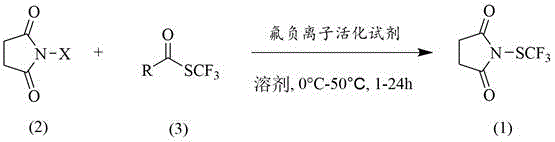
Mechanistically, the success of this transformation relies on the unique ability of the fluoride anion to activate the trifluoromethyl thioester. Upon addition of the fluoride source, the fluoride ion attacks the carbonyl carbon of the thioester, generating a transient tetrahedral intermediate. This activation increases the leaving group ability of the trifluoromethylthio moiety, effectively generating a reactive -SCF3 species in situ. This species then undergoes nucleophilic substitution at the nitrogen center of the N-halosuccinimide (where X = Cl, Br, or I), displacing the halide and forming the N-S bond. The choice of halogen on the succinimide substrate influences the reaction rate, with N-iodo and N-bromo succinimides generally reacting more readily than the N-chloro analog due to the weaker N-X bond strength. Crucially, the absence of transition metals means that the impurity profile of the final product is devoid of heavy metal contaminants, a critical quality attribute for any reagent intended for late-stage functionalization of drug candidates.
Impurity control in this system is further enhanced by the tunability of the reaction conditions. The patent demonstrates that by adjusting the molar ratio of the fluoride activator and the thioester, side reactions such as hydrolysis of the thioester or over-fluorination can be minimized. The use of phase transfer catalysts or additives like 18-crown-6 can further enhance the solubility of inorganic fluoride salts in organic media, ensuring homogeneous reaction conditions that promote consistent product quality. This level of control is essential for maintaining a narrow impurity spectrum, which simplifies the analytical validation required for regulatory filings. By avoiding the formation of metal-thiolate complexes that can lead to difficult-to-remove colored impurities, this method yields a cleaner crude product, reducing the load on purification columns and crystallization steps.
How to Synthesize N-Trifluoromethylthiosuccinimide Efficiently
To implement this synthesis in a laboratory or pilot plant setting, the process begins with the selection of appropriate starting materials, specifically an N-halosuccinimide and a trifluoromethyl thioester. The reaction is typically initiated by dissolving the fluoride activating reagent and the thioester in a dry organic solvent under an inert atmosphere. Once the mixture is homogenized, the N-halosuccinimide is added, and the reaction is allowed to proceed with stirring. The detailed standardized synthesis steps, including specific molar ratios, solvent volumes, and workup procedures optimized for maximum yield and purity, are outlined below.
- Dissolve the N-halosuccinimide substrate (chloro, bromo, or iodo-) in a suitable organic solvent such as acetonitrile or dichloromethane.
- Add a fluoride anion activating reagent (e.g., TBAF, KF with crown ether) and the trifluoromethyl thioester donor to the reaction mixture.
- Stir the reaction at mild temperatures between 0°C and 50°C for 1 to 24 hours, followed by standard purification to isolate the high-purity product.
Commercial Advantages for Procurement and Supply Chain Teams
For procurement managers and supply chain directors, the shift to this metal-free synthesis route represents a significant opportunity for cost optimization and risk mitigation. The traditional reliance on silver-based reagents exposes the supply chain to volatility in precious metal markets and potential shortages of high-purity silver salts. By transitioning to a process based on commodity chemicals like N-bromosuccinimide and potassium fluoride, manufacturers can secure a more stable and predictable supply of raw materials. This stability is crucial for long-term production planning and ensures continuity of supply for downstream API synthesis. Furthermore, the elimination of heavy metals removes the need for expensive metal scavenging resins and specialized waste disposal protocols associated with silver contamination, leading to substantial operational expenditure savings.
- Cost Reduction in Manufacturing: The replacement of expensive silver trifluoromethanesulfonate with low-cost inorganic fluorides and simple thioesters fundamentally alters the cost structure of the reagent. Since the fluoride activators and N-halosuccinimides are produced on a multi-ton scale for other industries, their pricing is stable and competitive. This raw material substitution eliminates the premium associated with noble metal chemistry, allowing for a drastic reduction in the cost of goods sold (COGS). Additionally, the simplified workup procedure reduces solvent consumption and labor hours, further enhancing the economic viability of the process for commercial scale-up.
- Enhanced Supply Chain Reliability: Sourcing high-purity silver salts often involves complex logistics and limited supplier bases, creating single points of failure in the supply chain. In contrast, the reagents required for this novel method, such as N-bromosuccinimide and various crown ethers, are widely available from multiple global chemical suppliers. This diversification of the supply base reduces procurement risk and shortens lead times. The robustness of the reaction conditions also means that the synthesis is less susceptible to delays caused by the need for specialized anhydrous or anaerobic environments often required for sensitive metal catalysts.
- Scalability and Environmental Compliance: The mild reaction temperatures (0°C to 50°C) and atmospheric pressure conditions make this process inherently safer and easier to scale from gram to ton quantities. There is no need for specialized high-pressure reactors or cryogenic cooling systems, which lowers capital expenditure requirements for manufacturing facilities. From an environmental perspective, the metal-free nature of the reaction aligns with green chemistry principles by reducing the generation of hazardous heavy metal waste. This facilitates easier compliance with increasingly stringent environmental regulations regarding wastewater discharge and solid waste disposal, minimizing the environmental footprint of the manufacturing operation.
Frequently Asked Questions (FAQ)
The following questions address common technical and commercial inquiries regarding the implementation of this synthesis technology. These answers are derived directly from the experimental data and technical specifications provided in the patent documentation, ensuring accuracy and relevance for process development teams evaluating this route for adoption.
Q: Why is the metal-free synthesis of N-trifluoromethylthiosuccinimide advantageous for pharmaceutical applications?
A: Traditional methods often rely on expensive silver salts which leave toxic heavy metal residues. This novel fluoride-activated route eliminates transition metals, simplifying purification and ensuring compliance with strict ICH Q3D guidelines for elemental impurities in drug substances.
Q: What are the cost drivers in the conventional synthesis of trifluoromethyl sulfide reagents?
A: Conventional processes typically utilize silver trifluoromethanesulfonate or similar noble metal donors, which are prohibitively expensive for large-scale production. The new method replaces these with commercially available N-halosuccinimides and inexpensive thioesters, significantly lowering raw material costs.
Q: Can this synthesis method be scaled for industrial manufacturing?
A: Yes, the reaction operates under mild conditions (0°C to 50°C) and atmospheric pressure using common organic solvents. The absence of sensitive transition metal catalysts and the use of robust inorganic fluoride sources make the process highly amenable to kilogram-to-ton scale-up.
Partnering with NINGBO INNO PHARMCHEM: Your Reliable N-Trifluoromethylthiosuccinimide Supplier
At NINGBO INNO PHARMCHEM, we recognize the critical role that high-quality fluorinating reagents play in the development of next-generation therapeutics. Our technical team has thoroughly analyzed the metal-free synthesis route disclosed in CN112778190B and possesses the extensive experience scaling diverse pathways from 100 kgs to 100 MT/annual commercial production. We are equipped to manufacture N-trifluoromethylthiosuccinimide using this advanced, cost-effective methodology, ensuring that our clients receive material that meets stringent purity specifications without the burden of heavy metal impurities. Our rigorous QC labs employ state-of-the-art analytical techniques to verify the identity and purity of every batch, guaranteeing consistency and reliability for your R&D and manufacturing needs.
We invite pharmaceutical and agrochemical companies to leverage our expertise to optimize their supply chains for fluorinated intermediates. By partnering with us, you gain access to a Customized Cost-Saving Analysis that quantifies the economic benefits of switching to this metal-free reagent for your specific applications. We encourage you to contact our technical procurement team today to request specific COA data, discuss route feasibility assessments, and explore how we can support your project timelines with reliable, high-performance chemical solutions.
Engineering Bottleneck?
Can't scale up this synthesis? Upload your target structure or CAS, and our CDMO team will evaluate the industrial feasibility within 24 hours. Request Evaluation →