
Revolutionizing Dioxa[5]helicene Production: A Metal-Free Route for High-Performance Optoelectronics
Revolutionizing Dioxa[5]helicene Production: A Metal-Free Route for High-Performance Optoelectronics
The rapid advancement of organic electronics demands precursors that combine structural complexity with exceptional purity and cost-efficiency. Patent CN113912618A introduces a groundbreaking methodology for the synthesis of Dioxa[5]helicene compounds, a class of heteroatom-containing helical hydrocarbons with significant potential in optoelectronic functional materials and asymmetric catalysis. Unlike conventional approaches that rely heavily on expensive transition metal catalysts and harsh oxidative conditions, this invention leverages a simple, base-mediated intramolecular cyclization strategy. By utilizing commercially available organic bases and mild thermal conditions, the process achieves high yields while maintaining a clean impurity profile. This technical insight report analyzes the mechanistic advantages of this metal-free route and its implications for supply chain stability and cost reduction in the manufacturing of advanced display and semiconductor materials.
The Limitations of Conventional Methods vs. The Novel Approach
The Limitations of Conventional Methods
Historically, the synthesis of helical hydrocarbons, particularly those containing heteroatoms like oxygen, has been fraught with significant chemical and economic challenges. Traditional pathways often depend on oxidative photocyclization or transition metal-catalyzed cross-coupling reactions, which necessitate the use of precious metals such as palladium or platinum. These methods not only inflate the raw material costs but also introduce severe purification bottlenecks, as removing trace metal residues to parts-per-million levels is mandatory for electronic grade materials. Furthermore, oxidative conditions can be indiscriminate, leading to over-oxidation or degradation of sensitive functional groups, thereby limiting the structural diversity of the final helicene products. The complexity of these multi-step sequences often results in lower overall yields and generates substantial hazardous waste, posing environmental compliance risks for large-scale manufacturers.
The Novel Approach
The methodology disclosed in CN113912618A represents a paradigm shift by replacing complex catalytic cycles with a direct, base-promoted cyclization. The core innovation lies in the transformation of a triflate-substituted precursor (Formula II) into the fused dioxa[5]helicene skeleton (Formula I) using strong organic bases like 1,8-diazabicyclo[5.4.0]undec-7-ene (DBU). 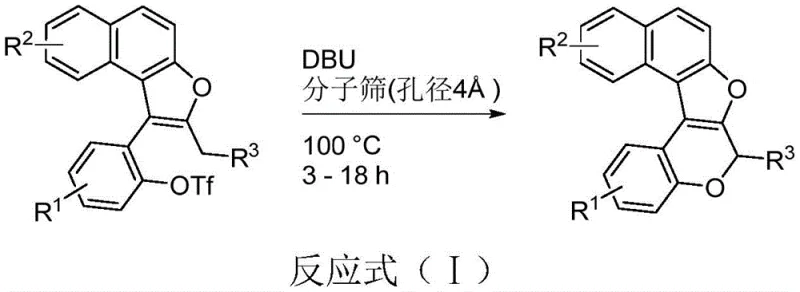 As illustrated in the reaction scheme, this process operates under relatively mild thermal conditions (50-140°C) and tolerates a wide array of functional groups, including halogens and ethers, which are typically incompatible with harsh organometallic reagents. The elimination of transition metals simplifies the downstream processing significantly, as there is no need for specialized metal scavengers, directly translating to reduced operational expenditure and a greener manufacturing footprint.
Mechanistic Insights into Base-Catalyzed Intramolecular Cyclization
The success of this synthesis hinges on the precise activation of the benzylic position adjacent to the furan ring by the organic base. In the presence of DBU and activated molecular sieves, the reaction proceeds through a deprotonation-rearrangement-cyclization sequence that effectively closes the pyran ring onto the naphthalene-furan scaffold. The molecular sieves play a critical dual role: they sequester trace water that could hydrolyze the triflate leaving group prematurely, and they help drive the equilibrium toward the cyclized product by removing protic byproducts. This mechanistic pathway ensures high atom economy and minimizes the formation of oligomeric side products that often plague acid-catalyzed condensations. The resulting dioxa[5]helicene structure possesses a rigid, non-planar geometry with inherent chirality, arising from the steric clash between the terminal rings, which locks the molecule into a helical conformation essential for circularly polarized luminescence applications.
Beyond the primary cyclization, the robustness of the dioxa[5]helicene core allows for extensive post-synthetic modification, expanding its utility in ligand design and material science. For instance, the brominated derivatives obtained through this method can serve as versatile handles for further cross-coupling reactions, such as the Buchwald-Hartwig amination shown below. ![Downstream application showing Pd-catalyzed amination of dioxa[5]helicene to form chiral amine derivatives](/insights/img/dioxa-5-helicene-synthesis-oled-supplier-20260303014358-014.webp) This secondary functionalization capability demonstrates that the base-catalyzed core synthesis does not compromise the chemical integrity of the scaffold; rather, it provides a stable platform for constructing complex chiral ligands or emissive layers. The ability to introduce nitrogen-containing groups via palladium catalysis after the initial metal-free ring closure offers a hybrid strategy that maximizes both cost efficiency in the early stages and structural precision in the final functionalization steps.
This secondary functionalization capability demonstrates that the base-catalyzed core synthesis does not compromise the chemical integrity of the scaffold; rather, it provides a stable platform for constructing complex chiral ligands or emissive layers. The ability to introduce nitrogen-containing groups via palladium catalysis after the initial metal-free ring closure offers a hybrid strategy that maximizes both cost efficiency in the early stages and structural precision in the final functionalization steps.
How to Synthesize Dioxa[5]helicene Efficiently
The operational simplicity of this patented process makes it highly attractive for pilot plant and commercial scale-up. The procedure typically involves charging the triflate precursor and the organic base into a reactor containing an anhydrous polar aprotic solvent such as dimethylformamide (DMF) or dimethyl sulfoxide (DMSO). To ensure optimal conversion, activated 4Å molecular sieves are added to the reaction mixture to maintain strict anhydrous conditions, which is critical for preventing the hydrolysis of the reactive triflate intermediate. The detailed standardized synthesis steps, including specific molar ratios, temperature ramping profiles, and workup procedures, are outlined in the guide below.
- Charge the triflate precursor (Formula II) and a strong organic base such as DBU into a reaction vessel with anhydrous solvent like DMF.
- Add activated molecular sieves (4Å) to the mixture to scavenge moisture and drive the equilibrium forward under a protective nitrogen atmosphere.
- Heat the reaction mixture to 100°C for 3 to 18 hours to facilitate intramolecular cyclization, followed by aqueous workup and chromatographic purification.
Commercial Advantages for Procurement and Supply Chain Teams
For procurement managers and supply chain directors, the transition to this metal-free synthesis route offers tangible strategic benefits that extend beyond mere technical feasibility. The most immediate impact is the drastic reduction in raw material costs associated with the elimination of precious metal catalysts and specialized ligands, which are subject to volatile market pricing and geopolitical supply risks. By relying on commodity chemicals like DBU and standard organic solvents, manufacturers can secure a more stable and predictable cost structure for their helicene intermediates. Furthermore, the simplified purification workflow reduces the consumption of silica gel and eluents, lowering the total cost of goods sold (COGS) and minimizing the environmental burden of solvent waste disposal.
- Cost Reduction in Manufacturing: The removal of transition metal catalysts such as palladium or rhodium eliminates one of the most significant variable costs in fine chemical synthesis. Since these metals are not required for the core ring-closing step, the process avoids the expensive metal scavenging and recovery steps that are mandatory for pharmaceutical and electronic grade materials. This qualitative shift in the cost structure allows for significant margin improvement, especially when producing high-volume intermediates for OLED displays where purity specifications are stringent but price sensitivity is high.
- Enhanced Supply Chain Reliability: Dependence on specialized organometallic reagents often creates single points of failure in the supply chain, as these materials may have long lead times or limited suppliers. In contrast, the reagents used in this protocol, including the triflate precursors and organic bases, are widely available from multiple global chemical distributors. This diversification of the supply base ensures business continuity and reduces the risk of production stoppages due to raw material shortages, enabling more reliable delivery schedules for downstream customers.
- Scalability and Environmental Compliance: The reaction conditions are inherently safer and easier to manage on a large scale compared to photochemical or high-pressure hydrogenation processes. Operating at atmospheric pressure and moderate temperatures (around 100°C) reduces the energy intensity of the manufacturing process and lowers the capital expenditure required for specialized high-pressure reactors. Additionally, the absence of heavy metals simplifies wastewater treatment and regulatory compliance, facilitating faster approval for new manufacturing sites and reducing the long-term liability associated with hazardous waste management.
Frequently Asked Questions (FAQ)
The following questions address common technical and commercial inquiries regarding the implementation of this synthesis technology. These answers are derived directly from the experimental data and scope defined in the patent documentation, providing clarity on the practical aspects of adopting this route for industrial production. Understanding these nuances is essential for R&D teams evaluating the feasibility of integrating dioxa[5]helicene derivatives into their existing product portfolios.
Q: Does this synthesis method leave heavy metal residues in the final product?
A: No, unlike traditional methods that rely on palladium or other transition metals, this patented process utilizes organic bases like DBU. This ensures the final dioxa[5]helicene product is free from toxic heavy metal contaminants, which is critical for electronic applications.
Q: What is the substrate scope for this cyclization reaction?
A: The method demonstrates excellent functional group tolerance. It successfully accommodates various substituents including halogens (bromo, chloro), alkyl groups, alkoxy groups, and even sensitive heterocycles like pyridine, allowing for diverse derivative synthesis.
Q: Can this process be scaled for industrial production of OLED materials?
A: Yes, the reaction conditions are mild (100°C) and utilize cheap, commercially available reagents. The absence of expensive catalysts and the high isolated yields (up to 97% in optimized cases) make it highly suitable for commercial scale-up.
Partnering with NINGBO INNO PHARMCHEM: Your Reliable Dioxa[5]helicene Supplier
As the demand for chiral organic semiconductors and advanced optical materials continues to surge, securing a supply partner with deep technical expertise is paramount. NINGBO INNO PHARMCHEM stands at the forefront of this evolution, leveraging the latest advancements in metal-free synthesis to deliver high-purity dioxa[5]helicene intermediates. Our team possesses extensive experience scaling diverse pathways from 100 kgs to 100 MT/annual commercial production, ensuring that we can meet the rigorous volume requirements of the global display and pharmaceutical industries. We maintain stringent purity specifications through our rigorous QC labs, guaranteeing that every batch meets the exacting standards required for next-generation optoelectronic applications.
We invite industry leaders to collaborate with us to optimize their material sourcing strategies. By engaging with our technical procurement team, you can request a Customized Cost-Saving Analysis tailored to your specific volume needs. We encourage you to reach out today to obtain specific COA data and route feasibility assessments, allowing you to validate the superior quality and economic advantages of our metal-free dioxa[5]helicene production capabilities.