
Unlocking Efficient Commercial Production of High-Purity Aryl Formate Derivatives Using Novel Copper Catalysis
The landscape of fine chemical synthesis is constantly evolving, driven by the need for more sustainable and efficient pathways to critical building blocks. A significant breakthrough in this domain is documented in patent CN102557943B, which discloses a robust method for synthesizing aromatic formic acid aryl ester derivatives. This technology addresses long-standing challenges in the production of these vital intermediates, which are ubiquitous in the construction of complex pharmaceutical agents and agrochemicals. By leveraging a copper-catalyzed oxidative coupling strategy, the process circumvents the limitations of classical esterification techniques. For R&D directors and procurement specialists seeking a reliable pharmaceutical intermediate supplier, understanding the nuances of this patent is essential. The methodology utilizes readily available arylboronic acids and acyl chlorides as starting materials, reacting them under an oxygen atmosphere in the presence of a copper catalyst, a specific ligand, and a basic compound. This approach not only streamlines the synthetic route but also ensures high product quality and reaction yields, making it a compelling candidate for industrial adoption.
The Limitations of Conventional Methods vs. The Novel Approach
The Limitations of Conventional Methods
Historically, the synthesis of aromatic formic acid aryl esters has relied heavily on the direct esterification of aromatic acids with phenols or the Bayer-Villiger oxidation rearrangement. The traditional acid-catalyzed esterification often necessitates harsh reaction conditions, including elevated temperatures and the use of strong mineral acids, which can lead to significant safety hazards and equipment corrosion. Furthermore, these aggressive conditions frequently result in poor functional group compatibility, causing decomposition of sensitive substrates and generating complex impurity profiles that are difficult to purify. Alternatively, the Bayer-Villiger oxidation, while useful for certain ketones, suffers from inherent selectivity issues when applied to symmetric or similarly substituted aromatic ketones. In such cases, the migratory aptitude of the groups on either side of the carbonyl is nearly identical, leading to a mixture of regioisomers and drastically reduced yields of the desired ester. These inefficiencies translate directly into higher manufacturing costs and extended lead times, creating bottlenecks for supply chain managers responsible for cost reduction in fine chemical manufacturing.
The Novel Approach
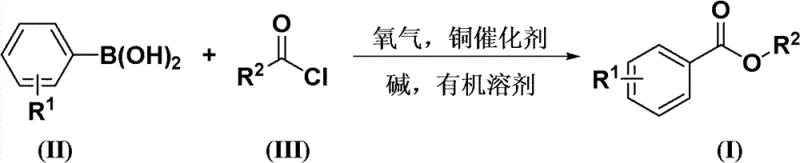
In stark contrast to these legacy methods, the novel approach detailed in the patent utilizes a transition metal-catalyzed cross-coupling strategy that operates under significantly milder conditions. By employing arylboronic acids and acyl chlorides in the presence of molecular oxygen, the reaction achieves high selectivity and efficiency without the need for corrosive strong acids or dangerous peroxides. The core transformation involves the oxidative coupling of the boron species with the acyl chloride, facilitated by a copper catalyst system. This method demonstrates exceptional tolerance for various functional groups, allowing for the synthesis of diverse derivatives without protecting group manipulations. The visual representation of this general transformation highlights the simplicity and elegance of the route, where complex ester linkages are formed directly from stable precursors. This shift in synthetic logic not only improves the environmental profile of the process but also enhances the overall economic viability by reducing waste and energy consumption.
Mechanistic Insights into Copper-Catalyzed Oxidative Esterification
The success of this synthetic methodology hinges on the intricate interplay between the copper catalyst, the ligand, and the oxidant. Mechanistically, the reaction is believed to proceed through a catalytic cycle involving the oxidation of a copper(I) species to copper(II) by molecular oxygen, followed by transmetallation with the arylboronic acid. The resulting organocopper intermediate then undergoes nucleophilic attack on the acyl chloride, or alternatively, the acyl chloride reacts with the copper species to form an acyl-copper intermediate which subsequently couples with the boronic acid. The presence of a ligand, such as 1,4-diazabicyclo[2.2.2]octane (DABCO) or bidentate phosphines like DPEphos, is crucial for stabilizing the active copper species and facilitating the turnover of the catalytic cycle. The base, typically an inorganic salt like potassium carbonate or cesium fluoride, serves to activate the boronic acid and neutralize the hydrochloric acid byproduct generated during the acylation step. This carefully balanced system ensures that the reaction proceeds smoothly at temperatures ranging from 100°C to 120°C, avoiding the thermal degradation often seen in harsher protocols.
From an impurity control perspective, the mildness of the reaction conditions is a decisive factor in achieving the reported high purity levels, often exceeding 98%. In traditional acid-catalyzed processes, side reactions such as ether formation, polymerization, or hydrolysis of the ester product are common, necessitating extensive downstream purification. However, the copper-catalyzed oxidative pathway minimizes these competing reactions due to the specific activation of the reactants by the metal center. The use of oxygen as the terminal oxidant is particularly advantageous, as the only byproduct is water or harmless inorganic salts, simplifying the workup procedure. Post-reaction processing involves simple solvent removal and aqueous extraction, which effectively removes residual copper salts and unreacted starting materials. This streamlined purification process is highly attractive for commercial scale-up of complex pharmaceutical intermediates, as it reduces the number of unit operations and solvent usage, thereby lowering the overall cost of goods sold.
How to Synthesize Aryl Formate Derivatives Efficiently
To implement this synthesis effectively, one must adhere to the optimized parameters regarding reagent ratios and reaction environment. The patent specifies a molar ratio of acyl chloride to arylboronic acid of approximately 1:1.5, ensuring that the boronic acid is in slight excess to drive the reaction to completion. The copper catalyst loading is kept low, typically around 0.1 equivalents, which is sufficient to maintain catalytic activity while minimizing metal contamination in the final product. The choice of solvent is also critical, with toluene identified as the preferred medium due to its ability to dissolve both organic reactants and withstand the reaction temperature without participating in side reactions. While the general procedure is robust, minor adjustments to the ligand and base may be required depending on the electronic nature of the substituents on the aromatic rings. For a detailed breakdown of the specific operational steps and safety considerations, please refer to the standardized guide below.
- Charge the reactor with arylboronic acid, acyl chloride, copper catalyst (e.g., neutralized verdigris), ligand (e.g., DABCO), and base (e.g., potassium carbonate) in an inert organic solvent like toluene.
- Maintain the reaction mixture under an oxygen atmosphere and heat to a temperature between 100°C and 120°C for approximately 24 to 36 hours to ensure full conversion.
- Upon completion, remove the solvent under reduced pressure, extract the residue with saturated brine, separate the organic layer, and evaporate to dryness to obtain the high-purity product.
Commercial Advantages for Procurement and Supply Chain Teams
For procurement managers and supply chain heads, the adoption of this copper-catalyzed technology offers tangible strategic benefits beyond mere chemical curiosity. The primary advantage lies in the substantial cost optimization achieved by replacing expensive precious metal catalysts, such as palladium, with abundant and inexpensive copper salts. This substitution significantly lowers the raw material cost per kilogram of the final product, directly impacting the bottom line. Furthermore, the use of molecular oxygen as the oxidant eliminates the need for costly and hazardous stoichiometric oxidants, reducing both material costs and waste disposal fees. The mild reaction conditions also translate to lower energy consumption, as the process does not require extreme heating or cryogenic cooling, making it more sustainable and easier to integrate into existing manufacturing infrastructure. These factors collectively contribute to a more resilient and cost-effective supply chain for high-value intermediates.
- Cost Reduction in Manufacturing: The elimination of precious metals and hazardous oxidants leads to a drastic simplification of the bill of materials. By utilizing commodity chemicals like arylboronic acids and acyl chlorides, the process leverages widely available feedstocks that are less susceptible to supply shocks compared to specialized reagents. Additionally, the high atom economy of the oxidative coupling means that less raw material is wasted as byproducts, further enhancing the economic efficiency of the production run. The reduced need for complex purification steps also lowers the consumption of solvents and chromatography media, which are often significant cost drivers in fine chemical manufacturing.
- Enhanced Supply Chain Reliability: The robustness of the reaction conditions ensures consistent batch-to-batch quality, which is critical for maintaining uninterrupted supply to downstream customers. Since the process tolerates a wide range of functional groups, it allows for the flexible production of various derivatives using a common platform technology. This flexibility enables manufacturers to respond quickly to changing market demands without the need for extensive process re-validation. Moreover, the stability of the reagents and the simplicity of the operation reduce the risk of batch failures due to operator error or equipment malfunction, thereby securing the continuity of supply for critical pharmaceutical intermediates.
- Scalability and Environmental Compliance: Scaling this process from laboratory to commercial production is straightforward due to the absence of exothermic hazards associated with strong oxidants or acids. The use of oxygen gas can be safely managed with standard sparging techniques, and the reaction mixture remains homogeneous, facilitating heat transfer in large reactors. From an environmental standpoint, the generation of minimal waste and the use of non-toxic copper catalysts align with green chemistry principles, helping companies meet increasingly stringent regulatory requirements. This compliance reduces the administrative burden and potential fines associated with hazardous waste management, making the process not only technically superior but also legally and environmentally sound.
Frequently Asked Questions (FAQ)
The following questions address common technical inquiries regarding the implementation and scope of this synthetic method. These insights are derived directly from the experimental data and technical specifications outlined in the patent documentation. Understanding these details is crucial for technical teams evaluating the feasibility of adopting this route for their specific projects. The answers provided reflect the optimal conditions and observed outcomes reported in the study, serving as a reliable reference for process development.
Q: What are the primary advantages of this copper-catalyzed method over traditional esterification?
A: Unlike traditional Fischer esterification which requires harsh acidic conditions and high temperatures, this method operates under mild conditions with excellent functional group tolerance and avoids the selectivity issues associated with Bayer-Villiger oxidation.
Q: Which copper catalysts and ligands provide the optimal yield for this transformation?
A: Experimental data indicates that neutralized verdigris combined with DABCO as a ligand and potassium carbonate as a base in toluene provides superior yields, often exceeding 80% with purity above 98%.
Q: Is this process suitable for large-scale manufacturing of pharmaceutical intermediates?
A: Yes, the use of inexpensive copper catalysts, readily available arylboronic acids, and mild reaction temperatures makes this protocol highly scalable and economically viable for commercial production.
Partnering with NINGBO INNO PHARMCHEM: Your Reliable Aryl Formate Derivative Supplier
At NINGBO INNO PHARMCHEM, we recognize the transformative potential of advanced catalytic technologies like the one described in CN102557943B for the production of high-quality chemical intermediates. As a leading CDMO partner, we possess extensive experience scaling diverse pathways from 100 kgs to 100 MT/annual commercial production, ensuring that our clients receive a consistent and reliable supply of materials. Our state-of-the-art facilities are equipped with rigorous QC labs capable of meeting stringent purity specifications, guaranteeing that every batch of aryl formate derivative meets the highest industry standards. We understand that in the pharmaceutical and agrochemical sectors, the integrity of the supply chain is paramount, and we are committed to delivering products that facilitate your downstream synthesis without compromise.
We invite you to collaborate with us to leverage this efficient synthetic route for your specific needs. Our technical team is ready to provide a Customized Cost-Saving Analysis tailored to your project requirements, demonstrating how this copper-catalyzed method can optimize your manufacturing budget. Please contact our technical procurement team today to request specific COA data and route feasibility assessments. By partnering with us, you gain access to not just a product, but a comprehensive solution that combines cutting-edge chemistry with reliable commercial execution, ensuring your projects stay on schedule and within budget.