
Advanced Manufacturing of 2-Cyano-5-Aminopyrimidine: A Strategic Upgrade for Pharmaceutical Intermediates
The pharmaceutical and agrochemical industries are constantly seeking more efficient pathways to access functionalized heterocycles, which serve as the backbone for countless bioactive molecules. Patent CN102276537A introduces a significant technological advancement in the preparation of 2-cyano-5-aminopyrimidine, a critical intermediate with demonstrated potential in anti-cancer and antibacterial applications. This innovation addresses long-standing challenges in pyrimidine synthesis by streamlining the production process into a concise four-step sequence, starting from readily available 2-hydroxypyrimidine hydrochloride. By integrating a novel photochemical reduction strategy in the final step, the methodology not only improves overall yield but also mitigates the environmental and safety hazards associated with traditional catalytic hydrogenation. For R&D directors and procurement specialists, understanding this patented route is essential for securing a reliable supply of high-purity pyrimidine derivatives while optimizing manufacturing costs.
The Limitations of Conventional Methods vs. The Novel Approach
The Limitations of Conventional Methods
Historically, the synthesis of 2,5-disubstituted pyrimidines has been fraught with operational complexities that hinder large-scale commercialization. As illustrated in prior art references such as Chem. Pharm. Bull. 2000 and Collection of Czechoslovak Chemical Communications 1975, traditional routes often necessitate a cumbersome six-step sequence to achieve the desired substitution pattern. These legacy methods frequently suffer from poor control over the final reaction steps, leading to the formation of difficult-to-remove by-products and a significant erosion of overall yield. The reliance on multiple protection and de-protection strategies, along with harsh reaction conditions in earlier stages, creates a bottleneck for supply chain continuity. Furthermore, the accumulation of impurities through six distinct unit operations demands extensive purification resources, driving up the cost of goods sold and complicating regulatory compliance for pharmaceutical grade materials.
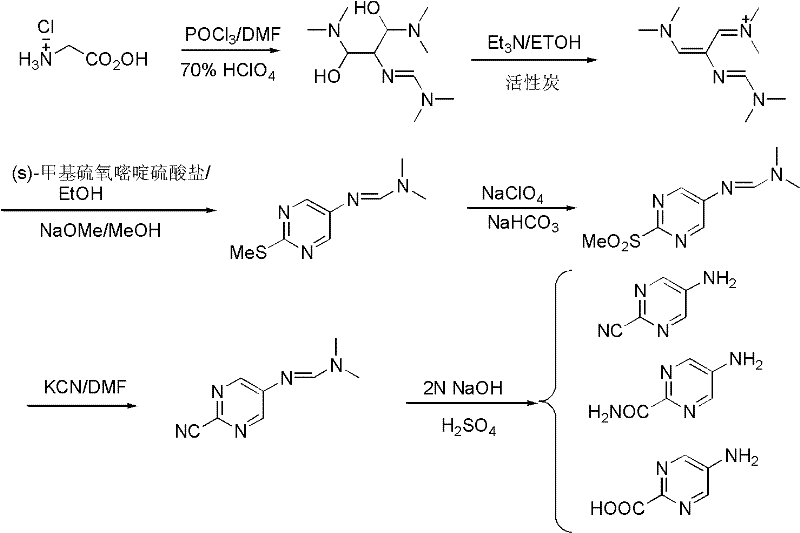
The Novel Approach
In stark contrast to the convoluted legacy pathways, the methodology disclosed in CN102276537A achieves the target molecule through a highly efficient four-step trajectory. This streamlined approach begins with the direct nitration of 2-hydroxypyrimidine hydrochloride, followed by a chlorination step to activate the ring for nucleophilic attack. The true brilliance of this route lies in the subsequent cyanation and photoreduction steps, which proceed under remarkably mild conditions. By eliminating two entire synthetic stages compared to conventional methods, the process drastically reduces solvent consumption, energy usage, and waste generation. The simplicity of the work-up procedures, particularly the ability to isolate intermediates like 2-cyano-5-nitropyrimidine with high purity through simple extraction and crystallization, ensures a robust and reproducible manufacturing protocol suitable for multi-ton production scales.
Mechanistic Insights into Photochemical Reduction and Cyanation
The core chemical innovation in this patent centers on the strategic application of photochemical reduction for converting the nitro group to an amino group without compromising the sensitive cyano functionality. In the final step, 2-cyano-5-nitropyrimidine is subjected to irradiation at a wavelength of 254nm in the presence of formic acid and acetonitrile. This photo-induced electron transfer mechanism facilitates the selective reduction of the nitro moiety while leaving the nitrile group intact, a transformation that is notoriously difficult to achieve with high chemoselectivity using standard metal-catalyzed hydrogenation. The use of formic acid serves as a benign hydrogen donor, avoiding the introduction of transition metal residues that would require costly scavenging steps later in the drug substance manufacturing process. This mechanistic elegance ensures that the final product, 2-cyano-5-aminopyrimidine, is obtained with exceptional purity profiles directly after recrystallization.

Preceding the reduction, the cyanation step employs a sophisticated nucleophilic aromatic substitution mechanism facilitated by DABCO (1,4-Diazabicyclo[2.2.2]octane). The reaction of 2-chloro-5-nitropyrimidine with sodium cyanide in a DMSO-water mixed solvent system leverages the strong electron-withdrawing nature of the nitro group to activate the C-2 position for displacement. DABCO acts as a phase transfer catalyst and potentially stabilizes the transition state, allowing the reaction to proceed efficiently at room temperature. This mild condition is critical for preventing the hydrolysis of the nitrile group or the decomposition of the pyrimidine ring, which are common side reactions in high-temperature cyanations. The precise control over stoichiometry and solvent ratios described in the patent ensures that the conversion is driven to completion, minimizing the presence of unreacted chloro-impurities that could complicate downstream processing.
How to Synthesize 2-Cyano-5-Aminopyrimidine Efficiently
Implementing this synthesis requires careful attention to the specific reaction parameters outlined in the patent to maximize yield and safety. The process begins with the nitration of the hydrochloride salt, followed by chlorination using phosphorus oxychloride, setting the stage for the key functionalization steps. The subsequent cyanation and photoreduction require strict control of light exposure and reagent purity to ensure consistent results. For detailed operational protocols, including exact molar ratios, solvent volumes, and work-up procedures, please refer to the standardized synthesis guide below which encapsulates the critical process parameters for successful execution.
- Nitration of 2-hydroxypyrimidine hydrochloride using fuming nitric acid and sulfuric acid to yield 2-hydroxy-5-nitropyrimidine.
- Chlorination via elimination-addition using phosphorus oxychloride and N,N-dimethylaniline to form 2-chloro-5-nitropyrimidine.
- Nucleophilic substitution with sodium cyanide and DABCO followed by photochemical reduction using formic acid under UV light (254nm) to obtain the final amine product.
Commercial Advantages for Procurement and Supply Chain Teams
From a commercial perspective, the adoption of this four-step synthesis offers profound advantages for procurement managers and supply chain heads tasked with securing cost-effective and reliable raw materials. The reduction in step count directly correlates to a significant decrease in manufacturing lead time and operational expenditure. By removing two synthetic steps, the process inherently reduces the consumption of solvents, reagents, and utilities, leading to substantial cost savings in the production of this high-value intermediate. Furthermore, the avoidance of expensive transition metal catalysts in the reduction step eliminates the need for specialized equipment for metal removal and the associated analytical testing for residual metals, further streamlining the quality control budget. This economic efficiency makes the material more accessible for early-stage drug development programs where budget constraints are often tight.
- Cost Reduction in Manufacturing: The streamlined four-step route fundamentally alters the cost structure of producing 2-cyano-5-aminopyrimidine. By consolidating the synthesis into fewer unit operations, manufacturers can achieve higher throughput with existing infrastructure, effectively lowering the fixed cost allocation per kilogram of product. The use of commodity chemicals such as sodium cyanide and formic acid, rather than proprietary or precious metal catalysts, ensures that raw material costs remain stable and predictable. Additionally, the high yields reported in the patent examples, particularly in the final reduction step, minimize material loss, ensuring that the theoretical yield is closely approached in practical scenarios, which is a key driver for margin improvement.
- Enhanced Supply Chain Reliability: Supply chain resilience is bolstered by the use of widely available starting materials like 2-hydroxypyrimidine hydrochloride. Unlike routes that depend on scarce or geographically concentrated reagents, this methodology relies on bulk chemicals that are sourced from a robust global market. The mild reaction conditions, specifically the room temperature cyanation and ambient pressure photoreduction, reduce the risk of unplanned shutdowns due to equipment failure or safety incidents. This operational stability translates into more consistent delivery schedules for downstream customers, mitigating the risk of production delays that can ripple through the entire pharmaceutical supply network.
- Scalability and Environmental Compliance: The environmental profile of this process aligns well with modern green chemistry principles, facilitating easier regulatory approval and permitting for manufacturing sites. The elimination of heavy metal catalysts reduces the burden of hazardous waste disposal and wastewater treatment, lowering the environmental compliance costs associated with production. The scalability of the photochemical step has been proven in various industrial contexts, and the straightforward work-up procedures involving simple extractions and crystallizations are easily adaptable from laboratory to pilot and commercial scales. This ease of scale-up ensures that supply can be rapidly ramped up to meet surging demand without requiring extensive process re-engineering.
Frequently Asked Questions (FAQ)
The following questions address common technical and commercial inquiries regarding the production and application of 2-cyano-5-aminopyrimidine based on the patented technology. These insights are derived directly from the experimental data and process descriptions found in the intellectual property documentation, providing clarity on the feasibility and benefits of this specific synthetic route for potential partners and licensees.
Q: What are the primary advantages of the photochemical reduction method described in CN102276537A?
A: The photochemical reduction method eliminates the need for hazardous metal catalysts often used in traditional hydrogenation, significantly simplifying downstream purification and reducing heavy metal contamination risks in the final API.
Q: How does this 4-step route compare to conventional 6-step syntheses in terms of scalability?
A: By reducing the synthetic sequence from 6 steps to 4, the process minimizes cumulative yield losses and operational complexity. The mild reaction conditions, particularly the room temperature cyanation, enhance safety and ease of scale-up for industrial production.
Q: Is the 2-cyano-5-aminopyrimidine intermediate suitable for anti-cancer drug development?
A: Yes, the patent explicitly highlights the compound's potential in biological anti-cancer applications. The dual functionality of the amino and cyano groups allows for versatile derivatization, making it a valuable building block for novel kinase inhibitors and other therapeutic agents.
Partnering with NINGBO INNO PHARMCHEM: Your Reliable 2-Cyano-5-Aminopyrimidine Supplier
At NINGBO INNO PHARMCHEM, we recognize the critical role that high-quality heterocyclic intermediates play in the development of next-generation therapeutics. Our technical team possesses extensive experience scaling diverse pathways from 100 kgs to 100 MT/annual commercial production, ensuring that the innovative processes described in patents like CN102276537A can be successfully translated into industrial reality. We maintain stringent purity specifications and operate rigorous QC labs to guarantee that every batch of 2-cyano-5-aminopyrimidine meets the exacting standards required for pharmaceutical applications. Our commitment to technical excellence allows us to navigate the complexities of photochemical reactions and sensitive nucleophilic substitutions with precision and consistency.
We invite global pharmaceutical and agrochemical companies to collaborate with us to leverage this advanced manufacturing technology. By partnering with our technical procurement team, you can request a Customized Cost-Saving Analysis tailored to your specific volume requirements. We encourage you to contact us today to obtain specific COA data and route feasibility assessments, ensuring that your supply chain is built on a foundation of scientific rigor and commercial reliability.