
Advanced Silver-Catalyzed Synthesis of 9,10-Phenanthrene Dicarboxylic Esters for Commercial Scale-Up
Introduction to Next-Generation Phenanthrene Scaffold Construction
The development of efficient synthetic routes for polycyclic aromatic hydrocarbons remains a cornerstone of modern medicinal chemistry, particularly for constructing complex pharmacophores found in bioactive natural products. Patent CN110683949B discloses a groundbreaking methodology for the preparation of 9,10-phenanthrene dicarboxylic ester compounds, addressing critical bottlenecks in current manufacturing paradigms. This innovation leverages a silver-catalyzed oxidative cyclization strategy that transforms readily available phenylboronic acid compounds and butynedioic acid ester derivatives into valuable phenanthrene cores through a streamlined one-pot process. By shifting away from traditional noble metal catalysis, this technology offers a robust platform for generating high-purity pharmaceutical intermediates with exceptional atom economy and operational simplicity. The strategic integration of potassium persulfate as a terminal oxidant alongside a silver carbonate catalyst enables the reaction to proceed under remarkably mild thermal conditions, thereby preserving sensitive functional groups that are often compromised in harsher synthetic environments.
For research and development teams focused on pipeline acceleration, the ability to access the phenanthrene parent structure through such a direct pathway represents a significant strategic advantage. The patent highlights that the resulting 9,10-phenanthrene dicarboxylic acid ester motif is not merely a static structural element but a versatile synthetic handle capable of further functionalization, making it an indispensable building block for diverse industrial applications ranging from agrochemicals to advanced electronic materials. The methodology described herein effectively democratizes access to these complex scaffolds by removing the dependency on specialized, multi-step precursor synthesis, thus aligning perfectly with the industry's growing demand for sustainable and cost-effective chemical manufacturing solutions that do not compromise on molecular complexity or purity standards.
The Limitations of Conventional Methods vs. The Novel Approach
The Limitations of Conventional Methods
Historically, the construction of the phenanthrene skeleton has relied heavily on transition metal-catalyzed cross-coupling reactions that impose substantial logistical and financial burdens on the supply chain. Prominent literature precedents, such as those reported by Heck et al. and Glorius et al., typically necessitate the use of palladium salts to mediate the coupling of aryl iodides or 2-phenylphenylboronic acids with alkynes, processes that are inherently plagued by the high cost of palladium residues and the difficulty of removing trace metals to meet stringent pharmaceutical specifications. Furthermore, alternative approaches utilizing iron, iridium, or rhodium catalysts often require the preparation of exotic substrates like 2-alkynylbenzene formates or 2-arylbenzoyl chlorides, which demand multi-step synthetic sequences prior to the actual cyclization event. These conventional pathways are frequently characterized by harsh reaction conditions, extensive formation of side products, and cumbersome purification protocols that drastically reduce overall throughput and increase the environmental footprint of the manufacturing process.
The reliance on such complex methodologies creates significant vulnerabilities in the supply chain, including extended lead times for raw material procurement and heightened sensitivity to fluctuations in the market prices of precious metals. Additionally, the necessity for multiple reaction steps increases the cumulative risk of yield loss and impurity accumulation, complicating the regulatory approval process for final drug substances. The requirement for specialized additives and rigorous exclusion of air or moisture in many of these traditional protocols further escalates the operational complexity, making them less attractive for large-scale commercial production where robustness and reproducibility are paramount. Consequently, there has been a persistent and urgent need within the fine chemical sector for a more direct, economical, and operationally simple method to access these vital structural motifs without sacrificing chemical diversity or product quality.
The Novel Approach
In stark contrast to the convoluted pathways of the past, the novel approach detailed in the patent data utilizes a direct annulation strategy that couples simple phenylboronic acids with dimethyl butynedioic acid esters in a single reaction vessel. This paradigm shift eliminates the need for pre-functionalized aryl halides or complex organometallic reagents, relying instead on the innate reactivity of boronic acids activated by a cost-effective silver salt catalyst. The reaction system is designed to operate under exceptionally mild conditions, specifically at a temperature of 60 ℃, which minimizes energy consumption and reduces the thermal stress on sensitive molecular architectures. By employing a biphasic solvent system comprising fluorobenzene and water, the method achieves excellent solubility profiles for both organic substrates and inorganic oxidants, facilitating efficient mass transfer and reaction kinetics without the need for hazardous co-solvents or extreme pressures.
This streamlined protocol not only simplifies the operational workflow but also dramatically enhances the economic viability of producing phenanthrene derivatives on a commercial scale. The use of silver carbonate as the preferred catalyst, combined with potassium persulfate as a green oxidant, ensures that the reaction proceeds with high selectivity and minimal byproduct formation, thereby simplifying downstream purification. The ability to tolerate a wide range of substituents on the phenyl ring, including electron-donating groups like methyl and methoxy as well as electron-withdrawing groups like fluorine, underscores the versatility of this method for generating diverse libraries of analogs. For procurement and supply chain managers, this translates to a more resilient sourcing strategy where raw materials are commodity chemicals rather than bespoke synthons, effectively decoupling production schedules from the volatility of specialized reagent markets.
Mechanistic Insights into Silver-Catalyzed Oxidative Cyclization
The mechanistic underpinning of this transformation involves a sophisticated interplay between the silver catalyst and the persulfate oxidant to drive the oxidative cyclization of the alkyne and boronic acid components. The reaction initiates with the activation of the phenylboronic acid by the silver species, likely forming a transient organosilver intermediate that is poised for nucleophilic attack on the electron-deficient alkyne moiety of the butynedioic acid ester. The presence of potassium persulfate serves a dual role: it regenerates the active silver catalyst from reduced species and provides the necessary oxidative potential to close the ring system, ultimately aromatizing the intermediate to form the stable phenanthrene core. This catalytic cycle is highly efficient, as evidenced by the low catalyst loading of merely 3% required to drive the reaction to completion, indicating a high turnover number that is critical for minimizing metal contamination in the final product.
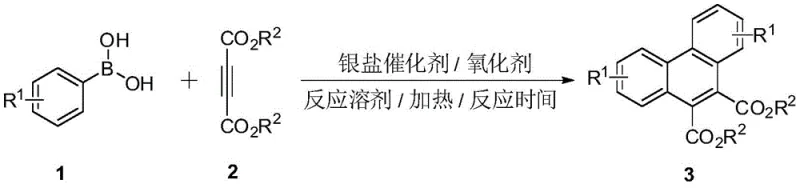
Crucially, the choice of the fluorobenzene and water solvent system plays a pivotal role in stabilizing the transition states and managing the solubility of the inorganic oxidant. The biphasic nature of the medium allows for the effective partitioning of reactants and byproducts, which helps in suppressing unwanted homocoupling side reactions that are common in boronic acid chemistry. The mild thermal input of 60 ℃ is sufficient to overcome the activation barrier for the cyclization step without promoting decomposition pathways, ensuring a clean impurity profile that is essential for pharmaceutical applications. Furthermore, the tolerance of various substituents suggests that the electronic properties of the phenyl ring do not significantly hinder the catalytic cycle, allowing for the synthesis of a broad spectrum of derivatives with consistent quality. This mechanistic robustness provides R&D directors with the confidence to scale this chemistry for the production of high-purity OLED materials or polymer additives where structural precision is non-negotiable.
How to Synthesize 9,10-Phenanthrene Dicarboxylic Esters Efficiently
The execution of this synthesis is designed to be straightforward and adaptable to standard laboratory and pilot plant equipment, requiring no specialized high-pressure reactors or inert atmosphere gloveboxes. The protocol involves the sequential addition of the phenylboronic acid substrate, the butynedioic acid ester, the silver carbonate catalyst, and the potassium persulfate oxidant into a pressure-resistant tube, followed by the introduction of the optimized fluorobenzene-water solvent mixture. The reaction mixture is then sealed and subjected to heating in an oil bath, where it maintains a steady state at 60 ℃ for a duration of 0.5 hour, after which the progress is monitored via thin-layer chromatography to ensure complete conversion. Upon completion, the reaction is cooled to room temperature, and the crude product is isolated through standard flash column chromatography, yielding the target 9,10-phenanthrene dicarboxylic acid ester as a high-purity white solid suitable for immediate downstream use.
- Charge a pressure-resistant tube with phenylboronic acid compound, butynedioic acid ester compound, silver carbonate catalyst (3%), and potassium persulfate oxidant (4.0 equivalents).
- Add a mixed solvent system of fluorobenzene and water in a volume ratio of 3: 1 to the reaction vessel.
- Seal the tube and heat the mixture in an oil bath at 60 ℃ for 0.5 hour, followed by cooling and flash column chromatography purification.
Commercial Advantages for Procurement and Supply Chain Teams
From a commercial perspective, this patented methodology offers transformative benefits that directly address the pain points of cost, availability, and scalability in the fine chemical sector. The substitution of expensive palladium or rhodium catalysts with abundant silver salts results in a drastic reduction in raw material costs, while the use of commodity chemicals like phenylboronic acid and dimethyl acetylenedicarboxylate ensures a stable and predictable supply chain. The elimination of multi-step precursor synthesis further compresses the manufacturing timeline, allowing for faster response to market demands and reduced inventory holding costs. Moreover, the mild reaction conditions and simple workup procedures minimize energy consumption and waste generation, aligning with increasingly stringent environmental regulations and sustainability goals that are critical for maintaining social license to operate in the global chemical industry.
- Cost Reduction in Manufacturing: The economic impact of this process is profound, primarily driven by the replacement of precious metal catalysts with silver carbonate, which is significantly more affordable and easier to source globally. By avoiding the need for complex aryl iodide or 2-phenylphenylboronic acid substrates, the method removes several costly synthetic steps from the value chain, leading to substantial savings in both material and labor expenses. The high atom economy of the one-pot reaction ensures that a greater proportion of the input mass is converted into the desired product, reducing the burden on waste disposal systems and lowering the overall cost of goods sold. Additionally, the short reaction time of 0.5 hour maximizes reactor utilization rates, allowing facilities to produce higher volumes with existing infrastructure and thereby improving capital efficiency.
- Enhanced Supply Chain Reliability: The reliance on widely available starting materials mitigates the risk of supply disruptions that often plague specialized reagent markets. Phenylboronic acids and dialkyl acetylenedicarboxylates are produced on a massive scale for various industries, ensuring consistent quality and competitive pricing regardless of geopolitical fluctuations. The robustness of the reaction conditions means that the process is less susceptible to variations in utility supplies or minor deviations in operating parameters, enhancing the reliability of delivery schedules for downstream customers. This stability is particularly valuable for long-term contracts where consistent supply of high-purity intermediates is critical for maintaining continuous pharmaceutical or agrochemical production lines without interruption.
- Scalability and Environmental Compliance: The simplicity of the post-reaction processing, which involves basic column chromatography rather than complex distillation or crystallization sequences, facilitates easy scale-up from gram to ton quantities. The use of a fluorobenzene-water system reduces the reliance on chlorinated solvents, contributing to a greener process profile that meets modern environmental standards. The low catalyst loading and the absence of toxic heavy metals like palladium simplify the purification of the final product, ensuring that residual metal levels are well below regulatory limits for pharmaceutical ingredients. This environmental compatibility not only reduces compliance costs but also enhances the brand reputation of manufacturers who adopt this sustainable technology, appealing to eco-conscious partners and investors.
Frequently Asked Questions (FAQ)
The following questions address common technical and commercial inquiries regarding the implementation of this silver-catalyzed synthesis route, providing clarity for stakeholders evaluating its adoption. These answers are derived directly from the experimental data and technical disclosures within the patent documentation, ensuring accuracy and relevance for decision-makers. Understanding these details is crucial for assessing the feasibility of integrating this technology into existing manufacturing workflows and for optimizing the production of phenanthrene-based intermediates.
Q: What are the primary advantages of this silver-catalyzed method over traditional palladium routes?
A: This method eliminates the need for expensive palladium, iridium, or rhodium catalysts and complex substrates like aryl iodides. It utilizes cheap phenylboronic acids and operates under mild conditions (60 ℃) with a short reaction time of 0.5 hour, significantly simplifying the process and reducing raw material costs.
Q: What is the optimal solvent system for maximizing yield in this transformation?
A: Experimental data indicates that a mixed solvent system of fluorobenzene and water in a volume ratio of 3:1 provides the highest efficiency, achieving yields up to 70% with silver carbonate as the catalyst, outperforming pure organic solvents or other aqueous ratios.
Q: Is this synthesis suitable for large-scale manufacturing of pharmaceutical intermediates?
A: Yes, the process is highly scalable due to its one-pot nature, mild thermal requirements, and the use of inexpensive, commercially available reagents. The simple post-treatment involving column chromatography facilitates easy isolation of high-purity products suitable for downstream drug synthesis.
Partnering with NINGBO INNO PHARMCHEM: Your Reliable 9,10-Phenanthrene Dicarboxylic Ester Supplier
At NINGBO INNO PHARMCHEM, we recognize the strategic importance of accessing advanced synthetic technologies that drive innovation in the pharmaceutical and fine chemical sectors. Our team of expert chemists possesses extensive experience scaling diverse pathways from 100 kgs to 100 MT/annual commercial production, ensuring that the transition from laboratory discovery to industrial reality is seamless and efficient. We are committed to delivering high-purity 9,10-phenanthrene dicarboxylic esters that meet stringent purity specifications, supported by our rigorous QC labs and state-of-the-art analytical capabilities. By leveraging the efficiencies of the silver-catalyzed route described in CN110683949B, we can offer our partners a competitive edge through superior product quality and consistent supply reliability.
We invite you to engage with our technical procurement team to discuss how this novel synthesis method can be tailored to your specific project requirements. Whether you need a Customized Cost-Saving Analysis for your current supply chain or require specific COA data and route feasibility assessments for new drug candidates, we are ready to provide the support you need. Contact us today to explore how our expertise in commercial scale-up of complex pharmaceutical intermediates can accelerate your development timelines and optimize your manufacturing costs.