
Advanced Metal-Free Synthesis of 3-Acyl Indoles for High-Purity Pharmaceutical Intermediates
The pharmaceutical and fine chemical industries are constantly seeking robust, sustainable, and cost-effective methodologies for constructing privileged heterocyclic scaffolds. A groundbreaking approach detailed in patent CN110498757B introduces a highly efficient synthesis method for 3-acyl indole compounds that completely eliminates the need for metal participation. This innovation leverages nucleophilic organic small-molecule catalysts to drive the intramolecular cyclization of N-tert-butoxycarbonyl-N-acyl-2-allenylaniline derivatives. By operating under mild thermal conditions ranging from 50°C to 120°C, this protocol offers a distinct advantage over traditional methods that often require harsh reagents or expensive transition metals. The significance of this technology lies in its ability to produce high-purity indole derivatives, which serve as critical intermediates for anti-inflammatory agents and other bioactive molecules, while adhering to strict environmental and safety standards required by modern regulatory bodies.
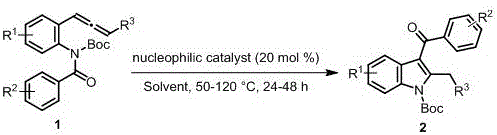
The Limitations of Conventional Methods vs. The Novel Approach
The Limitations of Conventional Methods
Historically, the construction of the 3-acyl indole backbone has relied heavily on classical Friedel-Crafts acylation strategies or transition-metal-catalyzed carbonylation reactions. Traditional Friedel-Crafts approaches typically necessitate the use of stoichiometric amounts of Lewis acids, which generate substantial quantities of hazardous waste and often suffer from poor regioselectivity, leading to the formation of unwanted 1-acylindole byproducts that are difficult to separate. Furthermore, modern transition-metal-catalyzed methods, while effective, introduce significant supply chain vulnerabilities due to the reliance on scarce and expensive metals such as palladium, rhodium, or iridium. These metal residues pose a severe contamination risk in Active Pharmaceutical Ingredient (API) manufacturing, requiring costly and complex purification steps to meet stringent ppm limits. Additionally, many of these conventional routes involve multi-step sequences with low atom economy, resulting in increased raw material consumption and higher overall production costs that negatively impact the commercial viability of the final drug product.
The Novel Approach
In stark contrast, the methodology disclosed in the patent utilizes a metal-free organocatalytic strategy that fundamentally reshapes the economic and operational landscape of indole synthesis. By employing readily available nucleophilic catalysts such as 4-dimethylaminopyridine (DMAP) or tricyclohexylphosphine, the reaction proceeds through a unique activation mechanism that avoids the use of any metallic species. This approach not only drastically reduces the cost of goods by eliminating expensive metal catalysts and ligands but also simplifies the downstream processing workflow. The reaction conditions are remarkably mild, typically requiring temperatures between 50°C and 120°C in common organic solvents like tetrahydrofuran or 1,4-dioxane, which enhances operational safety and energy efficiency. Moreover, the method exhibits exceptional atom economy, as the cyclization occurs intramolecularly without the need for external acylating agents or stoichiometric additives, thereby minimizing waste generation and aligning perfectly with green chemistry principles essential for sustainable manufacturing.
Mechanistic Insights into Nucleophilic Organocatalytic Cyclization
The core of this innovative synthesis lies in the ability of the nucleophilic catalyst to activate the allenyl moiety of the substrate, initiating a cascade of bond-forming events that construct the indole ring with high precision. The catalyst attacks the electron-deficient allene system to generate a zwitterionic intermediate, which subsequently undergoes an intramolecular nucleophilic attack by the aromatic ring. This step is crucial as it dictates the regioselectivity of the reaction, ensuring that the acyl group is installed exclusively at the 3-position of the indole nucleus rather than the 1-position. The absence of metal coordination spheres allows for a more direct and less sterically hindered pathway, facilitating the rapid formation of the carbon-carbon and carbon-nitrogen bonds required for ring closure. Following the cyclization, a proton transfer and catalyst regeneration step occur, releasing the final 3-acyl indole product and allowing the catalytic cycle to continue efficiently with minimal catalyst loading, typically around 20 mol%.
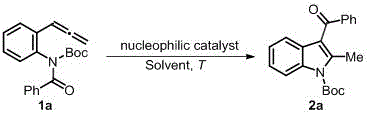
From an impurity control perspective, this metal-free mechanism offers superior selectivity profiles compared to radical-based or metal-mediated pathways. Traditional methods often suffer from side reactions such as polymerization of the allene substrate or over-acylation, which complicate purification. However, the controlled nucleophilic activation in this new method suppresses these competing pathways, leading to cleaner reaction profiles and higher crude purity. The use of the Boc protecting group on the nitrogen atom further stabilizes the intermediate and prevents N-acylation side reactions, ensuring that the final product stream contains minimal structural analogs. This high level of chemical fidelity is paramount for pharmaceutical applications, where impurity profiles must be rigorously characterized and controlled to ensure patient safety and regulatory approval.
How to Synthesize N-Boc-3-Acyl Indoles Efficiently
To implement this cutting-edge synthesis route in a laboratory or pilot plant setting, operators must adhere to specific procedural guidelines that maximize yield and reproducibility. The process begins with the precise weighing of the N-tert-butoxycarbonyl-N-acyl-2-allenylaniline substrate and the chosen nucleophilic catalyst, ensuring an inert atmosphere is maintained throughout to prevent moisture sensitivity issues. The reaction mixture is then heated to the optimized temperature range, and progress is monitored using standard analytical techniques such as HPLC or TLC. Detailed standardized synthetic steps, including specific solvent ratios, workup procedures, and purification parameters, are provided in the technical guide below to assist process chemists in replicating these results effectively.
- Combine N-tert-butoxycarbonyl-N-acyl-2-allenylaniline substrate with a nucleophilic organic catalyst (e.g., DMAP, PPy) in an anhydrous organic solvent under nitrogen atmosphere.
- Heat the reaction mixture to a temperature between 50°C and 120°C and maintain stirring for a duration of 24 to 48 hours to ensure complete cyclization.
- Upon completion, remove the solvent under reduced pressure and purify the crude residue via column chromatography or recrystallization to isolate the target 3-acyl indole.
Commercial Advantages for Procurement and Supply Chain Teams
For procurement managers and supply chain directors, the adoption of this metal-free synthesis route presents a compelling value proposition centered on cost stability and operational resilience. By removing the dependency on volatile transition metal markets, manufacturers can secure a more predictable cost structure for their raw materials, shielding the business from sudden price spikes associated with precious metals. The simplified reaction design also translates to reduced utility consumption, as the moderate temperature requirements eliminate the need for energy-intensive heating or cryogenic cooling systems. Furthermore, the use of commodity-grade organic solvents and catalysts ensures that sourcing remains straightforward and reliable, minimizing the risk of supply disruptions that could halt production lines. These factors collectively contribute to a leaner, more agile manufacturing process that enhances the overall competitiveness of the supply chain.
- Cost Reduction in Manufacturing: The elimination of expensive transition metal catalysts and specialized ligands results in a substantial decrease in direct material costs. Additionally, the simplified purification process reduces the consumption of silica gel and solvents during chromatography, further lowering the cost per kilogram of the final API intermediate. The high atom economy of the reaction means that less raw material is wasted as byproducts, maximizing the yield obtained from each batch and improving the overall return on investment for the manufacturing campaign.
- Enhanced Supply Chain Reliability: Sourcing nucleophilic organocatalysts like DMAP or phosphines is significantly less complex than procuring specialized metal complexes, which often have long lead times and limited suppliers. This accessibility ensures that production schedules can be maintained without delay, even during periods of global supply chain stress. The robustness of the reaction conditions also allows for flexibility in manufacturing locations, enabling companies to diversify their production footprint and reduce geopolitical risks associated with single-source dependencies.
- Scalability and Environmental Compliance: The absence of heavy metals simplifies waste treatment protocols, as effluent streams do not require complex metal scavenging or disposal procedures. This aligns with increasingly stringent environmental regulations and reduces the administrative burden of compliance reporting. The mild reaction conditions facilitate easy scale-up from gram to ton quantities without the need for specialized high-pressure reactors, allowing for rapid capacity expansion to meet market demand while maintaining a smaller environmental footprint.
Frequently Asked Questions (FAQ)
The following questions address common technical and commercial inquiries regarding the implementation of this metal-free synthesis technology. These insights are derived directly from the experimental data and scope of the patent, providing clarity on substrate compatibility, catalyst selection, and process optimization. Understanding these details is essential for R&D teams evaluating the feasibility of integrating this route into their existing development pipelines.
Q: What are the advantages of using nucleophilic organocatalysts over transition metals for indole synthesis?
A: Nucleophilic organocatalysts eliminate the risk of toxic heavy metal residues, which is critical for pharmaceutical compliance. They are also significantly cheaper and easier to remove during purification compared to complex metal-ligand systems.
Q: Can this metal-free method tolerate diverse functional groups on the substrate?
A: Yes, the method demonstrates excellent substrate tolerance, accommodating electron-withdrawing groups like cyano and trifluoromethyl, as well as electron-donating groups like methoxy and alkyl chains, without compromising yield.
Q: Is this process suitable for large-scale commercial production?
A: Absolutely. The reaction operates under mild conditions (50-120°C) without requiring specialized high-pressure equipment or cryogenic temperatures, making it highly amenable to kilogram-to-ton scale manufacturing.
Partnering with NINGBO INNO PHARMCHEM: Your Reliable 3-Acyl Indole Supplier
At NINGBO INNO PHARMCHEM, we recognize the transformative potential of this metal-free synthesis route for the production of high-value pharmaceutical intermediates. As a dedicated CDMO partner, we possess extensive experience scaling diverse pathways from 100 kgs to 100 MT/annual commercial production, ensuring that your transition from lab bench to market is seamless and efficient. Our state-of-the-art facilities are equipped with rigorous QC labs capable of meeting stringent purity specifications, guaranteeing that every batch of 3-acyl indole delivered meets the highest quality standards required for drug substance manufacturing. We are committed to leveraging our technical expertise to optimize this novel chemistry for your specific needs, delivering consistent quality and reliability.
We invite you to engage with our technical procurement team to discuss how this innovative synthesis method can drive value for your organization. By requesting a Customized Cost-Saving Analysis, you can gain a deeper understanding of the economic benefits specific to your volume requirements. We encourage you to reach out for specific COA data and route feasibility assessments to validate the performance of this technology against your current supply chain benchmarks. Let us collaborate to engineer a more efficient and sustainable future for your chemical supply needs.
Engineering Bottleneck?
Can't scale up this synthesis? Upload your target structure or CAS, and our CDMO team will evaluate the industrial feasibility within 24 hours. Request Evaluation →