
Scalable Visible Light Nickel Catalyzed Asymmetric Beta-Arylation for High-Purity Pharmaceutical Intermediates
The pharmaceutical and fine chemical industries are constantly seeking robust methodologies to construct chiral scaffolds efficiently, and the recent disclosure in Chinese Patent CN114456207B presents a transformative approach to synthesizing chiral β-aryl ketones. This technology leverages a sophisticated dual catalytic system combining visible light photoredox catalysis with asymmetric nickel catalysis to achieve high stereocontrol under remarkably mild conditions. Unlike traditional thermal processes that often demand extreme temperatures and generate significant waste, this invention utilizes blue LED irradiation to drive the reaction at ambient temperature (25°C), representing a paradigm shift towards greener, energy-efficient organic synthesis. For R&D directors and procurement strategists, this patent offers a compelling route to access high-value intermediates with reduced environmental impact and improved operational safety, positioning it as a critical asset for modern supply chains focused on sustainability and cost-effectiveness.
The Limitations of Conventional Methods vs. The Novel Approach
The Limitations of Conventional Methods
Historically, the synthesis of β-aryl ketones has relied on methodologies that pose significant challenges for large-scale manufacturing and environmental compliance. A prominent example found in prior art involves the conjugate addition of aromatic nucleophiles to α,β-unsaturated ketones using elemental selenium, which necessitates harsh reaction conditions such as heating to 150°C in DMF solvent.  This thermal requirement not only consumes substantial energy but also introduces safety hazards associated with high-temperature operations in polar aprotic solvents. Furthermore, alternative approaches utilizing directing group-assisted C-H activation often require stoichiometric amounts of expensive palladium catalysts and generate racemic mixtures that necessitate costly downstream resolution steps. The reliance on toxic reagents like selenium and the inability to directly access optically active products without additional purification stages severely limits the atom economy and commercial viability of these legacy processes, creating bottlenecks in the supply of high-purity pharmaceutical intermediates.
The Novel Approach
In stark contrast, the methodology described in CN114456207B circumvents these limitations by employing a visible light-driven radical strategy that operates at room temperature. The core innovation lies in the activation of 1,2-disubstituted cyclopropanols via single-electron transfer, facilitated by an iridium photocatalyst under 465nm blue light irradiation. 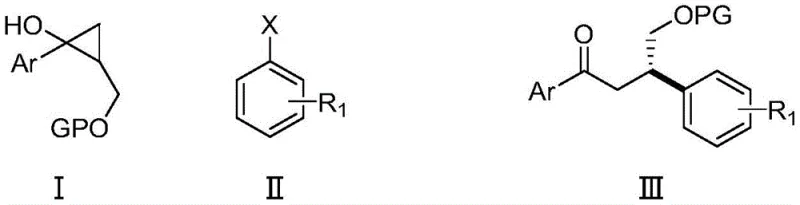 This mild activation allows for the ring-opening of the strained cyclopropane to generate a nucleophilic radical species that couples with aryl halides in the presence of a nickel catalyst. By replacing high-thermal energy input with photon energy, the process drastically reduces the carbon footprint of the manufacturing operation. Moreover, the direct formation of the chiral center during the coupling event eliminates the need for resolution, thereby streamlining the synthetic route and enhancing the overall yield of the desired enantiomer, which is crucial for the cost reduction in fine chemical manufacturing of complex drug candidates.
Mechanistic Insights into Visible Light/Nickel Dual Catalytic Asymmetric Beta-Arylation
The success of this transformation hinges on the intricate interplay between the photoredox cycle and the nickel catalytic cycle, orchestrated by a specifically designed chiral ligand environment. Upon irradiation with blue LEDs, the excited state of the iridium photocatalyst oxidizes the cyclopropanol substrate, triggering the fragmentation of the strained three-membered ring to release a β-keto radical. This radical species is subsequently captured by a low-valent nickel complex generated in situ from nickel acetate and the chiral ligand. The stereochemical outcome of the reaction is dictated by the geometry of the nickel-ligand complex, where the bulky substituents on the ligand shield specific quadrants of the metal center, forcing the incoming radical and aryl group to approach in a highly defined orientation. This precise spatial control ensures that the reductive elimination step occurs with high fidelity, delivering the chiral β-aryl ketone with excellent enantiomeric ratios.
Central to this stereocontrol is the use of specialized Pyox ligands, particularly those bearing bulky adamantyl groups, as illustrated in the preferred ligand structure.  The steric bulk of the adamantyl moiety creates a rigid chiral pocket that effectively discriminates between the prochiral faces of the radical intermediate, preventing the formation of the undesired enantiomer. Comparative studies within the patent demonstrate that ligands with smaller substituents, such as phenyl or sec-butyl groups, fail to provide adequate steric differentiation, resulting in poor enantioselectivity (er values near 50:50). This mechanistic understanding underscores the importance of ligand design in asymmetric catalysis and provides a clear rationale for the high optical purity observed in the patented examples, offering R&D teams a reliable blueprint for optimizing similar transformations for diverse substrate scopes.
How to Synthesize Chiral Beta-Aryl Ketones Efficiently
To implement this cutting-edge technology in a laboratory or pilot plant setting, operators must adhere to strict protocols regarding light source calibration and atmospheric control to ensure reproducibility and safety. The process begins with the careful preparation of the catalytic mixture under an inert nitrogen or argon atmosphere to prevent the quenching of radical intermediates by oxygen. Detailed standard operating procedures for the synthesis, including precise molar ratios of the iridium photocatalyst, nickel source, and chiral ligand, are essential for achieving the reported yields and stereoselectivity. The following guide outlines the standardized synthesis steps derived from the patent examples to assist technical teams in replicating this efficient pathway.
- Combine iridium photocatalyst, nickel acetate, chiral Pyox ligand, 1,2-disubstituted cyclopropanol substrate, and aryl bromide in a reaction vessel under inert atmosphere.
- Add DMF solvent and collidine base, seal the vessel, and irradiate with 465nm blue LEDs while maintaining temperature at 25°C for 48 hours.
- Remove solvent under vacuum and purify the crude residue via silica gel column chromatography using ethyl acetate and petroleum ether to isolate the target chiral ketone.
Commercial Advantages for Procurement and Supply Chain Teams
For procurement managers and supply chain heads, the adoption of this visible light/nickel catalyzed protocol offers tangible strategic benefits that extend beyond mere technical novelty. The shift from thermal to photochemical activation fundamentally alters the cost structure of production by eliminating the need for energy-intensive heating systems and high-pressure reactors. This transition to ambient temperature processing not only lowers utility costs but also simplifies the engineering requirements for reaction vessels, allowing for the use of standard glass-lined or stainless steel equipment equipped with LED arrays rather than specialized high-temperature autoclaves. Consequently, the barrier to entry for manufacturing these complex intermediates is lowered, enabling more flexible and responsive production scheduling that can adapt quickly to market demands without the long lead times associated with thermal ramp-up and cool-down cycles.
- Cost Reduction in Manufacturing: The economic advantage of this method is primarily driven by the substitution of expensive and toxic reagents with abundant and affordable alternatives. By utilizing nickel acetate instead of precious metals like palladium or rhodium, the raw material cost for the catalyst system is significantly reduced, which is a critical factor when scaling to multi-ton production volumes. Furthermore, the elimination of stoichiometric oxidants or harsh activating agents minimizes the generation of hazardous waste, thereby reducing the costs associated with waste treatment and environmental compliance. The high atom economy of the direct coupling reaction ensures that a greater proportion of the starting materials are converted into the final product, maximizing the value derived from every kilogram of feedstock purchased and processed.
- Enhanced Supply Chain Reliability: The robustness of this synthetic route contributes to a more resilient supply chain by mitigating risks associated with reagent scarcity and process instability. The starting materials, specifically 1,2-disubstituted cyclopropanols and aryl bromides, are readily available from global chemical suppliers, ensuring a steady flow of inputs even during periods of market volatility. Additionally, the mild reaction conditions reduce the likelihood of thermal runaways or decomposition events that can halt production lines, leading to more consistent batch-to-batch quality and reliable delivery schedules. This stability is paramount for pharmaceutical customers who require uninterrupted supply of critical intermediates to maintain their own drug manufacturing timelines and regulatory filings.
- Scalability and Environmental Compliance: From a sustainability perspective, this technology aligns perfectly with the industry's push towards greener chemistry principles, facilitating easier regulatory approval and community acceptance. The use of visible light as a traceless reagent avoids the accumulation of chemical byproducts, and the ability to run reactions at room temperature significantly lowers the overall energy consumption of the facility. This environmental profile not only helps companies meet their corporate social responsibility goals but also future-proofs their operations against increasingly stringent environmental regulations. The scalability of photochemical reactions has improved dramatically with modern flow chemistry technologies, allowing this batch process to be potentially adapted for continuous manufacturing, further enhancing throughput and safety profiles for commercial scale-up of complex pharmaceutical intermediates.
Frequently Asked Questions (FAQ)
The following questions address common technical and commercial inquiries regarding the implementation of this visible light catalyzed synthesis, providing clarity on its practical application and advantages over legacy methods. These insights are derived directly from the experimental data and comparative examples provided in the patent documentation, ensuring that stakeholders have accurate information for decision-making. Understanding these nuances is essential for evaluating the feasibility of integrating this technology into existing production portfolios.
Q: What are the advantages of this visible light method over traditional selenium-based synthesis?
A: Unlike traditional methods requiring elemental selenium at harsh temperatures (150°C), this patent utilizes mild room temperature conditions (25°C) with blue light, significantly reducing energy consumption and eliminating toxic selenium waste.
Q: How does the chiral Pyox ligand influence stereoselectivity?
A: The bulky adamantyl group on the (S)-4-(Ad)-2-(5-Me)-Pyox ligand creates a specific steric environment around the nickel center, effectively discriminating between enantiotopic faces during the radical addition to ensure high enantiomeric ratios (up to 95:5 er).
Q: Is this process suitable for large-scale commercial production?
A: Yes, the reaction operates at ambient temperature and pressure using commercially available nickel and iridium catalysts, avoiding high-pressure hydrogenation or cryogenic conditions, which facilitates safer and more economical scale-up for industrial manufacturing.
Partnering with NINGBO INNO PHARMCHEM: Your Reliable Chiral Beta-Aryl Ketones Supplier
As the demand for enantiomerically pure building blocks continues to rise in the development of next-generation therapeutics, partnering with an experienced CDMO like NINGBO INNO PHARMCHEM becomes a strategic imperative. We possess extensive experience scaling diverse pathways from 100 kgs to 100 MT/annual commercial production, ensuring that the transition from laboratory discovery to industrial reality is seamless and efficient. Our facilities are equipped with state-of-the-art photochemical reactors and rigorous QC labs capable of meeting stringent purity specifications, guaranteeing that every batch of chiral β-aryl ketones delivered meets the highest international standards for pharmaceutical applications.
We invite potential partners to engage with our technical procurement team to discuss how this innovative visible light nickel catalysis can be tailored to your specific project needs. By requesting a Customized Cost-Saving Analysis, you can gain a detailed understanding of the economic benefits specific to your target molecule. We encourage you to contact us today to obtain specific COA data and route feasibility assessments, allowing you to make informed decisions that optimize both the quality and cost-efficiency of your supply chain for high-purity chiral beta-aryl ketones.