
Advanced Ionic Platinum Complexes for Next-Generation OLED Display Manufacturing
Advanced Ionic Platinum Complexes for Next-Generation OLED Display Manufacturing
The rapid evolution of the display industry from Liquid Crystal Displays (LCDs) to Organic Light Emitting Diodes (OLEDs) has created an insatiable demand for high-performance emissive materials that can deliver superior color purity and energy efficiency. Patent CN113292607B introduces a groundbreaking class of ionic luminescent platinum complexes based on benzimidazole phosphine ligands, specifically designed to overcome the historical limitations of platinum-based emitters. These novel organometallic compounds, characterized by molecular formulas such as [C44H31N3PPtS]OTF, exhibit exceptional photoluminescence quantum efficiencies reaching up to 86.6% in solution and 69.1% in the solid state. For R&D directors and procurement specialists in the electronic chemical sector, this technology represents a significant leap forward in developing stable, efficient, and commercially viable alternatives to expensive iridium-based phosphors, promising to redefine the cost-performance ratio in next-generation flexible displays and lighting solutions.
The Limitations of Conventional Methods vs. The Novel Approach
The Limitations of Conventional Methods
Historically, the commercialization of platinum(II) complexes for OLED applications has been hindered by their inherent planar quadrilateral geometry, which predisposes them to strong intermolecular pi-pi stacking interactions. In conventional designs, this close packing leads to severe triplet-triplet annihilation and concentration quenching, drastically reducing the luminous efficiency of the device, especially at the high doping concentrations required for practical manufacturing. Furthermore, many existing synthetic routes for phosphorescent materials rely on harsh reaction conditions or expensive noble metal catalysts that complicate purification and increase the overall cost of goods sold. The inability to effectively tune the steric environment around the platinum center without sacrificing electronic properties has long been a bottleneck, limiting the internal quantum efficiency and operational lifetime of devices utilizing traditional Pt-emitters compared to their iridium counterparts.
The Novel Approach
The innovative strategy outlined in the patent data employs a sophisticated ligand design featuring bulky benzimidazole phosphine moieties that introduce significant steric hindrance around the central platinum atom. By integrating a rigid benzimidazole core with a voluminous diphenylphosphine group, the new complexes effectively prevent the detrimental face-to-face stacking that plagues earlier generations of materials. This structural modification not only preserves the high spin-orbit coupling necessary for efficient intersystem crossing but also ensures that the emissive triplet states remain isolated even in the solid state. As illustrated in the synthetic pathway for the ligands, this approach allows for precise tuning of the emission color from yellow to orange-yellow while maintaining high quantum yields, offering a robust platform for full-color OLED development without the prohibitive costs associated with iridium scarcity.
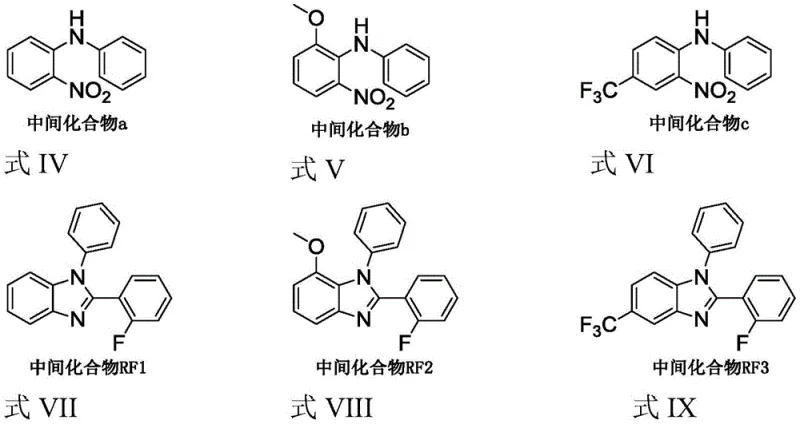
This strategic molecular engineering directly addresses the core stability and efficiency issues, providing a scalable route to high-purity emissive dopants. The synthesis involves a logical progression from readily available o-nitroaniline derivatives, ensuring that the supply chain remains resilient and cost-effective. By avoiding complex macrocyclic structures or unstable intermediates, the process facilitates easier purification via standard column chromatography and recrystallization techniques, which is critical for meeting the stringent purity specifications required by top-tier panel manufacturers.
Mechanistic Insights into Benzimidazole Phosphine Ligand Coordination
The mechanistic success of these ionic platinum complexes lies in the synergistic interaction between the cyclometalated benzothiazole unit and the ancillary benzimidazole phosphine ligand. During the final complexation step, the silver salt acts as a halide abstractor, facilitating the coordination of the neutral phosphine ligand to the platinum center while the triflate anion provides the necessary charge balance for the ionic structure. This ionic nature enhances the solubility of the complexes in common organic processing solvents, which is advantageous for solution-processable OLED fabrication methods like inkjet printing. The strong sigma-donating capability of the phosphine group stabilizes the platinum center against decomposition, while the pi-accepting nature of the benzimidazole ring helps modulate the HOMO-LUMO gap, resulting in the observed yellow emission profiles with maximum wavelengths around 527nm to 574nm.
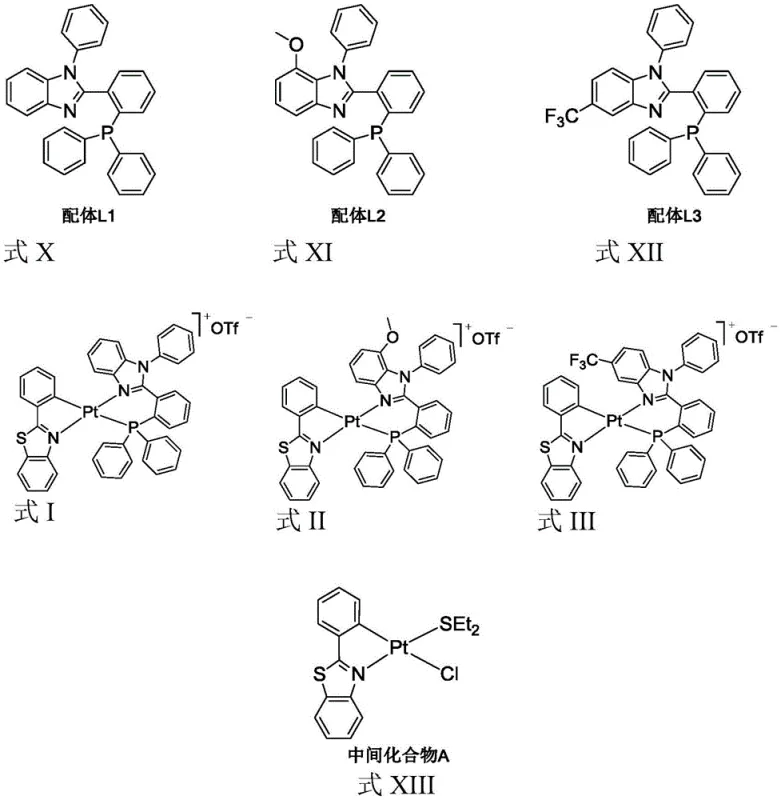
Furthermore, the crystallographic data confirms that the bulky substituents on the ligand framework successfully enforce a distorted geometry that inhibits close contact between adjacent molecules in the crystal lattice. This structural distortion is key to minimizing non-radiative decay pathways that typically arise from aggregation. For the R&D team, understanding this structure-property relationship is vital for further optimizing the emission color and lifetime. The presence of electron-withdrawing groups like trifluoromethyl or electron-donating methoxy groups on the benzimidazole ring allows for fine-tuning of the electronic density, demonstrating a versatile chemical platform that can be adapted for various color gamuts without redesigning the entire synthetic backbone.
How to Synthesize Ionic Luminescent Platinum Complex Efficiently
The preparation method described in the patent offers a robust and reproducible five-step sequence that balances yield with operational simplicity, making it highly attractive for process chemistry teams aiming for kilogram-scale production. The initial steps involve the formation of the functionalized benzimidazole scaffold through copper-catalyzed coupling and subsequent condensation, followed by the introduction of the phosphine group under inert atmosphere to prevent oxidation. The parallel synthesis of the platinum precursor intermediate A ensures that both key components are ready for the final convergent step, which proceeds under mild room temperature conditions to preserve the integrity of the sensitive organometallic bonds. Detailed standardized synthesis steps are provided in the guide below to ensure consistent batch-to-batch quality.
- Synthesize o-nitroaniline intermediates via copper-catalyzed coupling at 165-170°C.
- Perform condensation with 2-fluorobenzaldehyde and sodium hydrosulfite to form benzimidazole precursors.
- Execute nucleophilic substitution with potassium diphenylphosphide to generate the bulky phosphine ligand.
- Prepare the platinum precursor intermediate A using 2-phenylbenzothiazole and potassium chloroplatinite.
- Complete the final complexation by reacting the ligand with intermediate A and silver triflate in dichloromethane.
Commercial Advantages for Procurement and Supply Chain Teams
From a procurement and supply chain perspective, this technology offers substantial advantages by leveraging commodity chemicals and eliminating the need for ultra-low temperature cryogenic reactions often seen in organometallic synthesis. The reliance on standard solvents such as N,N-dimethylformamide, tetrahydrofuran, and dichloromethane means that facilities do not require specialized infrastructure upgrades, significantly lowering the barrier to entry for contract manufacturing organizations. Moreover, the use of copper iodide as a catalyst in the early stages is far more economical than using palladium or other precious metals, driving down the raw material costs substantially. The ability to purify intermediates via simple extraction and rotary evaporation before the final high-value step minimizes waste generation and solvent consumption, aligning with modern green chemistry initiatives and reducing environmental compliance costs.
- Cost Reduction in Manufacturing: The synthetic route eliminates the need for expensive iridium precursors, replacing them with more abundant platinum salts and organic ligands derived from bulk chemicals like iodobenzene and nitroanilines. By operating the final complexation at room temperature, the process drastically reduces energy consumption associated with heating and cooling cycles, leading to significant operational expenditure savings. Additionally, the high crystallinity of the final products allows for efficient purification through volatilization and washing, reducing the loss of valuable material during downstream processing and improving the overall mass balance of the production line.
- Enhanced Supply Chain Reliability: The starting materials, including 2-fluorobenzaldehyde and potassium diphenylphosphide, are widely available from multiple global suppliers, mitigating the risk of single-source bottlenecks that often plague the specialty chemical industry. The robustness of the reaction conditions, which tolerate standard inert gas protection rather than requiring extreme vacuum or glovebox environments for every step, ensures that production can be maintained consistently even in facilities with varying levels of technical sophistication. This resilience translates to shorter lead times and more predictable delivery schedules for downstream OLED panel manufacturers who depend on a steady flow of high-quality emissive dopants.
- Scalability and Environmental Compliance: The process is inherently scalable as demonstrated by the successful execution of reactions in multi-hundred milliliter scales in the examples, with clear pathways to liter-scale reactors without exothermic runaway risks. The waste streams primarily consist of aqueous salt solutions and recoverable organic solvents, which can be treated using standard industrial wastewater protocols, avoiding the generation of persistent heavy metal contaminants that are difficult to remediate. This environmental profile simplifies the permitting process for new production lines and supports corporate sustainability goals, making the technology a preferred choice for environmentally conscious electronics brands.
Frequently Asked Questions (FAQ)
The following questions address common technical and commercial inquiries regarding the implementation of this ionic platinum complex technology in industrial settings. These answers are derived directly from the experimental data and characterization results provided in the patent documentation, ensuring accuracy for decision-makers evaluating this material for integration into their product pipelines. Understanding these specifics is crucial for assessing the feasibility of adoption and the potential return on investment for R&D projects focused on next-generation display technologies.
Q: What is the primary advantage of these ionic platinum complexes over traditional iridium emitters?
A: These platinum complexes offer a cost-effective alternative to iridium while maintaining high photoluminescence quantum efficiency (up to 86.6% in solution). The specific benzimidazole phosphine ligand design effectively suppresses pi-pi stacking interactions that typically quench emission in planar Pt(II) complexes.
Q: Are the reaction conditions suitable for large-scale commercial production?
A: Yes, the synthesis utilizes standard organic solvents like DMF, THF, and dichloromethane, and operates at moderate temperatures (mostly below 170°C). The final complexation step occurs at room temperature, which significantly simplifies thermal management and energy consumption during scale-up.
Q: What are the key photophysical properties of the synthesized complexes?
A: The complexes exhibit strong absorption near 230nm and emit yellow to orange-yellow light with maximum wavelengths between 527nm and 574nm depending on the substituent. They demonstrate excellent solid-state quantum efficiencies up to 69.1%, making them highly viable for solid-state OLED device fabrication.
Partnering with NINGBO INNO PHARMCHEM: Your Reliable Ionic Luminescent Platinum Complex Supplier
As the global demand for high-resolution and energy-efficient displays continues to surge, securing a dependable source of advanced emissive materials is critical for maintaining competitive advantage in the electronics market. NINGBO INNO PHARMCHEM stands at the forefront of this sector, leveraging extensive experience scaling diverse pathways from 100 kgs to 100 MT/annual commercial production to deliver these complex organometallic structures with unmatched consistency. Our state-of-the-art rigorous QC labs and adherence to stringent purity specifications ensure that every batch of ionic platinum complex meets the exacting standards required for high-performance OLED fabrication, minimizing defect rates and maximizing device yield for our partners.
We invite procurement leaders and technical directors to engage with our expert team to discuss how this patented technology can be integrated into your supply chain to drive innovation and efficiency. By requesting a Customized Cost-Saving Analysis, you can gain deeper insights into the economic benefits of switching to our platinum-based emitters compared to traditional alternatives. Please contact our technical procurement team today to obtain specific COA data and route feasibility assessments tailored to your specific volume requirements and application needs, ensuring a seamless transition to superior display performance.