
Advanced Palladium-Catalyzed Suzuki Coupling for Scalable 2-Arylacrolein Diacetal Production
Advanced Palladium-Catalyzed Suzuki Coupling for Scalable 2-Arylacrolein Diacetal Production
The landscape of organic synthesis for complex aldehyde derivatives is constantly evolving, driven by the need for more efficient and scalable routes to key pharmaceutical building blocks. A significant breakthrough in this domain is detailed in patent CN111423315A, which discloses a novel method for synthesizing 2-arylacrolein diacetals via a palladium-catalyzed Suzuki coupling reaction. This technology addresses long-standing challenges in constructing the 2-aryl-substituted acrolein skeleton, a motif prevalent in numerous bioactive molecules and advanced material precursors. By leveraging the versatility of Suzuki-Miyaura cross-coupling, this invention provides a robust pathway that tolerates a wide array of functional groups, thereby expanding the chemical space accessible to process chemists. The methodology is particularly notable for its operational simplicity and the high quality of the resulting intermediates, which are crucial for downstream applications in drug discovery and development.
The Limitations of Conventional Methods vs. The Novel Approach
The Limitations of Conventional Methods
Historically, the synthesis of 2-substituted acrolein diacetals has relied on several classical methodologies, each fraught with significant drawbacks that hinder industrial adoption. Traditional approaches such as the Wittig reaction, while conceptually straightforward, often suffer from severe steric hindrance effects that drastically reduce yields when bulky aryl groups are introduced. Furthermore, alternative strategies involving the addition of alkynaldehydes necessitate the use of expensive and thermally unstable iodohydrocarbons as aryl sources, introducing safety hazards and cost inefficiencies into the supply chain. Another common route, the intermolecular Mizoroki-Heck reaction, requires highly reactive aryl trifluoromethanesulfonates which are not only costly but also pose storage and handling difficulties due to their sensitivity. Additionally, ring-opening reactions of 2-aryl-1,1-dichlorocyclopropanes are severely limited by the scarcity and complex preparation of the requisite starting materials. These cumulative limitations create a bottleneck for the reliable production of high-purity intermediates needed for modern pharmaceutical pipelines.

The Novel Approach
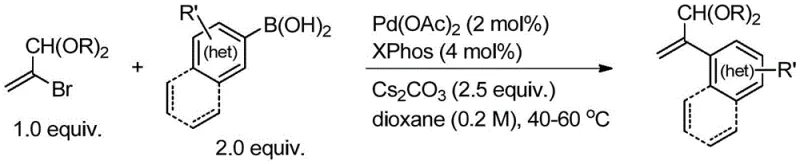
In stark contrast to these legacy methods, the technology outlined in CN111423315A introduces a paradigm shift by utilizing a palladium-catalyzed Suzuki coupling between 2-bromoacrolein diethyl acetal and diverse arylboronic acids. This approach fundamentally alters the reaction landscape by employing stable, commercially abundant boronic acids instead of hazardous halides or unstable ylides. The reaction proceeds under remarkably mild conditions, typically between 40-60°C, which minimizes thermal degradation of sensitive functional groups and reduces energy consumption. The use of a specialized ligand system ensures high catalytic turnover, allowing for excellent yields across a broad substrate scope including electron-rich and electron-deficient arenes. This novel strategy effectively bypasses the steric and electronic constraints of previous methods, offering a streamlined, one-step construction of the carbon-carbon bond that defines the 2-arylacrolein core.
Mechanistic Insights into Pd-Catalyzed Suzuki Coupling
The efficacy of this synthesis relies on a sophisticated catalytic cycle mediated by the palladium-XPhos complex. The mechanism initiates with the oxidative addition of the palladium(0) species into the carbon-bromine bond of the 2-bromoacrolein diethyl acetal, forming a reactive organopalladium(II) intermediate. The bulky and electron-rich nature of the XPhos ligand is critical here, as it stabilizes the monoligated palladium species, facilitating rapid oxidative addition even with sterically demanding substrates. Subsequently, the arylboronic acid, activated by the cesium carbonate base, undergoes transmetallation with the palladium center. This step transfers the aryl group to the metal, setting the stage for the final reductive elimination. The reductive elimination step regenerates the active palladium(0) catalyst and releases the desired 2-arylacrolein diacetal product. This cycle is highly efficient, minimizing the formation of homocoupling byproducts and ensuring that the precious metal catalyst is utilized to its full potential throughout the reaction duration.
From an impurity control perspective, the choice of reagents and conditions plays a pivotal role in ensuring product purity. The use of cesium carbonate as a base is particularly advantageous as it promotes the formation of the reactive boronate species without inducing side reactions such as acetal hydrolysis or double bond isomerization, which are common pitfalls in aldehyde chemistry. Furthermore, the mild temperature range of 40-60°C prevents the thermal decomposition of the diacetal protecting group, which can occur under harsher acidic or basic conditions found in other protocols. The reaction mixture is designed to be easily workable; post-reaction processing involves simple extraction with ethyl acetate and brine, followed by standard drying and filtration. This clean reaction profile significantly reduces the burden on downstream purification processes, allowing for the isolation of high-purity intermediates via straightforward column chromatography, which is essential for meeting the stringent specifications required by regulatory bodies in the pharmaceutical industry.
How to Synthesize 2-Arylacrolein Diacetal Efficiently
The practical implementation of this synthesis is designed for ease of execution in both laboratory and pilot plant settings. The protocol begins with the precise charging of the catalyst system, consisting of palladium acetate and the XPhos ligand, along with the inorganic base and the arylboronic acid partner into a reaction vessel equipped with agitation. Following the establishment of an inert nitrogen atmosphere to prevent catalyst oxidation, the solvent dioxane and the electrophilic partner, 2-bromoacrolein diethyl acetal, are introduced. The reaction is then heated to the optimized temperature range, where it proceeds to completion within a few hours. For a comprehensive understanding of the specific molar ratios, solvent volumes, and purification parameters required to replicate these results, please refer to the standardized synthesis steps provided below.
- Charge a reaction vessel with Pd(OAc)2, XPhos ligand, Cs2CO3 base, and the specific arylboronic acid substrate under inert atmosphere.
- Inject dioxane solvent and 2-bromoacrolein diethyl acetal, then heat the mixture to 40-60°C for 3-6 hours to facilitate coupling.
- Quench with ethyl acetate and brine, extract the organic phase, dry over magnesium sulfate, and purify via column chromatography.
Commercial Advantages for Procurement and Supply Chain Teams
For procurement managers and supply chain directors, the adoption of this patented methodology offers tangible strategic benefits that extend beyond mere chemical yield. The transition to a Suzuki coupling framework eliminates the dependency on volatile and expensive reagents like aryl triflates or unstable iodohydrocarbons, which are often subject to supply chain disruptions and price volatility. By shifting to arylboronic acids, which are commodity chemicals produced at massive scales globally, manufacturers can secure a more stable and predictable supply of raw materials. This stability is crucial for maintaining continuous production schedules and avoiding costly downtime associated with sourcing specialty reagents. Furthermore, the simplified workup procedure reduces the consumption of solvents and consumables during the isolation phase, contributing to a leaner and more cost-effective manufacturing process overall.
- Cost Reduction in Manufacturing: The economic impact of this process is driven primarily by the elimination of costly and hazardous reagents found in conventional methods. By avoiding the use of expensive aryl trifluoromethanesulfonates and unstable iodides, the raw material costs are significantly lowered. Additionally, the mild reaction conditions reduce energy expenditures associated with heating and cooling, while the high selectivity of the catalyst minimizes waste generation. The ability to use lower catalyst loadings without sacrificing performance further enhances the cost-efficiency profile, making this route highly competitive for large-scale production where margin optimization is critical.
- Enhanced Supply Chain Reliability: The reliance on commercially available arylboronic acids and standard inorganic bases creates a robust supply chain architecture. Unlike specialized reagents that may have single-source suppliers or long lead times, the key inputs for this reaction are widely stocked by major chemical distributors. This ubiquity ensures that production can be scaled up rapidly without the risk of material shortages. Moreover, the stability of the starting materials allows for longer storage times and simpler logistics, reducing the complexity of inventory management and ensuring that manufacturing operations can proceed without interruption due to raw material degradation or availability issues.
- Scalability and Environmental Compliance: From an environmental and safety standpoint, this method aligns well with green chemistry principles. The avoidance of toxic tin reagents (often used in Stille couplings) or harsh strong bases reduces the hazard profile of the process. The reaction generates minimal heavy metal waste due to the efficiency of the palladium cycle, simplifying effluent treatment and disposal. The operational safety is enhanced by the moderate temperatures and the use of relatively benign solvents like dioxane (which can potentially be substituted or recovered), making the process easier to permit and operate within strict regulatory frameworks. This compliance readiness accelerates the timeline for technology transfer from R&D to commercial manufacturing.
Frequently Asked Questions (FAQ)
The following questions address common technical and commercial inquiries regarding the implementation of this synthesis technology. These insights are derived directly from the experimental data and beneficial effects reported in the patent documentation, providing a clear picture of what partners can expect when integrating this chemistry into their workflows. Understanding these nuances is vital for making informed decisions about process adoption and resource allocation.
Q: What are the advantages of this Suzuki coupling method over traditional Wittig reactions?
A: Unlike Wittig reactions which suffer from steric hindrance issues, this Pd-catalyzed method offers broader substrate compatibility and milder conditions, avoiding the need for unstable iodohydrocarbons or difficult-to-separate isomers.
Q: What catalyst system is utilized for this transformation?
A: The process utilizes a robust catalyst system comprising Pd(OAc)2 and the bulky phosphine ligand XPhos, which facilitates efficient oxidative addition and reductive elimination cycles even at low loadings.
Q: Is this process suitable for large-scale manufacturing?
A: Yes, the reaction operates at moderate temperatures (40-60°C) in dioxane with commercially available boronic acids, making it highly amenable to scale-up without requiring cryogenic conditions or exotic reagents.
Partnering with NINGBO INNO PHARMCHEM: Your Reliable 2-Arylacrolein Diacetal Supplier
At NINGBO INNO PHARMCHEM, we recognize the critical role that high-quality intermediates play in the success of your drug development programs. Our team of expert chemists has extensively evaluated the technology described in CN111423315A and possesses the capability to execute this palladium-catalyzed Suzuki coupling with precision and reliability. We bring extensive experience scaling diverse pathways from 100 kgs to 100 MT/annual commercial production, ensuring that your transition from benchtop to plant floor is seamless. Our facilities are equipped with rigorous QC labs and adhere to stringent purity specifications, guaranteeing that every batch of 2-arylacrolein diacetal meets the exacting standards required for pharmaceutical applications.
We invite you to collaborate with us to leverage this advanced synthetic route for your specific project needs. By partnering with our technical procurement team, you can access a Customized Cost-Saving Analysis tailored to your volume requirements and timeline. We encourage you to reach out today to request specific COA data and route feasibility assessments, allowing us to demonstrate how our expertise can drive efficiency and value in your supply chain.