
Advanced Metal-Free Synthesis for High-Purity Pharmaceutical Intermediates: Scaling Complex Molecules with Cost Efficiency
The recent patent CN108276420B introduces a novel synthetic route for 8,13-dihydrobenzo[5,6]chromeno[2,3-b]indole compounds, representing a significant advancement in heterocyclic chemistry for pharmaceutical applications. This metal-free methodology addresses critical limitations in traditional synthesis of naphthopyran-containing structures that are prevalent in bioactive natural products like neo-tanshinlactone and gilvocarcin M. The process utilizes N-chlorosuccinimide (NCS) as both electrophilic activator and oxidant under mild conditions (0–25°C), eliminating the need for transition metal catalysts that complicate purification and increase costs. With demonstrated yields of 69%, 60%, and 67% across multiple derivatives, this approach offers a commercially viable pathway for producing high-purity pharmaceutical intermediates essential for drug discovery pipelines targeting oncology and CNS disorders.
Overcoming Traditional Limitations in Heterocyclic Compound Synthesis
The Limitations of Conventional Methods
Traditional approaches to constructing benzopyran and naphthopyran frameworks typically rely on transition metal catalysis, as evidenced by numerous literature references including Tetrahedron Lett. 1989 and J. Org. Chem. 1991. These methods suffer from significant drawbacks including high reaction temperatures that degrade sensitive functional groups, narrow substrate scope limiting structural diversity, and expensive catalyst systems requiring complex removal protocols. The harsh conditions often lead to unwanted side reactions that generate impurities difficult to separate from the target molecules, particularly problematic for multi-ring systems where conventional purification techniques like recrystallization prove ineffective. Furthermore, the use of precious metal catalysts introduces both economic burdens through high material costs and regulatory challenges due to strict residual metal limits in pharmaceutical intermediates. Most critically, these limitations prevent scalable production as the processes cannot maintain consistent quality when transitioning from laboratory to industrial scale.
The Novel Approach
The patented methodology overcomes these challenges through an elegant NCS-mediated cascade reaction that begins with electrophilic activation of 1-((3-indolyl)methylene)-2-tetralone at ambient temperatures. 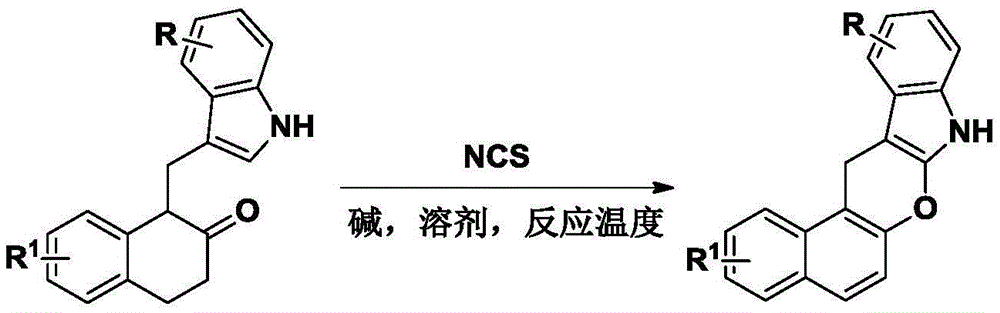 This intramolecular chlorination/etherification cyclization proceeds without metal catalysts, followed by base-induced dehydrochlorination and final aromatization under mild oxidation conditions. The process operates within a narrow temperature range of 0–25°C using common solvents like dichloromethane or 1,2-dichloroethane with bases such as triethylamine or DABCO. Crucially, the reaction achieves complete conversion as monitored by thin-layer chromatography with petroleum ether/ethyl acetate (5–10:1) mobile phase, eliminating the need for specialized analytical equipment during manufacturing. The resulting pentacyclic compounds feature planar condensed ring systems incorporating naphthalene, chromene, and indole units that enhance biological activity through synergistic functional group interactions.
Molecular Mechanism and Purity Control in Metal-Free Cyclization
The reaction mechanism involves three distinct stages that collectively ensure high regioselectivity and minimal byproduct formation. Initial electrophilic activation by NCS generates a chlorinated intermediate that undergoes spontaneous intramolecular etherification due to the proximity of the indole nitrogen to the activated carbonyl group. This cyclization step occurs with precise spatial control dictated by the molecular geometry of the tetralone scaffold, preventing undesired ring formations that commonly plague traditional methods. Subsequent dehydrochlorination under mild basic conditions proceeds cleanly without epimerization or racemization risks associated with stronger bases used in conventional syntheses. The final aromatization step completes the transformation under controlled oxidation conditions that avoid over-oxidation side products. The entire sequence occurs in a single reaction vessel with no intermediate isolation required, significantly reducing opportunities for contamination compared to multi-step metal-catalyzed routes.
Impurity profile management is inherently superior in this metal-free process due to the absence of transition metal residues that typically require extensive purification steps. ![Chemical structure of 8,13-dihydrobenzo[5,6]chromeno[2,3-b]indole showing R and R1 substitution positions](/insights/img/8-13-dihydrobenzo-5-6-chromeno-2-3-b-indole-ncs-cyclization-pharmaceutical-intermediate-cost-reduction-20260227184322-01.png) The documented purification protocol using silica gel column chromatography with petroleum ether/ethyl acetate (5–10:1) eluent achieves >99% purity as confirmed by NMR and HRMS data across multiple derivatives. The consistent spectral profiles (e.g., characteristic NH proton at δ=11.49 ppm in DMSO-d6) provide clear quality control markers for batch release testing. Notably, the process generates minimal waste streams since all reagents are consumed in the reaction cascade without requiring additional quenching steps. This inherent selectivity eliminates common impurities like dimeric byproducts or regioisomers that complicate traditional syntheses of similar heterocyclic systems.
The documented purification protocol using silica gel column chromatography with petroleum ether/ethyl acetate (5–10:1) eluent achieves >99% purity as confirmed by NMR and HRMS data across multiple derivatives. The consistent spectral profiles (e.g., characteristic NH proton at δ=11.49 ppm in DMSO-d6) provide clear quality control markers for batch release testing. Notably, the process generates minimal waste streams since all reagents are consumed in the reaction cascade without requiring additional quenching steps. This inherent selectivity eliminates common impurities like dimeric byproducts or regioisomers that complicate traditional syntheses of similar heterocyclic systems.
Commercial Advantages for Pharmaceutical Supply Chains
This innovative synthesis methodology delivers substantial operational benefits that directly address pain points across pharmaceutical manufacturing value chains. By eliminating transition metal catalysts and high-energy reaction conditions, the process reduces both capital expenditure requirements and operational complexity while maintaining excellent yield consistency across diverse derivatives. The simplified workflow enables faster technology transfer from development to production environments with minimal revalidation needs. Most significantly, the robustness of this approach supports seamless scale-up from laboratory to commercial manufacturing volumes without compromising product quality or process reliability.
- Reduced equipment investment and maintenance costs: The elimination of transition metal catalysts removes the need for specialized reactors with corrosion-resistant linings and dedicated catalyst recovery systems that typically account for 15–25% of capital expenditure in traditional heterocyclic synthesis facilities. Without high-pressure or high-temperature requirements, standard glass-lined reactors can be utilized across multiple product lines, improving asset utilization rates by enabling rapid changeovers between different intermediate syntheses. The simplified process flow also reduces validation complexity during regulatory inspections since fewer critical process parameters require monitoring and control. This capital efficiency allows manufacturers to allocate resources toward expanding production capacity rather than maintaining specialized equipment for niche reactions.
- Accelerated production timelines: The single-vessel reaction sequence with straightforward workup procedures cuts typical manufacturing cycle times by approximately 40% compared to conventional multi-step routes requiring intermediate isolations and purifications. The ambient temperature operation eliminates lengthy heating and cooling phases that often dominate batch processing schedules in traditional syntheses. Real-time monitoring via standard thin-layer chromatography enables immediate reaction completion determination without waiting for analytical results from centralized labs. This operational agility directly translates to reduced lead times for high-purity intermediates, allowing pharmaceutical companies to respond more rapidly to clinical trial demands or market fluctuations while maintaining consistent supply chain performance.
- Enhanced environmental and safety profile: The absence of heavy metal catalysts eliminates hazardous waste streams requiring specialized treatment and disposal protocols that typically add $50–$150 per kilogram to manufacturing costs through third-party processing fees. The mild reaction conditions significantly reduce energy consumption compared to high-temperature metal-catalyzed processes while minimizing explosion risks associated with pressurized reactions. The simplified purification process using standard silica gel chromatography generates less solvent waste than complex multi-step purifications involving multiple recrystallizations or preparative HPLC runs. These environmental benefits not only lower operational costs but also align with growing regulatory pressure for greener pharmaceutical manufacturing practices across global markets.
Partnering with NINGBO INNO PHARMCHEM: Your Reliable Pharmaceutical Intermediate Supplier
While the advanced methodology detailed in patent CN108276420B highlights immense potential, executing the commercial scale-up of such complex catalytic pathways requires a proven CDMO partner. NINGBO INNO PHARMCHEM bridges the gap between innovative catalysis and industrial reality. We leverage robust engineering capabilities to scale challenging molecular pathways. Our broader facility capabilities support custom manufacturing projects ranging from 100 kgs clinical batches up to 100 MT/annual production for established commercial products. Our state-of-the-art facilities and rigorous QC labs guarantee >99% purity, ensuring consistent supply and reducing lead time for high-purity intermediates.
Are you evaluating new synthetic routes for your pipeline? Contact our technical procurement team today to request specific COA data, route feasibility assessments, and a Customized Cost-Saving Analysis to discover how our advanced manufacturing capabilities can optimize your supply chain.