
Revolutionizing Aliphatic Asymmetric Thiourea Synthesis: A Green, Scalable Route for Industrial Applications
The chemical industry is currently witnessing a significant paradigm shift towards greener, more sustainable synthetic methodologies, particularly in the realm of fine chemical intermediates used for polymer additives and water treatment. Patent CN113929607A introduces a groundbreaking preparation method for aliphatic asymmetric thiourea compounds that fundamentally alters the traditional manufacturing landscape. This innovative technology replaces hazardous organic solvents with water or operates under solvent-free conditions, addressing critical environmental and safety concerns associated with legacy processes. By utilizing a unique stepwise reaction mechanism involving secondary and primary amines with carbon disulfide, the process achieves exceptional product purity levels exceeding 98.9% while drastically simplifying downstream purification. For R&D directors and procurement managers seeking reliable rubber additive suppliers, this patent represents a viable pathway to high-quality trialkyl thiourea compounds essential for rubber vulcanization accelerators and metal corrosion inhibitors. The ability to synthesize these complex molecules without generating high-COD wastewater or relying on expensive solvent recovery systems marks a substantial advancement in industrial organic synthesis efficiency.
The Limitations of Conventional Methods vs. The Novel Approach
The Limitations of Conventional Methods
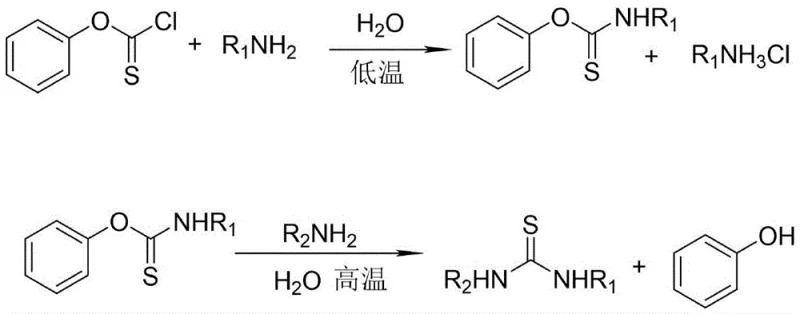
Historically, the synthesis of asymmetric thiourea compounds has been plagued by significant technical and environmental drawbacks that hinder large-scale commercial viability. Traditional routes, such as those utilizing phenoxysulfuryl chloride or substituted phenoxysulfuryl chloride, often suffer from low overall yields and generate substantial amounts of high-ammonia nitrogen and high-COD wastewater, creating a severe burden on waste treatment facilities. Furthermore, alternative methods involving the simultaneous reaction of amines with carbon disulfide in organic solvents like DMF or DMSO frequently result in the uncontrollable formation of symmetric thiourea byproducts, necessitating complex and costly purification steps such as column chromatography. The reliance on volatile organic compounds (VOCs) not only escalates production costs due to solvent recovery requirements but also poses significant occupational health and safety risks for plant operators. Additionally, the use of aromatic primary amines with nitrogen atoms directly connected to benzene rings in older protocols limits the structural diversity of the final products, restricting their applicability in specialized fields like ozone aging inhibition.
The Novel Approach
In stark contrast to these inefficient legacy processes, the novel methodology disclosed in the patent employs a strategic, stepwise addition protocol that effectively eliminates the formation of symmetric byproducts. By first reacting a secondary amine with carbon disulfide to form a stable dithiocarbamic acid intermediate, the process ensures that the thiocarbonyl group is exclusively activated for nucleophilic attack by the subsequently added primary amine. This precise control over reaction kinetics allows for the synthesis of aliphatic asymmetric thioureas with high selectivity, removing the need for energy-intensive chromatographic separation. Moreover, the substitution of toxic organic solvents with water or the complete elimination of reaction media significantly reduces the environmental footprint of the manufacturing process. The resulting crude products often possess sufficient purity for direct application after simple filtration or distillation, thereby streamlining the supply chain and reducing the lead time for high-purity polymer additives. This approach not only enhances the economic feasibility of producing rubber vulcanization accelerators but also aligns perfectly with global regulatory trends demanding cleaner chemical manufacturing practices.
Mechanistic Insights into Stepwise Dithiocarbamate Formation
The core innovation of this synthesis lies in the meticulous manipulation of nucleophilicity and reaction thermodynamics through a staged addition sequence. Initially, the secondary amine reacts with carbon disulfide at controlled low temperatures ranging from 10°C to 46°C to generate a dithiocarbamic acid salt or intermediate. This step is crucial because secondary amines generally exhibit different nucleophilic characteristics compared to primary amines, and forming this intermediate first prevents the competitive self-reaction of primary amines that would otherwise lead to symmetric urea derivatives. Once the dithiocarbamate species is fully established, the primary amine is introduced slowly into the system, where it undergoes a nucleophilic substitution or addition-elimination sequence. The subsequent heating phase, typically raised to between 60°C and 100°C, drives the elimination of hydrogen sulfide gas, pushing the equilibrium towards the formation of the stable thiourea bond. This mechanistic pathway ensures that the nitrogen atoms flanking the thiocarbonyl group originate from distinct amine sources, guaranteeing the asymmetry of the final molecule.

From an impurity control perspective, this mechanism offers superior selectivity compared to one-pot reactions where all reagents are mixed simultaneously. In conventional one-pot syntheses, the statistical probability of two primary amine molecules reacting with one carbon disulfide molecule is high, leading to significant contamination with symmetric thiourea impurities that are difficult to separate due to similar physical properties. The patented stepwise route kinetically favors the formation of the asymmetric product by pre-consuming the carbon disulfide with the secondary amine, effectively blocking the pathway for symmetric byproduct generation. Furthermore, the use of water as a reaction medium can facilitate the precipitation of certain solid intermediates or products, allowing for easy physical separation via filtration. For liquid products, the absence of high-boiling organic solvents simplifies vacuum distillation, ensuring that the final API intermediate or specialty chemical meets stringent purity specifications required by downstream users in the rubber and water treatment industries.
How to Synthesize Aliphatic Asymmetric Thiourea Efficiently
The operational simplicity of this patented process makes it highly attractive for both laboratory-scale optimization and industrial-scale production. The procedure begins with the careful mixing of a secondary amine compound, which can be a low-fat secondary amine or one containing a benzene ring not directly connected to the nitrogen atom, with carbon disulfide. This initial reaction is conducted at mild temperatures to manage the exotherm and ensure the complete formation of the dithiocarbamic acid intermediate. Following this, a primary amine compound is slowly added to the reaction mixture, allowing for a controlled interaction that minimizes side reactions. The final stage involves heating the system to drive off hydrogen sulfide, a byproduct that must be safely captured and treated, leaving behind the desired aliphatic asymmetric thiourea. Detailed standardized synthesis steps, including specific molar ratios and temperature profiles for various amine substrates, are outlined in the technical guide below.
- Mix a secondary amine compound with carbon disulfide at 10-46°C to form a dithiocarbamic acid intermediate.
- Slowly add a primary amine compound to the intermediate mixture and react at low temperature.
- Heat the system to 60-100°C to remove hydrogen sulfide and isolate the final thiourea product.
Commercial Advantages for Procurement and Supply Chain Teams
For procurement managers and supply chain heads, the adoption of this water-based synthesis route offers compelling economic and logistical benefits that directly impact the bottom line. The elimination of expensive and hazardous organic solvents like DMF and DMSO removes the capital expenditure associated with solvent recovery units and reduces the ongoing operational costs related to solvent purchase and disposal. This shift significantly lowers the variable cost of goods sold (COGS), making the final thiourea products more price-competitive in the global market. Additionally, the simplified workup procedure, which often requires only filtration or simple distillation rather than complex chromatography, drastically reduces processing time and labor costs. The ability to recycle reaction mother liquor as a medium for subsequent batches further enhances resource efficiency, minimizing raw material waste and maximizing overall process yield. These factors collectively contribute to a more resilient and cost-effective supply chain for critical rubber additives and corrosion inhibitors.
- Cost Reduction in Manufacturing: The transition to a water-based or solvent-free system eliminates the need for costly organic solvents and the energy-intensive processes required for their recovery and purification. By avoiding the use of reagents like phenoxysulfuryl chloride, which generate high volumes of saline wastewater, the process significantly reduces waste treatment expenses. The high selectivity of the reaction minimizes the loss of valuable amine raw materials to symmetric byproducts, ensuring that a greater proportion of input costs are converted into saleable high-purity product. Furthermore, the potential to operate without additional media for liquid reactants reduces the total volume of material handling, lowering utility consumption for heating and cooling.
- Enhanced Supply Chain Reliability: The raw materials required for this synthesis, primarily various aliphatic and benzyl amines along with carbon disulfide, are commodity chemicals with robust global supply chains, reducing the risk of raw material shortages. The simplified process flow, characterized by fewer unit operations and shorter reaction times, increases the throughput capacity of existing manufacturing facilities without the need for major infrastructure upgrades. The stability of the dithiocarbamic acid intermediate allows for flexible scheduling and potential semi-batch operations, providing supply chain planners with greater agility to respond to fluctuating market demands. Moreover, the reduced generation of hazardous waste simplifies regulatory compliance, mitigating the risk of production stoppages due to environmental violations.
- Scalability and Environmental Compliance: The use of water as a reaction medium provides excellent heat transfer properties, which is critical for safely managing the exothermic reaction between amines and carbon disulfide on a large scale. This thermal control capability facilitates the safe scale-up from kilogram to multi-ton production levels, ensuring consistent product quality across different batch sizes. The process inherently generates less hazardous waste compared to traditional methods, aligning with increasingly stringent global environmental regulations regarding VOC emissions and wastewater discharge. The ability to recycle mother liquor not only improves the environmental profile of the plant but also demonstrates a commitment to circular economy principles, which is increasingly valued by downstream customers in the automotive and construction sectors.
Frequently Asked Questions (FAQ)
The following questions address common technical and commercial inquiries regarding the implementation of this novel thiourea synthesis technology. These insights are derived directly from the experimental data and process descriptions found in the patent literature, providing a factual basis for evaluating the feasibility of this route for your specific application needs. Understanding these nuances is essential for R&D teams planning pilot runs and for procurement specialists assessing the long-term viability of this supply source.
Q: Why is the stepwise addition of amines critical in this synthesis?
A: Simultaneous addition of primary and secondary amines often leads to the formation of symmetric thiourea byproducts. The patented stepwise method first forms a dithiocarbamic acid intermediate with the secondary amine, ensuring that the subsequent reaction with the primary amine yields the desired asymmetric structure with purity exceeding 98.9%.
Q: What are the environmental advantages of this water-based process?
A: Unlike traditional methods requiring toxic organic solvents like DMF or DMSO, this process utilizes water or operates solvent-free. This significantly reduces VOC emissions, eliminates the need for complex solvent recovery systems, and simplifies wastewater treatment, aligning with modern green chemistry standards.
Q: Can this method be scaled for industrial production of rubber additives?
A: Yes, the process is designed for scalability. The use of water as a medium facilitates heat transfer during the exothermic reaction with carbon disulfide, and the simple filtration or distillation workup allows for efficient large-scale manufacturing of rubber vulcanization accelerators and corrosion inhibitors.
Partnering with NINGBO INNO PHARMCHEM: Your Reliable Aliphatic Asymmetric Thiourea Supplier
At NINGBO INNO PHARMCHEM, we recognize the transformative potential of this green synthesis technology in delivering high-performance additives for the rubber and water treatment industries. As a dedicated CDMO partner, we possess extensive experience scaling diverse pathways from 100 kgs to 100 MT/annual commercial production, ensuring that the theoretical benefits of this patent are fully realized in a commercial setting. Our state-of-the-art facilities are equipped to handle the specific safety requirements of carbon disulfide chemistry while maintaining stringent purity specifications through our rigorous QC labs. We are committed to providing our partners with a secure supply of high-purity aliphatic asymmetric thiourea compounds that meet the exacting standards required for critical applications like rubber vulcanization and metal corrosion inhibition.
We invite you to collaborate with us to leverage this advanced manufacturing route for your next project. Our technical team is ready to provide a Customized Cost-Saving Analysis tailored to your specific volume requirements and quality targets. Please contact our technical procurement team today to request specific COA data and route feasibility assessments, and let us demonstrate how our expertise in green chemistry can drive value and efficiency in your supply chain.