
Scalable Production of Isonicotinoyl Azide: A Breakthrough in Agrochemical Intermediate Manufacturing
Scalable Production of Isonicotinoyl Azide: A Breakthrough in Agrochemical Intermediate Manufacturing
The global demand for high-efficiency plant growth regulators necessitates robust supply chains for key precursors, among which isonicotinoyl azide plays a pivotal role. Patent CN101735144B introduces a transformative synthesis methodology that addresses the longstanding inefficiencies associated with traditional production routes. This technical disclosure outlines a novel aqueous-phase nitrosation process that eliminates the reliance on volatile organic solvents, thereby enhancing both safety profiles and economic viability for large-scale manufacturing. By optimizing reaction parameters such as temperature control and reagent stoichiometry, the patented method achieves a remarkable yield stability that was previously unattainable with legacy techniques. For R&D directors and procurement specialists, understanding this technological leap is crucial for securing a reliable isonicotinoyl azide supplier capable of meeting stringent quality and volume requirements.
The Limitations of Conventional Methods vs. The Novel Approach
The Limitations of Conventional Methods
Historically, the synthesis of isonicotinoyl azide has been plagued by operational complexities and significant safety hazards inherent to the use of organic solvents. The pioneering work by Carrana in 1953 established a baseline method involving the dissolution of isoniazid in hydrochloric acid followed by nitrosation, but critically relied on repeated extractions with diethyl ether to isolate the product. This reliance on ether not only introduced substantial fire and explosion risks due to the solvent's low flash point but also resulted in prolonged processing times ranging from three to seven days to allow for crystal precipitation. Furthermore, the Tohur modification in 1958, while attempting to improve yield through neutralization with sodium carbonate, still suffered from instability issues where excessive alkalinity led to rapid decomposition of the sensitive azide moiety. Consequently, traditional yields rarely exceeded 70%, and the inconsistency of the neutralization point made batch-to-batch reproducibility a major challenge for industrial operators. The cumulative effect of these drawbacks was a high-cost production model with a significant environmental footprint due to solvent waste.
The Novel Approach
In stark contrast to the solvent-intensive legacy protocols, the methodology described in CN101735144B leverages a purely aqueous system to drive the crystallization of the target compound directly from the reaction matrix. By meticulously controlling the concentration of hydrochloric acid between 26% and 34% and maintaining a strict molar ratio of isoniazid to acid, the process ensures complete dissolution and optimal reactivity without the need for organic co-solvents. The innovation lies in the precise neutralization step using a specific concentration of sodium carbonate solution, which triggers the immediate precipitation of high-purity white crystals without the intermediate step of liquid-liquid extraction. This direct precipitation mechanism drastically compresses the production cycle to merely 2 to 4 hours, representing a monumental shift in throughput efficiency. Moreover, the elimination of ether extraction removes the most hazardous unit operation from the workflow, aligning the process with modern green chemistry principles and significantly reducing the burden on waste treatment facilities.
Mechanistic Insights into Aqueous Phase Nitrosation
The core chemical transformation involves the diazotization of the hydrazine group of isoniazid under acidic conditions to form the acyl azide functionality, a reaction that is highly sensitive to thermal and pH variations. The mechanism proceeds through the generation of nitrous acid in situ from sodium nitrite and hydrochloric acid, which then attacks the nucleophilic nitrogen of the hydrazide. Maintaining the reaction temperature within the narrow window of 0°C to 5.0°C is absolutely critical, as temperatures exceeding 5°C accelerate the decomposition of nitrous acid and promote side reactions that degrade the azide product. The patent data indicates that operating at the optimal 2°C maximizes the conversion efficiency, ensuring that the reactive intermediate is stabilized long enough to undergo the necessary structural rearrangement without undergoing hydrolytic degradation. This thermal control is the linchpin of the process, preventing the formation of unwanted byproducts that would otherwise complicate downstream purification.
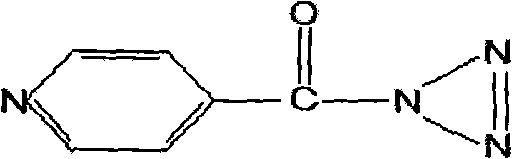
Following the nitrosation, the isolation mechanism relies on the solubility characteristics of the isonicotinoyl azide salt versus its free acid form. In the acidic medium, the product exists primarily as a soluble salt; however, upon the gradual addition of sodium carbonate solution to reach a neutral pH of 7, the solubility product is exceeded, leading to rapid nucleation and crystal growth. The patent specifies that using a sodium carbonate concentration between 10% and 19% is vital; concentrations above 19% create a localized alkaline environment that can cause the azide ring to decompose rapidly, while concentrations that are too low fail to drive the precipitation effectively. This delicate balance ensures that the product precipitates as a stable, white amorphous solid with a melting point of 43°C to 50°C, ready for simple filtration and drying. The result is a product with exceptional purity, free from the residual solvent contaminants that typically plague ether-extracted batches.
How to Synthesize Isonicotinoyl Azide Efficiently
Implementing this synthesis route requires strict adherence to the defined stoichiometric ratios and thermal boundaries to replicate the high yields reported in the patent literature. The process begins with the preparation of the acidic reaction medium, followed by the controlled addition of the nitrosating agent, and concludes with the precision neutralization that drives product isolation. Operators must utilize calibrated dosing systems to ensure the dropwise addition rates do not cause exothermic spikes that could compromise safety or yield. The following guide outlines the standardized operational framework derived from the patent examples, serving as a foundational reference for process engineers aiming to establish commercial production lines.
- Dissolve isoniazid in 26-34% hydrochloric acid solution at 0°C with a molar ratio of 1: 2.5 to 3.5.
- Dropwise add sodium nitrite solution (molar ratio 1: 1.0 to 1.5) maintaining temperature between 0°C and 5.0°C for 1-2 hours.
- Adjust pH to 7 using 10-19% sodium carbonate solution to precipitate crystals, then filter and dry.
Commercial Advantages for Procurement and Supply Chain Teams
For procurement managers and supply chain heads, the transition to this aqueous-based synthesis protocol offers profound strategic advantages that extend beyond mere technical metrics. The primary value proposition lies in the drastic simplification of the manufacturing workflow, which directly translates to reduced operational expenditures and enhanced supply reliability. By removing the need for large volumes of diethyl ether, facilities can eliminate the costly infrastructure required for solvent storage, recovery, and explosion-proof ventilation, thereby lowering the barrier to entry for production. Furthermore, the compression of the production cycle from several days to a single shift allows for significantly higher asset turnover, enabling suppliers to respond more agilely to fluctuating market demands for agrochemical intermediates. This efficiency gain is not theoretical; the patent explicitly notes a potential reduction in synthesis costs by more than 50%, a figure driven by savings in energy, solvent procurement, and labor hours.
- Cost Reduction in Manufacturing: The economic impact of eliminating organic solvents cannot be overstated, as it removes an entire category of variable costs associated with solvent purchase, distillation, and hazardous waste disposal. Traditional methods incurred heavy expenses due to the loss of ether during extraction and the energy intensity of recovering it for reuse, whereas the new method utilizes water as the primary medium, which is virtually cost-free. Additionally, the increase in yield from a maximum of 70% in older methods to a stable 97% means that nearly all raw material input is converted into saleable product, minimizing waste and maximizing return on investment for every kilogram of isoniazid purchased. These factors combine to create a substantially leaner cost structure that allows for more competitive pricing in the global market.
- Enhanced Supply Chain Reliability: From a logistics perspective, the shortened production timeline of 2 to 4 hours per batch dramatically improves the responsiveness of the supply chain. Unlike the legacy processes that tied up reactor capacity for up to a week, this rapid cycle allows for continuous or semi-continuous production schedules, ensuring that inventory levels can be replenished quickly to meet urgent orders. The stability of the yield also reduces the risk of batch failures, which are a common cause of supply disruptions in fine chemical manufacturing. By adopting this robust method, suppliers can guarantee consistent delivery schedules, providing downstream manufacturers of plant growth regulators with the certainty they need to plan their own production runs without fear of raw material shortages.
- Scalability and Environmental Compliance: The absence of volatile organic compounds (VOCs) makes this process inherently easier to scale and compliant with increasingly stringent environmental regulations. Scaling up ether-based reactions requires complex engineering controls to manage vapor pressure and explosion risks, often limiting the maximum viable batch size. In contrast, the aqueous nature of this synthesis allows for straightforward scale-up in standard glass-lined or stainless steel reactors without specialized explosion-proof modifications. The reduction in hazardous waste generation further simplifies the permitting process for new production lines and reduces the long-term liability associated with environmental compliance, making it a sustainable choice for long-term commercial operations.
Frequently Asked Questions (FAQ)
The following questions address common technical and commercial inquiries regarding the production and application of isonicotinoyl azide, based on the specific data points and operational parameters detailed in the patent documentation. Understanding these nuances is essential for technical teams evaluating the feasibility of integrating this intermediate into their existing supply chains. The answers provided reflect the consensus of the current state-of-the-art synthesis technology as validated by the experimental results in CN101735144B.
Q: What are the critical safety parameters for handling isonicotinoyl azide?
A: Isonicotinoyl azide is relatively flammable and explosive. The synthesis must be strictly maintained between 0°C and 5°C to prevent thermal decomposition and ensure stability during the nitrosation process.
Q: How does this method improve upon the traditional Carrana synthesis?
A: Unlike the Carrana method which requires extensive ether extraction and 3-7 days, this aqueous method eliminates organic solvents, reduces the cycle to 2-4 hours, and increases yield from <70% to 97%.
Q: Is this process suitable for large-scale commercial production?
A: Yes, the process is designed for industrialization. It avoids complex solvent recovery steps and uses common inorganic reagents, significantly lowering operational costs and environmental impact.
Partnering with NINGBO INNO PHARMCHEM: Your Reliable Isonicotinoyl Azide Supplier
At NINGBO INNO PHARMCHEM, we recognize that the successful commercialization of advanced agrochemicals depends on the availability of high-quality intermediates produced via efficient and safe pathways. Our technical team has thoroughly analyzed the breakthroughs presented in recent patent literature, including the aqueous nitrosation method, and we possess the extensive experience scaling diverse pathways from 100 kgs to 100 MT/annual commercial production. We are committed to delivering isonicotinoyl azide with stringent purity specifications, utilizing our rigorous QC labs to ensure that every batch meets the exacting standards required for the synthesis of potent plant growth regulators. Our facility is equipped to handle the precise temperature controls and stoichiometric additions necessary to replicate the high-yield performance described in the patent, ensuring a consistent supply for our global partners.
We invite procurement leaders and R&D directors to engage with us for a Customized Cost-Saving Analysis tailored to your specific volume requirements. By leveraging our optimized manufacturing capabilities, we can help you reduce the total cost of ownership for your raw materials while ensuring supply continuity. Please contact our technical procurement team today to request specific COA data and route feasibility assessments, and let us demonstrate how our commitment to technological excellence can drive value for your organization.