
Optimizing Triacetyl Ganciclovir Production: A Technical Breakthrough for Global Pharmaceutical Supply Chains
The pharmaceutical industry's relentless pursuit of efficient antiviral therapies has placed significant scrutiny on the manufacturing processes of key intermediates like triacetyl ganciclovir. As detailed in patent CN101463034A, a novel synthetic route has emerged that fundamentally alters the economic and technical landscape of producing this critical precursor. This technology leverages the condensation of monoacetyl guanine with a protected side chain, offering a robust alternative to legacy methods that have long plagued manufacturers with isomer contamination and yield losses. For R&D directors and procurement strategists alike, understanding the nuances of this process is essential for securing a reliable supply of high-purity pharmaceutical intermediates. The shift from diacetyl to monoacetyl starting materials represents not just a chemical tweak, but a strategic pivot towards more sustainable and cost-effective manufacturing paradigms.
Furthermore, the implications of this synthesis extend beyond the laboratory bench, influencing the entire supply chain dynamics for antiviral drug production. By addressing the root causes of impurity formation early in the synthetic sequence, this method ensures that downstream processing is streamlined, reducing the burden on purification units and minimizing solvent waste. As global demand for generic antivirals continues to rise, the ability to scale this specific condensation reaction becomes a competitive differentiator. Companies capable of mastering this route can offer substantial value to their partners through consistent quality and improved lead times. This report delves deep into the mechanistic advantages and commercial viability of this patented approach, providing a comprehensive analysis for stakeholders invested in the future of antiviral intermediate manufacturing.
The Limitations of Conventional Methods vs. The Novel Approach
The Limitations of Conventional Methods
Historically, the synthesis of triacetyl ganciclovir has relied heavily on the condensation of diacetyl guanine with protected side chains, a method exemplified by earlier patents such as EP 74306. This conventional approach suffers from a critical flaw: the presence of an acetyl group at the 9-position of the guanine ring creates significant steric hindrance, complicating the nucleophilic attack required for bond formation. More detrimentally, this method invariably leads to the formation of approximately 40% of the 7-position isomer, a structural impurity that is chemically stable and notoriously difficult to separate from the desired product. The removal of this isomer typically requires laborious purification techniques involving chloroform and methanol, which not only drives up solvent costs but also results in massive yield losses during the refinement stages. Additionally, the incomplete reaction of diacetyl guanine often leaves behind unreacted purine derivatives, further contaminating the crude product and necessitating multiple recrystallization cycles that erode overall process efficiency.
The Novel Approach
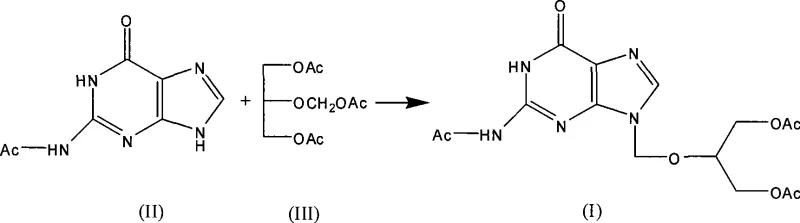
In stark contrast, the methodology disclosed in CN101463034A utilizes monoacetyl guanine as the primary nucleophile, a strategic modification that eliminates the steric bulk at the 9-position and dramatically enhances reaction selectivity. By employing monoacetyl guanine, the synthesis avoids the formation of the problematic 7-position isomer entirely, resulting in a crude product profile that is inherently cleaner and easier to purify. The reaction proceeds smoothly in polar aprotic solvents like dimethylformamide (DMF) under the catalysis of organic or mineral acids, achieving high conversion rates without the need for excessive reagent equivalents. This novel route not only simplifies the workup procedure through efficient extraction protocols but also ensures that the final triacetyl ganciclovir product achieves purity levels exceeding 98% with minimal processing. The elimination of complex isomer separation steps translates directly into reduced operational complexity and lower production costs, making this approach highly attractive for commercial scale-up.
Mechanistic Insights into Acid-Catalyzed Nucleophilic Substitution
The core of this synthetic breakthrough lies in the precise control of the nucleophilic substitution mechanism at the N9 position of the purine ring. In the presence of a strong acid catalyst such as p-toluenesulfonic acid or sulfuric acid, the oxygen atom of the acetoxy-methyl ether side chain is protonated, generating a highly reactive oxocarbenium ion intermediate. This electrophilic species is then attacked by the N9 nitrogen of the monoacetyl guanine, which acts as a potent nucleophile due to the absence of electron-withdrawing acetyl protection at that specific site. The use of polar aprotic solvents like DMF or DMSO is crucial here, as they stabilize the charged transition states and facilitate the dissolution of the polar guanine derivative, ensuring homogeneous reaction conditions. The temperature range of 100-150°C provides the necessary thermal energy to overcome the activation barrier for this substitution while maintaining the stability of the acetal protecting groups on the side chain. This delicate balance of acidity, solvent polarity, and thermal energy allows for a clean transformation that minimizes side reactions and degradation pathways often seen in harsher acidic environments.
From an impurity control perspective, the choice of monoacetyl guanine is paramount in defining the final quality of the intermediate. Unlike diacetyl guanine, which possesses two potential nucleophilic sites (N7 and N9) that can lead to regioisomeric mixtures, monoacetyl guanine directs the substitution almost exclusively to the N9 position due to electronic and steric factors. This inherent regioselectivity means that the reaction mixture contains negligible amounts of the 7-isomer, effectively solving the most persistent purification challenge associated with this class of compounds. Furthermore, the unreacted monoacetyl guanine can be easily separated from the product during the aqueous workup phase, as the differences in solubility between the starting material and the lipophilic triacetyl product are significant in ethyl acetate-water systems. This mechanistic clarity allows process chemists to design robust crystallization protocols that consistently deliver material meeting stringent pharmacopeial standards, ensuring that the subsequent hydrolysis to ganciclovir proceeds without the baggage of carryover impurities.
How to Synthesize Triacetyl Ganciclovir Efficiently
The practical implementation of this synthesis requires careful attention to molar ratios and reaction monitoring to maximize yield and purity. The patent specifies a molar ratio of monoacetyl guanine to the side chain precursor ranging from 1:1.0 to 1:5.0, with a preferred range of 1:1.2 to 1:2.0 to ensure complete consumption of the valuable guanine derivative. Catalyst loading is equally critical, typically maintained between 0.01 and 0.3 molar equivalents relative to the starting material, with p-toluenesulfonic acid hydrate being the most effective promoter for this transformation. Reaction progress is conveniently monitored via thin-layer chromatography (TLC) using a chloroform-methanol-ammonia developing system, allowing operators to determine the optimal endpoint which generally occurs between 6 and 72 hours depending on the specific temperature and solvent combination employed. Detailed standardized synthesis steps follow below to guide process replication.
- Charge monoacetyl guanine, 1,3-diacetyloxy-2-(acetyloxymethoxy)propane, and an organic solvent like DMF into a reactor equipped with agitation and temperature control.
- Add a catalytic amount of p-toluenesulfonic acid or sulfuric acid and heat the mixture to 100-150°C, maintaining the temperature for 6 to 72 hours until reaction completion.
- Remove the solvent under reduced pressure, extract the residue with ethyl acetate and water, separate the organic layer, and recrystallize the crude product to achieve >98% purity.
Commercial Advantages for Procurement and Supply Chain Teams
For procurement managers and supply chain leaders, the adoption of this monoacetyl guanine-based route offers compelling economic and logistical benefits that directly impact the bottom line. The primary advantage stems from the raw material cost structure; monoacetyl guanine requires less acetic anhydride for its preparation compared to diacetyl guanine, resulting in immediate savings on reagent costs at the very beginning of the supply chain. Moreover, the higher weight yield of triacetyl ganciclovir obtained from monoacetyl guanine means that less starting material is required to produce the same amount of final product, effectively increasing the throughput of existing manufacturing assets without the need for capital expansion. The simplified purification process, which relies on standard extraction and crystallization rather than complex chromatographic separations, drastically reduces solvent consumption and waste disposal costs, aligning with modern green chemistry initiatives and environmental compliance standards. These factors combine to create a manufacturing process that is not only cheaper but also more resilient to fluctuations in raw material availability.
- Cost Reduction in Manufacturing: The elimination of expensive and hazardous solvents like chloroform from the primary purification steps significantly lowers the operational expenditure associated with solvent recovery and waste treatment. By avoiding the formation of the 7-position isomer, the process removes the need for repetitive recrystallization cycles that traditionally result in substantial yield losses, thereby maximizing the mass balance of the valuable purine scaffold. The use of common industrial solvents like ethyl acetate and toluene further enhances cost efficiency, as these are readily available in bulk quantities at competitive prices compared to specialized halogenated solvents. Additionally, the reduced reaction time and lower catalyst loading contribute to lower utility costs per kilogram of product, creating a leaner and more profitable production model.
- Enhanced Supply Chain Reliability: The reliance on monoacetyl guanine, a simpler and more stable starting material than its diacetyl counterpart, reduces the risk of supply disruptions caused by complex upstream synthesis bottlenecks. The robustness of the reaction conditions, which tolerate a range of temperatures and catalyst types, ensures that production can continue even if specific reagents face temporary shortages, providing flexibility in sourcing strategies. The high purity of the crude product minimizes the risk of batch failures during quality control testing, ensuring a consistent flow of material to downstream API manufacturers and preventing costly delays in the drug production schedule. This reliability is crucial for maintaining long-term contracts with major pharmaceutical companies who prioritize supply security above all else.
- Scalability and Environmental Compliance: The process is inherently scalable, having been demonstrated effectively in multi-gram to kilogram batches without loss of efficiency, making it suitable for transfer to large-scale industrial reactors. The reduction in hazardous waste generation, particularly the avoidance of chlorinated solvents in the main isolation steps, simplifies environmental permitting and reduces the regulatory burden on manufacturing sites. The ability to recycle solvents like DMF and ethyl acetate further enhances the sustainability profile of the process, appealing to environmentally conscious stakeholders and investors. This alignment with strict environmental regulations ensures long-term operational continuity and mitigates the risk of shutdowns due to non-compliance issues.
Frequently Asked Questions (FAQ)
The following questions address common technical and commercial inquiries regarding the synthesis and supply of triacetyl ganciclovir, based on the detailed specifications found in the underlying patent literature. Understanding these nuances is vital for technical teams evaluating the feasibility of integrating this intermediate into their own production workflows. The answers provided reflect the consensus of current best practices in antiviral intermediate manufacturing and highlight the specific advantages of the monoacetyl route.
Q: Why is monoacetyl guanine preferred over diacetyl guanine for this synthesis?
A: Monoacetyl guanine lacks the acetyl group at the 9-position, eliminating steric hindrance during condensation and preventing the formation of difficult-to-remove 7-position isomers, thereby significantly improving selectivity and downstream purity.
Q: What catalysts are most effective for this condensation reaction?
A: Strong organic acids such as p-toluenesulfonic acid (tosic acid) or mineral acids like sulfuric acid are preferred, as they effectively promote the nucleophilic substitution without degrading the sensitive acetal side chain.
Q: How does this process impact the quality of the final Ganciclovir API?
A: By minimizing isomeric impurities and unreacted starting materials in the triacetyl intermediate, the subsequent hydrolysis step yields Ganciclovir with superior purity profiles, reducing the need for extensive and yield-loss-inducing purification steps.
Partnering with NINGBO INNO PHARMCHEM: Your Reliable Triacetyl Ganciclovir Supplier
At NINGBO INNO PHARMCHEM, we recognize that the quality of your final antiviral API is inextricably linked to the purity and consistency of your intermediates. Our technical team has extensively analyzed the pathway described in CN101463034A and possesses the expertise to execute this synthesis with precision and scale. We boast extensive experience scaling diverse pathways from 100 kgs to 100 MT/annual commercial production, ensuring that we can meet your volume requirements regardless of market fluctuations. Our facilities are equipped with rigorous QC labs and adhere to stringent purity specifications, guaranteeing that every batch of triacetyl ganciclovir we deliver meets the high standards required for pharmaceutical grade applications. We understand the critical nature of your supply chain and are committed to being a partner who delivers both technical excellence and operational reliability.
We invite you to engage with our technical procurement team to discuss how our optimized manufacturing capabilities can support your specific project needs. By requesting a Customized Cost-Saving Analysis, you can gain deeper insights into how our process efficiencies can translate into tangible financial benefits for your organization. We encourage you to reach out for specific COA data and route feasibility assessments tailored to your production timelines. Let us demonstrate how our commitment to advanced synthesis technologies can strengthen your supply chain and accelerate your path to market.