
Advanced Synthesis of Thiophene-Based Herbicide Intermediates for Commercial Scale-Up
The global demand for high-efficiency herbicides continues to drive innovation in the synthesis of heterocyclic intermediates, particularly those based on the thiophene scaffold. Patent CN1013113B, filed in 1991, presents a groundbreaking methodology for the preparation of nitrogen-substituted thiophene chloroacetamides, which serve as critical precursors in modern agrochemical formulations. This intellectual property outlines a robust synthetic pathway that transforms simple, commercially abundant starting materials into complex herbicidal active ingredients through a series of optimized condensation and oxidation steps. For R&D directors and procurement specialists alike, understanding the nuances of this patent is essential for securing a competitive edge in the agrochemical supply chain. The technology specifically addresses the challenges associated with constructing the thiophene ring system and functionalizing it with the necessary chloroacetamide moiety, offering a viable alternative to older, less efficient methods described in prior art such as British Patent 2114566A.
The Limitations of Conventional Methods vs. The Novel Approach
The Limitations of Conventional Methods
Historically, the synthesis of substituted thiophene derivatives suitable for herbicide applications has been plagued by reliance on scarce or expensive starting materials that complicate large-scale manufacturing. Prior art methods often required multi-step sequences with low overall yields, necessitating the isolation and purification of unstable intermediates which increased both operational costs and environmental waste. Traditional routes frequently employed harsh reaction conditions that were difficult to control on a metric ton scale, leading to inconsistent product quality and significant safety hazards for plant operators. Furthermore, the inability to source raw materials reliably meant that supply chains were vulnerable to market fluctuations, causing delays in the production of final agrochemical products. These conventional approaches often lacked the flexibility to accommodate various substituents on the thiophene ring, limiting the structural diversity available for new herbicide discovery programs.
The Novel Approach
In stark contrast, the methodology disclosed in CN1013113B leverages a highly efficient route starting from thiolactic acid and methacrylic acid, which are commodity chemicals available in substantial quantities globally. This novel approach streamlines the construction of the tetrahydrothiophene core through a facile cyclization process, significantly reducing the number of unit operations required to reach the key aminothiophene intermediate. By utilizing oxidizing agents such as thionyl chloride under mild conditions ranging from -30°C to +80°C, the process achieves aromatization of the ring system with high selectivity and minimal side reactions. The ability to potentially conduct the entire sequence from the ketone precursor to the final chloroacetamide in a single reactor vessel represents a paradigm shift in process intensification, drastically cutting down on solvent usage and processing time. This streamlined workflow not only enhances the economic viability of the synthesis but also aligns with modern green chemistry principles by minimizing waste generation.
Mechanistic Insights into Oxidative Dehydrogenation and Cyclization
The core chemical transformation in this patent involves the conversion of a tetrahydrothiophene-3-ylidene imine (Formula I) into an aromatic aminothiophene (Formula II) via oxidative dehydrogenation. This step is critical as it establishes the stable aromatic system required for biological activity in the final herbicide. The mechanism typically proceeds through the interaction of the imine intermediate with an oxidizing agent, such as thionyl chloride, which facilitates the removal of hydrogen atoms to form the double bonds within the five-membered ring. Alternatively, the patent describes a catalytic pathway using noble metals like platinum or palladium supported on carbon, operating at elevated temperatures above 180°C under an inert atmosphere. Both pathways effectively drive the equilibrium towards the aromatic product, but the chemical oxidation route offers distinct advantages in terms of temperature control and equipment requirements for industrial reactors.
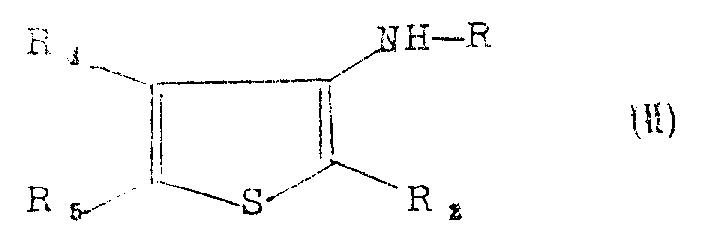
Controlling impurities during this dehydrogenation phase is paramount for ensuring the purity of the downstream herbicide intermediate. The use of thionyl chloride is particularly advantageous because it operates under moderate conditions that prevent thermal degradation of sensitive functional groups attached to the nitrogen atom or the ring carbons. The reaction generates gaseous byproducts like sulfur dioxide and hydrogen chloride, which can be easily scrubbed from the reaction mixture, driving the reaction to completion and simplifying the workup procedure. Furthermore, the specific choice of substituents, such as the C1-4 alkoxy-C2-4 alkyl group on the nitrogen, is designed to enhance the solubility and reactivity of the intermediate while remaining stable throughout the oxidative process. This precise control over the molecular architecture ensures that the resulting aminothiophene possesses the exact electronic and steric properties needed for the subsequent N-chloroacetylation step.
How to Synthesize N-(thiophen-3-yl)-chloroacetamide Efficiently
The synthesis protocol detailed in the patent provides a clear roadmap for producing high-purity herbicide intermediates suitable for commercial application. The process begins with the condensation of a tetrahydrothiophen-3-one derivative with a specific amine to form the imine, followed by the crucial oxidative dehydrogenation step discussed previously. Once the aromatic aminothiophene is secured, it undergoes N-chloroacetylation using chloroacetyl chloride to yield the final target molecule. This sequence is designed to be robust and scalable, allowing for adjustments in solvent systems and reaction times to optimize yield based on specific plant capabilities. The detailed standardized synthesis steps below outline the critical parameters for each stage to ensure reproducibility and safety.
- Condense tetrahydrothiophen-3-one with an amine to form the imine intermediate.
- Perform oxidative dehydrogenation using thionyl chloride or catalytic methods to aromatize the ring.
- React the resulting aminothiophene with chloroacetyl chloride to finalize the herbicide precursor.
Commercial Advantages for Procurement and Supply Chain Teams
For procurement managers and supply chain heads, the adoption of the synthesis route described in CN1013113B offers tangible strategic benefits that extend beyond simple chemical yield improvements. The reliance on bulk commodity chemicals like thiolactic acid and methacrylic acid as the foundational building blocks significantly de-risks the supply chain, ensuring that production is not held hostage by the availability of exotic or proprietary reagents. This accessibility translates directly into enhanced supply continuity, as these raw materials are produced by multiple manufacturers globally, fostering a competitive pricing environment that keeps input costs stable. Moreover, the simplified reaction sequence reduces the total number of processing days required per batch, allowing manufacturing facilities to increase throughput without necessitating capital expenditure on new reactor trains.
- Cost Reduction in Manufacturing: The elimination of complex isolation steps for unstable intermediates leads to substantial cost savings by reducing solvent consumption and labor hours associated with filtration and drying operations. By enabling a potential one-pot synthesis strategy, the process minimizes material transfer losses and lowers the energy demand for heating and cooling cycles across multiple vessels. The use of thionyl chloride as a dual-purpose reagent for both activation and oxidation further consolidates the bill of materials, simplifying inventory management and reducing the overall cost of goods sold. Additionally, the high selectivity of the reaction minimizes the formation of difficult-to-remove byproducts, thereby lowering the costs associated with downstream purification and waste disposal.
- Enhanced Supply Chain Reliability: Utilizing widely available starting materials ensures that production schedules are not disrupted by raw material shortages, a common pain point in the agrochemical sector. The robustness of the chemistry allows for flexible manufacturing campaigns, meaning that production can be easily scaled up or down in response to seasonal demand fluctuations for herbicides without compromising product quality. The stability of the intermediates under the described conditions also facilitates safer storage and transport if semi-finished goods need to be moved between different sites in a global supply network. This reliability is crucial for maintaining long-term contracts with major agrochemical companies who prioritize consistent delivery performance above all else.
- Scalability and Environmental Compliance: The process is inherently scalable, as demonstrated by the use of standard unit operations like distillation and reflux which are well-understood in chemical engineering. The generation of gaseous byproducts during the oxidation step allows for easy containment and neutralization using standard scrubber systems, ensuring compliance with stringent environmental regulations regarding volatile organic compounds and acidic emissions. The ability to recover and recycle unreacted starting materials, as noted in the Michael addition step for precursor synthesis, further enhances the sustainability profile of the manufacturing process. This alignment with green chemistry principles not only reduces the environmental footprint but also future-proofs the supply chain against increasingly strict regulatory frameworks governing chemical production.
Frequently Asked Questions (FAQ)
The following questions address common technical and commercial inquiries regarding the implementation of this thiophene synthesis technology. These answers are derived directly from the experimental data and claims presented in the patent documentation, providing clarity on reaction conditions and scope. Understanding these details is vital for technical teams evaluating the feasibility of integrating this route into existing manufacturing portfolios.
Q: What are the primary raw materials for this thiophene synthesis?
A: The process utilizes readily available commodity chemicals such as thiolactic acid and methacrylic acid to form the initial thiodipic acid precursor, ensuring supply chain stability.
Q: How is the aromatization of the thiophene ring achieved?
A: The patent describes effective dehydrogenation using oxidizing agents like thionyl chloride at mild temperatures (-30°C to +80°C) or catalytic dehydrogenation with platinum on carbon.
Q: Can this process be optimized for one-pot production?
A: Yes, the patent highlights that the reaction sequence from the ketone to the final chloroacetamide can potentially be conducted in the same reactor without isolating intermediate imines.
Partnering with NINGBO INNO PHARMCHEM: Your Reliable N-(thiophen-3-yl)-chloroacetamide Supplier
At NINGBO INNO PHARMCHEM, we possess extensive experience scaling diverse pathways from 100 kgs to 100 MT/annual commercial production, making us the ideal partner for bringing this advanced thiophene chemistry to market. Our state-of-the-art facilities are equipped to handle the specific reaction conditions required for the oxidative dehydrogenation and chloroacetylation steps, ensuring that every batch meets stringent purity specifications demanded by the agrochemical industry. With our rigorous QC labs and commitment to process safety, we guarantee a supply of high-purity intermediates that enable our clients to formulate effective herbicides with confidence. We understand the critical nature of crop protection timelines and are dedicated to supporting your R&D and commercial needs with unwavering reliability.
We invite you to contact our technical procurement team to request specific COA data and route feasibility assessments tailored to your project requirements. By collaborating with us, you gain access to a Customized Cost-Saving Analysis that demonstrates how implementing this patented synthesis route can optimize your manufacturing economics. Let us help you secure a sustainable and cost-effective supply chain for your next-generation agrochemical products.