
Advanced Spiro[fluorene-9,9'-xanthene] Hole Transport Materials for High-Efficiency Perovskite Solar Cells
Advanced Spiro[fluorene-9,9'-xanthene] Hole Transport Materials for High-Efficiency Perovskite Solar Cells
The rapid evolution of perovskite solar cell (PSC) technology has necessitated the development of hole transport materials (HTMs) that balance high efficiency with commercial viability, a challenge directly addressed by the innovations detailed in Chinese Patent CN112707882B. This patent introduces a novel series of organic small molecules based on an asymmetric spiro[fluorene-9,9'-xanthene] nucleus, specifically designed to overcome the inherent limitations of the industry-standard spiro-OMeTAD. By selectively binding N-(4-methoxyphenyl)-9,9'-dimethyl-9H-fluoren-2-amine (FPA) units to this unique spiro-core, the inventors have created materials like SFX-F, SFX-FM, and SFX-FP that exhibit superior hole mobility and thermal stability. For R&D directors and procurement specialists in the photovoltaic sector, this represents a critical opportunity to access high-purity electronic chemical intermediates that promise not only enhanced photoelectric conversion efficiency but also a more robust and cost-effective supply chain for next-generation solar modules.
The Limitations of Conventional Methods vs. The Novel Approach
The Limitations of Conventional Methods
Traditional hole transport materials, particularly spiro-OMeTAD, have long dominated the perovskite solar cell landscape despite suffering from significant drawbacks that hinder large-scale commercialization. The synthesis of spiro-OMeTAD is notoriously complex, involving multiple steps that require harsh reaction conditions and expensive precursors, which inevitably drives up the manufacturing cost and complicates the supply chain for reliable OLED material suppliers. Furthermore, spiro-OMeTAD exhibits relatively low hole mobility and modest thermal stability, which can lead to performance degradation over time and limit the operational lifespan of the solar devices. These factors create a bottleneck for the mass production of perovskite modules, as the high cost of the HTM layer disproportionately affects the overall levelized cost of energy, making it difficult to compete with established silicon-based technologies in the broader renewable energy market.
The Novel Approach
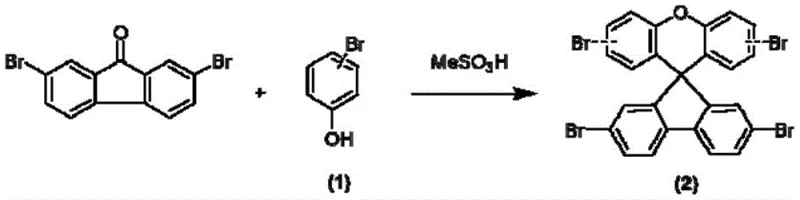
In stark contrast to conventional methods, the novel approach described in the patent utilizes a streamlined synthetic strategy centered around an asymmetric spiro[fluorene-9,9'-xanthene] core that can be constructed efficiently from readily available starting materials. The process begins with an acid-catalyzed cyclization reaction between 2,7-dibromofluorenone and phenol derivatives, a transformation that is both high-yielding and operationally simple, significantly reducing the barrier to entry for commercial scale-up of complex electronic chemicals. This core structure serves as a versatile platform for further functionalization, allowing for the precise tuning of electronic properties through the attachment of electron-donating FPA groups. The resulting materials demonstrate markedly improved glass transition temperatures and thermal decomposition profiles, ensuring that the hole transport layer remains stable under the thermal stresses encountered during device operation and encapsulation processes.
Mechanistic Insights into Buchwald-Hartwig Amination
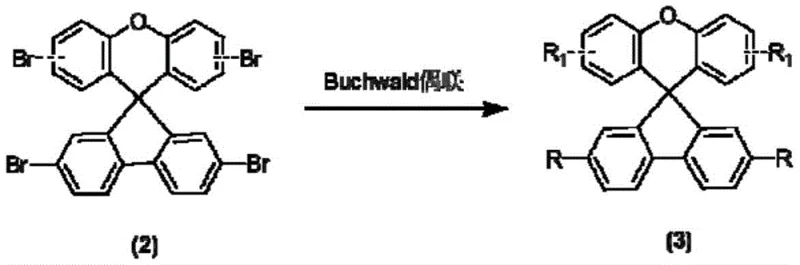
The final functionalization of the spiro-core relies on a sophisticated palladium-catalyzed Buchwald-Hartwig coupling reaction, which forms the critical carbon-nitrogen bonds necessary for hole transport functionality. This mechanistic step involves the activation of the aryl bromide sites on the spiro-intermediate by a palladium(0) species, typically generated in situ from precursors like tris(dibenzylideneacetone)dipalladium(0), followed by oxidative addition and subsequent coordination with the amine nucleophile. The use of bulky phosphine ligands, such as tri-tert-butylphosphine, is crucial for facilitating the reductive elimination step and preventing catalyst deactivation, thereby ensuring high conversion rates even with sterically hindered substrates. This catalytic cycle is highly sensitive to reaction parameters, requiring precise control over temperature and base concentration to minimize the formation of homocoupling byproducts and ensure the structural integrity of the final HTM molecule.
From an impurity control perspective, the selectivity of this coupling reaction is paramount for achieving the high purity specifications required for electronic grade materials. The patent specifies the use of anhydrous toluene as the solvent and strong bases like potassium tert-butoxide to drive the equilibrium towards the desired product while suppressing side reactions that could introduce deep trap states in the semiconductor film. By optimizing the molar ratios of the catalyst, ligand, and base, the process effectively minimizes residual palladium content, which is a critical quality attribute since trace metals can act as recombination centers and degrade device performance. This rigorous control over the reaction environment ensures that the final SFX series materials possess the clean impurity profile necessary for consistent batch-to-batch reproducibility in high-volume manufacturing settings.
How to Synthesize Spiro[fluorene-9,9'-xanthene] Derivatives Efficiently
The synthesis of these advanced hole transport materials is designed to be scalable and robust, leveraging standard organic synthesis techniques that are well-understood in the fine chemical industry. The process generally involves two main stages: first, the construction of the brominated spiro[fluorene-9,9'-xanthene] core through a condensation reaction in methanesulfonic acid, and second, the palladium-catalyzed amination to attach the charge-transporting arms. Detailed procedural parameters, including specific stoichiometric ratios, temperature ramps, and workup procedures, are critical for maximizing yield and purity, and these are comprehensively outlined in the experimental section of the patent documentation to guide process chemists in replicating the results.
- Synthesize the brominated spiro[fluorene-9,9'-xanthene] core intermediate by reacting 2,7-dibromofluorenone with phenol derivatives in methanesulfonic acid at elevated temperatures.
- Perform a Buchwald-Hartwig coupling reaction between the brominated spiro-core and N-(4-methoxyphenyl)-9,9-dimethyl-9H-fluoren-2-amine using a palladium catalyst system.
- Purify the final hole transport material via column chromatography to achieve high purity suitable for perovskite solar cell application.
Commercial Advantages for Procurement and Supply Chain Teams
For procurement managers and supply chain heads, the adoption of this new class of spiro[fluorene-9,9'-xanthene] materials offers compelling economic and logistical advantages over legacy solutions. The simplified synthetic route eliminates the need for exotic reagents and reduces the total number of unit operations, which directly translates to lower capital expenditure and operating costs for manufacturing facilities. Moreover, the reliance on commodity chemicals like phenol and fluorenone derivatives ensures a stable and diversified supply base, mitigating the risks associated with single-source dependencies that often plague the supply chains for specialized electronic materials. This resilience is crucial for maintaining continuous production schedules and meeting the demanding delivery timelines of the rapidly expanding perovskite solar market.
- Cost Reduction in Manufacturing: The streamlined synthesis pathway significantly lowers the cost of goods sold by reducing solvent consumption, energy usage, and purification complexity compared to traditional multi-step routes. By avoiding the use of expensive and hazardous reagents often required for spiro-OMeTAD synthesis, manufacturers can achieve substantial cost savings that improve the overall margin profile of the final solar modules. This economic efficiency makes the technology particularly attractive for cost reduction in electronic chemical manufacturing, enabling the production of high-performance devices at a price point that is competitive with conventional energy sources.
- Enhanced Supply Chain Reliability: The use of widely available starting materials ensures that the supply chain is less vulnerable to geopolitical disruptions or raw material shortages that can impact niche chemical sectors. The robustness of the reaction conditions allows for flexible manufacturing across different geographic locations, providing procurement teams with the leverage to negotiate better terms and secure long-term supply agreements. This reliability is essential for reducing lead time for high-purity electronic chemical intermediates, ensuring that downstream device manufacturers can maintain their production cadence without interruption.
- Scalability and Environmental Compliance: The process is inherently scalable, moving seamlessly from laboratory benchtop experiments to pilot plant and full commercial production without requiring fundamental changes to the chemistry. The use of standard solvents and the absence of heavy metal contaminants in the final product simplify waste treatment and disposal, aligning with increasingly stringent environmental regulations and sustainability goals. This ease of scale-up facilitates the commercial scale-up of complex polymer additives and small molecule HTMs, supporting the industry's transition from research prototypes to gigawatt-scale manufacturing.
Frequently Asked Questions (FAQ)
The following questions address common technical and commercial inquiries regarding the implementation of these novel hole transport materials in perovskite solar cell architectures. The answers are derived directly from the experimental data and beneficial effects reported in the patent, providing a factual basis for decision-making. Understanding these details is vital for stakeholders evaluating the feasibility of integrating SFX-series materials into their existing product lines or R&D pipelines.
Q: How does the thermal stability of SFX-FM compare to traditional spiro-OMeTAD?
A: According to patent data, the introduction of FPA groups into the xanthene unit significantly increases the glass transition and thermal decomposition temperatures, with SFX-FM showing a decomposition temperature of 445°C, which is superior for device longevity.
Q: What is the primary advantage of this synthesis route for procurement teams?
A: The synthesis utilizes readily available raw materials like phenol and 2,7-dibromofluorenone and avoids complex multi-step sequences, leading to substantially reduced production costs and simplified supply chain management compared to spiro-OMeTAD.
Q: Can these materials be scaled for commercial perovskite module production?
A: Yes, the process uses robust reaction conditions such as refluxing in toluene and standard purification methods, making it highly amenable to commercial scale-up from kilogram to metric ton quantities without requiring exotic reagents.
Partnering with NINGBO INNO PHARMCHEM: Your Reliable Spiro[fluorene-9,9'-xanthene] Supplier
As a leader in the fine chemical sector, NINGBO INNO PHARMCHEM is uniquely positioned to support the commercialization of these advanced hole transport materials through our extensive experience scaling diverse pathways from 100 kgs to 100 MT/annual commercial production. Our state-of-the-art facilities are equipped to handle the specific requirements of electronic chemical synthesis, including strict moisture control and advanced purification capabilities to meet stringent purity specifications. We understand that the transition from lab-scale innovation to industrial reality requires a partner who can navigate the complexities of process optimization, regulatory compliance, and quality assurance with precision and dedication.
We invite you to engage with our technical procurement team to discuss how we can tailor our manufacturing capabilities to your specific needs. By requesting a Customized Cost-Saving Analysis, you can gain deeper insights into the economic benefits of switching to our spiro[fluorene-9,9'-xanthene] derivatives. We encourage potential partners to contact us directly to obtain specific COA data and route feasibility assessments, ensuring that your next generation of perovskite solar cells is built on a foundation of high-quality, reliable, and cost-effective materials.