
Advanced Synthesis of Pyrazole Disulfide Intermediates for Commercial Scale Agrochemical Production
The global demand for high-efficacy insecticides continues to drive innovation in the synthesis of critical agrochemical intermediates, specifically within the phenylpyrazole class. Patent CN113149909B, published in April 2022, introduces a transformative preparation method for 5-amino-3-cyano-1-(2,6-dichloro-4-trifluoromethyl-phenyl) pyrazole disulfide, a pivotal precursor in the manufacturing of Fipronil. This technical breakthrough addresses long-standing inefficiencies in traditional halogenation processes by replacing hazardous neutralization steps with a streamlined vacuum distillation protocol. For R&D directors and procurement specialists, this patent represents a significant leap forward in process safety and environmental compliance, offering a robust alternative to legacy methods that rely heavily on liquid ammonia and hygroscopic solvents. The methodology detailed herein not only enhances the purity profile of the final disulfide product but also optimizes the overall mass balance of the reaction system.
The Limitations of Conventional Methods vs. The Novel Approach
The Limitations of Conventional Methods
Historically, the synthesis of this specific pyrazole disulfide has been plagued by operational complexities and environmental burdens inherent to the use of acetonitrile-chlorobenzene mixed solvent systems. As documented in prior art such as WO0130760A1, conventional routes necessitate the use of liquid ammonia to neutralize residual hydrogen chloride generated during the reaction, creating substantial safety hazards and wastewater treatment challenges. Furthermore, the high polarity of acetonitrile leads to significant water absorption during solvent recovery cycles, complicating the recycling process and increasing energy costs for drying and purification. These factors collectively result in a production environment that is difficult to scale sustainably, often yielding crude products with purity levels around 98.4% that require extensive downstream processing to meet stringent pharmaceutical or agrochemical standards. The reliance on such volatile and moisture-sensitive conditions imposes a heavy burden on supply chain reliability and operational expenditure.
The Novel Approach
The innovative strategy outlined in patent CN113149909B fundamentally reengineers the reaction medium by utilizing a mixed solvent system comprising tetrahydrofuran and a non-polar solvent such as dichloromethane or chlorobenzene. This strategic shift effectively mitigates the hygroscopic issues associated with pure acetonitrile, allowing for more efficient solvent recovery and direct reuse without intensive drying procedures. Crucially, the new process eliminates the need for liquid ammonia neutralization entirely; instead, the hydrogen chloride byproduct is removed concurrently with the solvent via vacuum distillation, significantly reducing the generation of hazardous waste streams. By optimizing the mass ratio of reactants and controlling the temperature profile during the addition of sulfur monochloride, this method achieves a refined product purity exceeding 99% with yields surpassing 90%, demonstrating a clear superiority in both chemical efficiency and environmental stewardship compared to established industrial practices.
Mechanistic Insights into Sulfur Monochloride-Mediated Halogenation
The core chemical transformation in this synthesis involves the oxidative coupling of the pyrazole thiol precursor using sulfur monochloride ($S_2Cl_2$) to form the critical disulfide bond. In the optimized protocol, the reaction is initiated at low temperatures, typically between -5°C and 20°C, to control the exothermic nature of the halogenation and prevent the degradation of sensitive functional groups on the pyrazole ring. The presence of tetrahydrofuran in the solvent mix plays a dual role: it acts as a solubilizing agent for the polar pyrazole substrate while moderating the reactivity of the sulfur species to minimize over-chlorination side reactions. As the reaction progresses and the temperature is raised to the 30-40°C range, the kinetics favor the formation of the symmetric disulfide linkage, ensuring high conversion rates while maintaining the integrity of the cyano and amino substituents essential for biological activity.
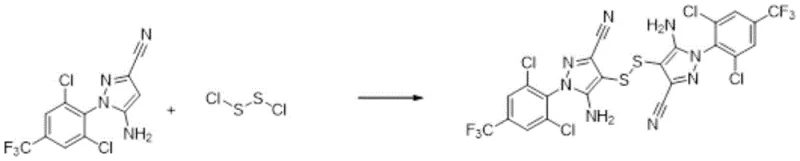
Impurity control is meticulously managed through a multi-stage purification sequence that targets specific byproducts such as unreacted hydrosulfides and polysulfides. The initial vacuum distillation step not only recovers the valuable solvent matrix but also strips out volatile acidic components, preventing them from catalyzing decomposition during storage. Subsequent crystallization steps utilize specific non-polar solvents to precipitate the target disulfide while leaving soluble impurities in the mother liquor. The final pulping refinement with acetonitrile is particularly effective at dissolving residual sulfhydryl compounds, which are often the most persistent contaminants in sulfur chemistry. This rigorous approach to impurity profiling ensures that the final active ingredient meets the strict specifications required for registration in major agricultural markets, providing R&D teams with a reliable source of high-quality material for formulation development.
How to Synthesize 5-amino-3-cyano-1-(2,6-dichloro-4-trifluoromethyl-phenyl) pyrazole disulfide Efficiently
Implementing this synthesis route requires precise adherence to the solvent ratios and thermal profiles defined in the patent to maximize yield and safety. The process begins with the dissolution of the starting pyrazole material in a carefully balanced mixture of tetrahydrofuran and dichloromethane, followed by the controlled addition of sulfur monochloride under inert atmosphere conditions. Operators must maintain strict temperature control during the exothermic addition phase to prevent runaway reactions, after which the mixture is heated to facilitate complete conversion. The subsequent workup involves a sophisticated distillation protocol to separate the product from the solvent and acid gases, followed by a two-step crystallization and pulping regimen to achieve the final purity specifications. Detailed standard operating procedures for each unit operation are critical for ensuring batch-to-batch consistency and regulatory compliance.
- Dissolve the pyrazole precursor in a mixed solvent of tetrahydrofuran and a non-polar solvent like dichloromethane, then cool and add sulfur monochloride dropwise.
- Heat the reaction mixture to 30-40°C to complete the halogenation, then perform vacuum distillation to recover solvents and remove hydrogen chloride gas.
- Purify the residue through a two-stage process involving crystallization with a single non-polar solvent followed by pulping refinement with acetonitrile.
Commercial Advantages for Procurement and Supply Chain Teams
For procurement managers and supply chain leaders, the adoption of this patented technology offers tangible benefits in terms of cost structure and operational resilience. By eliminating the requirement for liquid ammonia, facilities can avoid the capital expenditure and ongoing safety costs associated with storing and handling hazardous anhydrous gases, leading to a safer working environment and reduced insurance premiums. The improved solvent recovery efficiency directly translates to lower raw material consumption per kilogram of product, as the non-polar solvent mix is less prone to contamination and easier to recycle than traditional acetonitrile-heavy systems. This reduction in consumable usage, combined with the higher overall yield of the process, results in a significantly lowered cost of goods sold, making the final agrochemical intermediate more competitive in the global marketplace without compromising on quality standards.
- Cost Reduction in Manufacturing: The economic advantages of this process are driven primarily by the simplification of the downstream processing workflow and the elimination of expensive neutralization reagents. By removing the liquid ammonia step, manufacturers save on both the cost of the reagent itself and the specialized equipment needed for its safe deployment and scrubbing. Furthermore, the ability to recover and reuse the solvent mixture with minimal degradation reduces the volume of fresh solvent required, substantially lowering variable production costs. The higher yield achieved through optimized reaction conditions means that less starting material is wasted, further enhancing the overall economic efficiency of the manufacturing campaign.
- Enhanced Supply Chain Reliability: From a logistics perspective, the simplified process flow reduces the number of critical dependencies and potential bottlenecks in the production schedule. The avoidance of hazardous materials like liquid ammonia minimizes the risk of regulatory shutdowns or transportation delays that can disrupt supply continuity. Additionally, the robustness of the reaction against moisture ingress, thanks to the modified solvent system, allows for more flexible manufacturing windows and reduces the likelihood of batch failures due to environmental factors. This stability ensures a consistent flow of high-purity intermediates to downstream formulators, strengthening the reliability of the entire agrochemical supply chain.
- Scalability and Environmental Compliance: The design of this synthesis route is inherently scalable, utilizing standard unit operations such as distillation and crystallization that are easily adapted from pilot to commercial scale. The significant reduction in hazardous waste generation, particularly the elimination of ammonia-containing wastewater, aligns perfectly with increasingly stringent global environmental regulations. This 'green chemistry' approach not only future-proofs the manufacturing asset against tightening emission standards but also enhances the corporate sustainability profile, which is becoming a key differentiator in B2B procurement decisions for multinational agrochemical companies seeking responsible partners.
Frequently Asked Questions (FAQ)
The following questions address common technical and commercial inquiries regarding the implementation of this advanced synthesis technology. These insights are derived directly from the experimental data and claims presented in patent CN113149909B, providing a factual basis for evaluating the feasibility of adopting this route for commercial production. Understanding these nuances is essential for technical teams assessing the transition from legacy processes to this more efficient and environmentally friendly methodology.
Q: How does the new solvent system improve upon traditional acetonitrile-based methods?
A: The patented method replaces the traditional acetonitrile/chlorobenzene mix with a tetrahydrofuran and non-polar solvent blend. This significantly reduces water absorption during solvent recovery, simplifying the recycling process and lowering energy consumption compared to the hygroscopic nature of pure acetonitrile systems.
Q: What are the purity and yield benchmarks for this synthesis route?
A: According to the experimental data in patent CN113149909B, this optimized route achieves a refined product purity exceeding 99% and a yield greater than 90%, outperforming prior art methods which typically struggle to balance high yield with the removal of sulfhydryl byproducts.
Q: Does this process eliminate the need for hazardous neutralization agents?
A: Yes, a key advantage of this technology is the elimination of liquid ammonia for neutralization. Instead, hydrogen chloride byproduct is removed directly via vacuum distillation alongside solvent recovery, drastically reducing environmental pressure and safety risks associated with handling anhydrous ammonia.
Partnering with NINGBO INNO PHARMCHEM: Your Reliable 5-amino-3-cyano-1-(2,6-dichloro-4-trifluoromethyl-phenyl) pyrazole disulfide Supplier
At NINGBO INNO PHARMCHEM, we recognize the critical importance of securing a stable and high-quality supply of key agrochemical intermediates like 5-amino-3-cyano-1-(2,6-dichloro-4-trifluoromethyl-phenyl) pyrazole disulfide. Our technical team possesses extensive experience scaling diverse pathways from 100 kgs to 100 MT/annual commercial production, ensuring that we can meet the volumetric demands of global crop protection leaders. We operate stringent purity specifications and maintain rigorous QC labs equipped with advanced analytical instrumentation to guarantee that every batch meets the exacting standards required for Fipronil synthesis. Our commitment to process excellence allows us to deliver materials that consistently exceed industry benchmarks for purity and impurity profiles.
We invite you to engage with our technical procurement team to discuss how our capabilities align with your specific supply chain requirements. By requesting a Customized Cost-Saving Analysis, you can gain a deeper understanding of the economic benefits of switching to our optimized manufacturing route. We encourage potential partners to contact us directly to obtain specific COA data and route feasibility assessments, ensuring that your next project is built on a foundation of technical reliability and commercial viability.