
Advanced Manufacturing of Oseltamivir Intermediates: A Metal Halide Catalyzed Breakthrough for Global Supply Chains
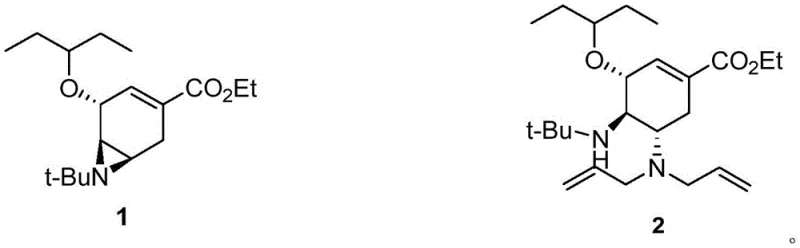
The pharmaceutical industry's relentless pursuit of efficient antiviral therapies has placed oseltamivir phosphate at the forefront of global health strategies, necessitating robust and scalable synthetic routes for its key intermediates. Patent CN114478290A introduces a transformative synthesis method that addresses critical bottlenecks in the production of ethyl (3R,4R,5S)-4-(tert-butylamine)-5-(dienylamino)-3-(pent-3-oxy)cyclohex-1-ene-1-carboxylate, a pivotal building block in the oseltamivir value chain. This innovation leverages the unique coordination chemistry of metal halides to catalyze the ring-opening of aziridine precursors, marking a significant departure from hazardous and inefficient legacy processes. By integrating a strategic salt-formation step directly into the workflow, this technology not only enhances the chemical purity and stability of the final intermediate but also streamlines the purification landscape, offering a compelling value proposition for manufacturers seeking to optimize their antiviral API supply chains.
The Limitations of Conventional Methods vs. The Novel Approach
The Limitations of Conventional Methods
Historically, the synthesis of this critical oseltamivir intermediate has been plagued by severe safety hazards and operational inefficiencies that hinder large-scale commercial viability. Prior art methodologies frequently relied on azide nucleophilic substitution reactions, which involve the handling of first-class explosive dangerous articles, posing unacceptable risks for industrial mass production environments. Alternative routes utilizing strong acid catalysts suffered from intense corrosivity and notoriously low yields, while methods employing sulfonic acids, such as 10-camphorsulfonic acid, often resulted in the formation of stubborn brown oily impurities. These traditional approaches typically necessitated rigorous and costly purification steps, specifically silica gel column chromatography, to achieve acceptable purity levels, thereby creating significant bottlenecks in throughput and driving up the cost of goods sold due to material loss and solvent consumption.
The Novel Approach
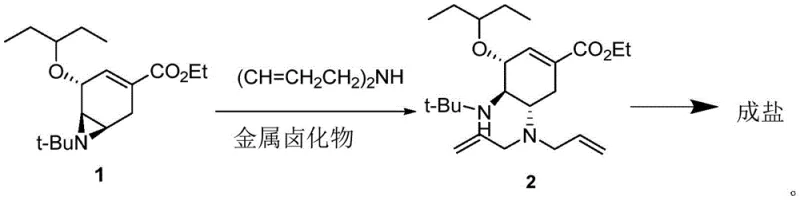
In stark contrast, the methodology disclosed in CN114478290A utilizes a Lewis acid metal halide catalyst system that operates under remarkably mild conditions, effectively circumventing the thermal degradation and side reactions associated with high-temperature sulfonic acid catalysis. The process initiates by forming a reactive complex between the metal halide and diallylamine, which then facilitates a highly selective ring-opening reaction with the aziridine precursor at temperatures ranging strictly between 20°C and 70°C. This controlled reactivity profile prevents the formation of genotoxic impurities and polymeric byproducts, ensuring a cleaner reaction profile. Furthermore, the strategic conversion of the reaction product into a stable salt form immediately post-synthesis allows for the isolation of high-purity material through simple crystallization and filtration, completely eliminating the need for resource-intensive column chromatography.
Mechanistic Insights into Metal Halide-Catalyzed Ring Opening
The core of this technological advancement lies in the sophisticated interplay between the metal halide catalyst and the amine nucleophile, which creates a highly active yet controlled species capable of precise stereochemical manipulation. The metal halide, acting as a Lewis acid, coordinates with the nitrogen atom of the diallylamine to generate a transient complex that enhances the nucleophilicity of the amine while simultaneously activating the aziridine ring of Compound 1 towards attack. This dual activation mechanism lowers the activation energy required for the ring-opening event, allowing the reaction to proceed efficiently at significantly lower temperatures compared to protonic acid catalysts. The preservation of the delicate stereocenters at the 3, 4, and 5 positions of the cyclohexene ring is critical for the biological activity of the final oseltamivir API, and this catalytic system demonstrates exceptional fidelity in maintaining the required (3R,4R,5S) configuration throughout the transformation.
Impurity control is further engineered through the thermodynamic stability imparted by the final salt formation step, which serves as a powerful purification driver. In conventional free-base syntheses, the product often exists as an oil that traps solvent and side products, leading to the notorious "brown oil" phenomenon described in prior art. By introducing an acid, such as hydrochloric acid or methanesulfonic acid, in an ethanol solution, the basic amine product is converted into a crystalline salt. This phase change from oil to solid crystal lattice inherently excludes non-ionic impurities and unreacted starting materials, effectively acting as a self-purifying mechanism. The result is a product with HPLC purity consistently exceeding 98.5% directly from the reactor workup, demonstrating a level of process robustness that is essential for meeting the stringent regulatory requirements of global pharmaceutical markets.
How to Synthesize Oseltamivir Intermediate Efficiently
The practical implementation of this synthesis route requires careful attention to temperature gradients and stoichiometric ratios to maximize the efficiency of the metal halide complex formation. Operators must first establish an inert atmosphere to prevent moisture interference with the Lewis acid catalyst, followed by the controlled addition of diallylamine to the metal halide suspension at low temperatures to ensure stable complexation. Once the complex is formed, the introduction of the aziridine substrate must be managed to maintain the exotherm within safe limits, followed by a sustained heating period to drive the reaction to completion. The subsequent workup involves a sequence of acid washing to remove residual metal species, drying to eliminate water, and finally, the critical salification step which precipitates the pure product. For a comprehensive breakdown of the specific operational parameters and safety protocols, please refer to the standardized synthesis guide below.
- React a metal halide (e.g., Zinc Chloride) with diallylamine in an organic solvent at low temperatures (-10 to 20°C) to form a catalytic complex.
- Introduce the aziridine precursor (Compound 1) to the complex and heat the mixture to 20-70°C to facilitate ring-opening and nucleophilic substitution.
- Perform post-reaction workup involving acid washing, drying, and concentration, followed by salification with an acid ethanol solution to isolate the high-purity product salt.
Commercial Advantages for Procurement and Supply Chain Teams
For procurement managers and supply chain directors, the adoption of this metal halide catalyzed process represents a strategic opportunity to de-risk the supply of critical antiviral intermediates while simultaneously driving down manufacturing costs. The elimination of silica gel column chromatography is perhaps the most significant economic driver, as this unit operation is notoriously expensive, solvent-intensive, and difficult to scale beyond kilogram quantities in a GMP environment. By replacing this batch-dependent purification with a crystallization-based isolation, the process becomes inherently more scalable, allowing for the transition from pilot plant batches to multi-ton commercial production without the need for proportional increases in purification infrastructure or solvent recovery capacity.
- Cost Reduction in Manufacturing: The economic benefits of this route are derived primarily from the drastic simplification of the downstream processing workflow. By removing the requirement for column chromatography, manufacturers can achieve substantial savings in silica gel procurement, solvent consumption, and waste disposal costs. Additionally, the higher reaction yields observed with metal halide catalysts compared to sulfonic acid methods mean that less raw material is required to produce the same amount of finished intermediate, directly improving the overall material efficiency and reducing the cost per kilogram of the active pharmaceutical ingredient.
- Enhanced Supply Chain Reliability: From a supply continuity perspective, the use of commercially available and stable metal halides like zinc chloride or magnesium chloride offers a distinct advantage over specialized chiral acids or hazardous azides which may face supply constraints or regulatory scrutiny. The milder reaction conditions also reduce the wear and tear on reactor vessels and associated equipment, minimizing unplanned maintenance downtime. Furthermore, the ability to produce a stable salt form of the intermediate ensures longer shelf-life and easier logistics, reducing the risk of product degradation during transit and storage.
- Scalability and Environmental Compliance: The environmental footprint of this synthesis is significantly reduced due to the lower energy requirements associated with moderate reaction temperatures and the decreased volume of organic solvents needed for purification. This aligns perfectly with modern green chemistry initiatives and helps pharmaceutical companies meet their sustainability goals. The process generates less hazardous waste, particularly by avoiding azide residues, simplifying the effluent treatment process and ensuring compliance with increasingly strict environmental regulations regarding toxic waste discharge.
Frequently Asked Questions (FAQ)
The following questions address common technical and commercial inquiries regarding the implementation of this novel synthesis route, drawing directly from the experimental data and comparative analysis provided in the patent literature. Understanding these nuances is vital for technical teams evaluating the feasibility of technology transfer and for commercial teams assessing the long-term viability of this supply source.
Q: Why is the metal halide catalyzed method superior to traditional camphorsulfonic acid catalysis?
A: The metal halide method operates at significantly milder temperatures (20-70°C vs 120°C) and avoids the formation of difficult-to-remove brown oily impurities. Crucially, it allows for direct salt formation, eliminating the need for silica gel column chromatography while achieving purities exceeding 98%.
Q: What safety advantages does this route offer over azide-based synthesis?
A: Traditional routes often utilize azide nucleophilic substitution, which involves first-class explosive hazardous materials unsuitable for large-scale industrial production. This novel method utilizes stable metal halides and amines, drastically reducing explosion risks and enhancing operational safety.
Q: How does the salt formation step impact product stability?
A: Converting the free base intermediate into a salt form (e.g., hydrochloride or maleate) significantly improves the chemical stability and physical handling properties of the oseltamivir intermediate, preventing degradation during storage and simplifying downstream processing.
Partnering with NINGBO INNO PHARMCHEM: Your Reliable Oseltamivir Intermediate Supplier
At NINGBO INNO PHARMCHEM, we recognize that the transition from laboratory innovation to commercial reality requires a partner with deep technical expertise and robust manufacturing capabilities. As a leading CDMO, we possess extensive experience scaling diverse pathways from 100 kgs to 100 MT/annual commercial production, ensuring that the promising metrics of patent CN114478290A can be fully realized in a GMP-compliant setting. Our state-of-the-art facilities are equipped with rigorous QC labs capable of verifying stringent purity specifications, guaranteeing that every batch of oseltamivir intermediate meets the exacting standards required for global regulatory submissions.
We invite forward-thinking pharmaceutical partners to collaborate with us to leverage this advanced catalytic technology for their antiviral portfolios. By engaging with our technical procurement team, you can request a Customized Cost-Saving Analysis tailored to your specific volume requirements, alongside specific COA data and route feasibility assessments. Let us help you secure a stable, high-quality supply of this critical intermediate, enabling you to focus on delivering life-saving medications to patients worldwide with confidence and efficiency.