
Advanced Manufacturing of High-Purity Cyproconazole: A Scalable Solution for Global Agrochemical Supply Chains
Introduction to Advanced Cyproconazole Manufacturing
The global demand for high-efficacy fungicides continues to drive innovation in agrochemical intermediate synthesis, particularly for sterol demethylation inhibitors like cyproconazole. Patent CN101565406B discloses a groundbreaking preparation process that addresses the critical bottlenecks of traditional manufacturing methods, specifically focusing on achieving high purity and yield while maintaining environmental compliance. This technical breakthrough is pivotal for supply chain stakeholders who require reliable agrochemical intermediate suppliers capable of delivering consistent quality at an industrial scale. The disclosed method transforms the synthesis landscape by introducing a novel purification strategy that bypasses the need for resource-intensive chromatographic separation, thereby enhancing the overall economic feasibility of producing this vital crop protection agent.
Furthermore, the significance of this patent extends beyond mere laboratory optimization; it represents a viable pathway for commercial scale-up of complex agrochemical intermediates. By re-engineering the purification sequence to rely on differential salt solubility rather than physical adsorption, the process ensures that the final product meets stringent purity specifications exceeding 97% content. This level of purity is essential for formulators who need to guarantee the efficacy and safety of the final fungicidal products applied to important cash crops. For procurement managers and technical directors, understanding the mechanistic underpinnings of this process is key to evaluating its potential for long-term cost reduction in agrochemical manufacturing and supply chain stability.
The Limitations of Conventional Methods vs. The Novel Approach
The Limitations of Conventional Methods
Historically, the synthesis of cyproconazole has been plagued by significant technical and economic hurdles that hindered its widespread industrial adoption. Traditional routes, as referenced in earlier patents such as U.S. Pat 4664696 and German patent DE 3406993, typically relied heavily on excessive consumption of sulfur ylide reagents during the epoxidation stage, leading to substantial environmental contamination and inflated raw material costs. Moreover, the crude products obtained from these conventional methods often contained high levels of isomeric impurities, specifically the 1,3,4-triazole derivative, which possesses physicochemical properties remarkably similar to the target molecule. Separating these impurities traditionally required laborious and expensive silica gel column chromatography followed by multiple rounds of recrystallization, a practice that is notoriously difficult to scale and results in significant product loss.
The Novel Approach
In stark contrast, the novel approach detailed in the patent data introduces a sophisticated chemical purification technique that elegantly circumvents the need for chromatographic separation. By leveraging the distinct chemical behaviors of the target cyproconazole and its major impurities when exposed to mineral acids, the process achieves separation through selective salification. The target molecule forms a stable salt that can be easily filtered and washed, while the impurities remain in the solution or form unstable salts that are removed during the washing phase. This strategic shift from physical separation to chemical differentiation not only drastically simplifies the unit operations but also significantly improves the total molar yield to approximately 80%, ensuring that the manufacturing process is both economically robust and environmentally sustainable for large-scale production facilities.
Mechanistic Insights into Salification-Based Purification
The core innovation of this synthesis route lies in the precise control of triazole isomer formation and the subsequent exploitation of their salt properties. Cyproconazole is a 1,2,4-triazole derivative, whereas the primary impurity is a 1,3,4-triazole isomer. While these molecules are structurally analogous, their nitrogen atom arrangements confer different basicities and stabilities to their corresponding acid salts. During the condensation reaction, the process utilizes specific catalysts and polar solvents to favor the formation of the 1,2,4-isomer, but more importantly, the downstream salification step acts as a powerful filter. When the crude mixture is treated with a mineral acid such as hydrochloric acid in a chlorinated solvent, the cyproconazole precipitates as a hydrochloride salt due to its lower solubility in that specific medium compared to the impurity salt.
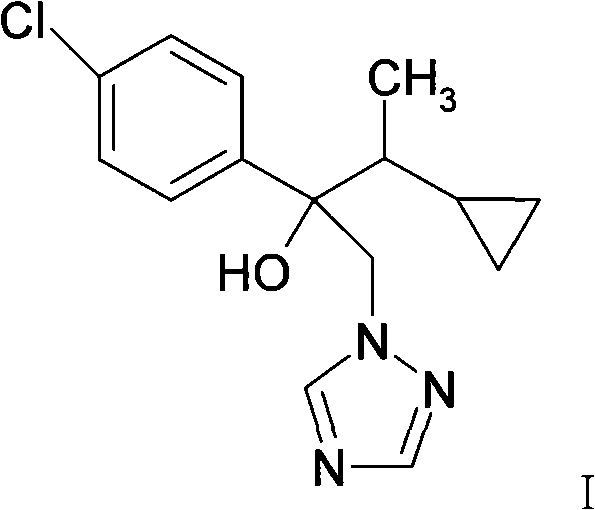
Following the isolation of the salt, the final deacidification step involves heating the salt in water, which regenerates the free base form of cyproconazole. This step is critical because the impurity salts, being less stable or having different hydrolysis profiles, do not regenerate into the solid product as efficiently or are washed away during the neutralization and filtration process. This mechanism ensures that the final white solid obtained is of high purity, typically above 97%, without the need for further recrystallization. For R&D directors, this mechanistic understanding highlights the robustness of the process against batch-to-batch variability, as the chemical separation is driven by fundamental thermodynamic properties rather than the kinetic nuances of chromatography.
How to Synthesize Cyproconazole Efficiently
The synthesis of cyproconazole via this patented route involves a sequence of well-defined chemical transformations starting from 1-(4-chlorophenyl)-2-cyclopropyl-1-acetone. The process begins with an epoxidation reaction using a sulfur ylide reagent generated in situ, followed by a condensation reaction with 1,2,4-triazole in a polar aprotic solvent. The critical purification occurs in the subsequent steps where the crude product is converted into a salt and then regenerated. This methodology is designed to be operationally simple and safe, avoiding the hazards associated with large-scale chromatography. The detailed standardized synthesis steps, including specific reagent ratios, temperature controls, and reaction times, are outlined in the guide below to ensure reproducibility and optimal yield.
- Perform epoxidation of 1-(4-chlorophenyl)-2-cyclopropyl-1-acetone using a sulfur ylide reagent in a weak polarity solvent with alkali to form the epoxy intermediate.
- Conduct condensation reaction with 1,2,4-triazole in a polar solvent (e.g., DMF) using a catalyst like potassium hydroxide to generate the crude cyproconazole.
- Purify the crude product by forming a salt with mineral acid (e.g., HCl), filtering the stable salt, and subsequently deacidifying with water to obtain the high-purity finished product.
Commercial Advantages for Procurement and Supply Chain Teams
For procurement managers and supply chain heads, the transition to this novel manufacturing process offers profound strategic advantages that directly impact the bottom line and operational reliability. The elimination of silica gel chromatography is perhaps the most significant value driver, as chromatography is a major bottleneck in fine chemical manufacturing that limits throughput and escalates costs due to high solvent and media consumption. By replacing this step with a scalable crystallization and filtration protocol, the process enables true commercial scale-up of complex agrochemical intermediates, allowing suppliers to meet large volume demands without the risk of production delays associated with batch purification bottlenecks.
- Cost Reduction in Manufacturing: The economic benefits of this process are derived from the drastic simplification of the purification workflow. By removing the requirement for expensive silica gel and the associated large volumes of elution solvents, the direct material costs are significantly lowered. Furthermore, the improved total molar yield of around 80% means that less raw material is wasted per kilogram of finished product, effectively reducing the cost of goods sold. The avoidance of multiple recrystallization steps also saves energy and labor costs, contributing to a more competitive pricing structure for the final active ingredient.
- Enhanced Supply Chain Reliability: Supply chain continuity is often threatened by complex purification steps that are prone to failure or variability. This robust synthetic route enhances reliability by utilizing standard unit operations such as filtration, washing, and drying, which are easily automated and controlled in a GMP-compliant facility. The use of readily available raw materials and common solvents like DMF and chloroform ensures that the supply chain is not dependent on exotic or scarce reagents, thereby reducing lead time for high-purity fungicides and mitigating the risk of raw material shortages.
- Scalability and Environmental Compliance: From an environmental and regulatory perspective, this process aligns with modern green chemistry principles by minimizing waste generation. The reduction in solvent usage and the elimination of silica gel waste streams simplify wastewater treatment and hazardous waste disposal, lowering the environmental compliance burden. This makes the process highly scalable, as it avoids the physical limitations of column chromatography which cannot be easily expanded to multi-ton production scales, ensuring a sustainable and continuous supply of high-quality cyproconazole for the global market.
Frequently Asked Questions (FAQ)
The following questions address common technical and commercial inquiries regarding the production of cyproconazole using this advanced methodology. These insights are derived directly from the patent specifications and are intended to clarify the operational benefits and chemical principles for potential partners and technical evaluators. Understanding these details is crucial for assessing the feasibility of integrating this supply source into your existing manufacturing or formulation pipelines.
Q: How does this process remove the major 1,3,4-triazole isomer impurity?
A: The process utilizes a selective salification step where the target cyproconazole (1,2,4-triazole derivative) forms a stable salt with mineral acids, while the major impurity (1,3,4-triazole derivative) forms a less stable salt with significantly different solubility properties, allowing for effective separation via filtration and washing without chromatography.
Q: Why is silica gel chromatography avoided in this manufacturing route?
A: Silica gel chromatography is impractical for industrial scale-up due to high costs, solvent consumption, and low throughput. This novel method replaces it with a chemical purification strategy (salification and recrystallization from water), making the process economically viable for ton-scale production.
Q: What represents the key cost-saving advantage of this synthesis method?
A: The primary cost savings arise from eliminating the need for repeated recrystallizations and expensive column chromatography, alongside optimized reagent usage in the epoxidation step, resulting in a higher total molar yield of approximately 80% and reduced waste treatment costs.
Partnering with NINGBO INNO PHARMCHEM: Your Reliable Cyproconazole Supplier
At NINGBO INNO PHARMCHEM, we recognize the critical importance of efficient and scalable synthesis routes in the modern agrochemical industry. As a premier CDMO partner, we possess extensive experience scaling diverse pathways from 100 kgs to 100 MT/annual commercial production, ensuring that our clients receive a consistent and reliable supply of high-purity intermediates. Our state-of-the-art facilities are equipped with rigorous QC labs and adhere to stringent purity specifications, allowing us to replicate the high-yield benefits of the patented process described above while maintaining full regulatory compliance and quality assurance standards.
We invite you to collaborate with us to leverage these technological advancements for your supply chain. Our technical team is ready to provide a Customized Cost-Saving Analysis tailored to your specific volume requirements, demonstrating how this optimized route can enhance your margins. Please contact our technical procurement team today to request specific COA data and route feasibility assessments, and let us demonstrate how we can become your trusted partner in delivering high-performance agrochemical solutions.