
Scalable Synthesis of AIE-Active Platinum Complexes for Next-Gen Display Technologies
The landscape of advanced optoelectronic materials is undergoing a significant transformation driven by the demand for smarter, more responsive luminescent compounds. Patent CN113717231A introduces a groundbreaking AIE (Aggregation Induced Emission) active mechanochromic five-membered six-membered heterocyclic platinum complex that addresses critical limitations in current stress-sensing technologies. This innovation represents a pivotal shift towards materials that not only exhibit high luminous quantum efficiency in solid states but also possess the unique ability to undergo rapid, reversible color changes upon mechanical stimulation. For R&D directors and procurement specialists in the electronic chemicals sector, understanding the synthetic pathway and commercial viability of this compound is essential for securing a competitive edge in the development of next-generation displays and anti-counterfeiting solutions. The patent outlines a robust methodology that leverages copper-catalyzed arylation and precise coordination chemistry to achieve superior molecular conformations.
Traditionally, the development of mechanochromic materials has been plagued by issues such as insufficient rapidness in the light-changing process and unobvious variation phenomena, which limit their practical utility in high-speed sensing applications. Conventional methods often rely on complex molecular architectures that pack too tightly in the solid state, quenching emission or preventing the necessary conformational flexibility required for stress response. Furthermore, many existing synthesis routes involve expensive transition metal catalysts or harsh conditions that complicate purification and reduce overall yield, creating bottlenecks for supply chain managers looking to source reliable electronic chemical suppliers. These legacy approaches frequently fail to deliver the high contrast and reversibility needed for sophisticated applications like dynamic information storage or real-time stress monitoring in structural components.
In stark contrast, the novel approach detailed in the patent utilizes a strategic incorporation of a pinene group to engineer steric hindrance directly into the molecular backbone. This structural modification effectively loosens molecular accumulation, allowing the molecules to rapidly amorphize under mechanical force and induce a phosphorescence change. The synthesis employs a cost-effective copper-catalyzed arylation reaction followed by a straightforward coordination step with potassium chloroplatinite, avoiding the need for prohibitively expensive noble metal catalysts in the initial coupling stage. This method not only simplifies the operational procedure but also significantly enhances reaction yields, with optimized examples demonstrating efficiencies reaching up to 95%. By focusing on a plane square-like structure that is highly susceptible to stress-induced conformational changes, this technology offers a scalable solution for producing high-purity optoelectronic materials with consistent performance characteristics.
Mechanistic Insights into Cu-Catalyzed Arylation and Platinum Coordination
The core of this technological breakthrough lies in the precise construction of the ligand system, specifically the (-)-(C^N^N) framework, which serves as the foundation for the platinum complex's unique photophysical properties. The synthesis begins with a copper-catalyzed arylation reaction between (-)-4,5-pinene-6'-bromo-2,2'-bipyridine and diphenylamine. This step is critical as it installs the bulky pinene moiety, which acts as a molecular spacer to prevent tight pi-pi stacking that typically leads to aggregation-caused quenching. The reaction proceeds under anhydrous argon protection in aprotic solvents like toluene, utilizing cuprous iodide as the catalyst and a synergistic mixture of sodium tert-butoxide and 1-methylimidazole as the base system. This specific combination of reagents ensures high conversion rates while minimizing side reactions, a crucial factor for maintaining the purity required in display material manufacturing.
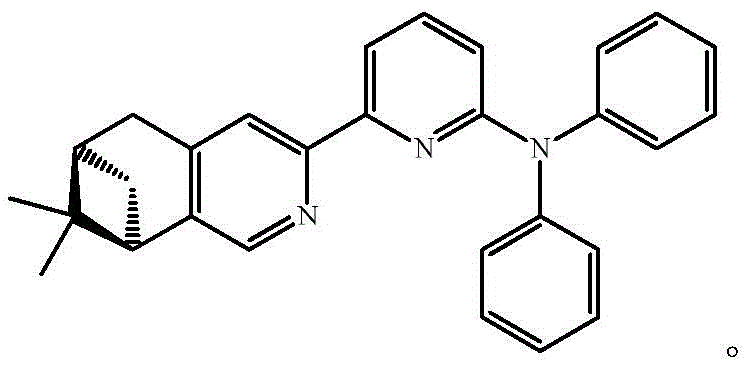
Following the ligand formation, the second stage involves the coordination of the organic ligand with potassium chloroplatinite in an acidic aqueous environment. This step forms the final five-membered six-membered heterocyclic platinum complex, locking the molecular geometry into a configuration that is highly sensitive to external stimuli. The resulting crystal structure, as analyzed in the patent, reveals a flexible conformation where the angle between the chelate coordination benzene ring and the bipyridine plane can vary significantly. In the yellow form, this angle is larger, whereas mechanical grinding reduces this angle, shifting the emission spectrum and causing a visible color change to orange. This mechanochromism is fully reversible; spraying the ground sample with dichloromethane restores the original crystalline form and yellow emission. Understanding this dynamic structural behavior is vital for R&D teams aiming to integrate these materials into sensors or anti-counterfeiting tags where reliability and repeatability are paramount.
How to Synthesize AIE-Active Platinum Complex Efficiently
The synthesis protocol described in the patent provides a clear roadmap for producing this high-value intermediate, emphasizing control over reaction parameters to maximize yield and purity. The process is divided into two distinct stages: the construction of the sterically hindered ligand and the subsequent metallation with platinum. Each step requires careful attention to temperature, solvent choice, and stoichiometric ratios to ensure the formation of the desired plane square complex without generating excessive impurities that could degrade luminescent performance. For technical teams preparing for pilot-scale runs, adhering to the specified molar concentrations and purification methods, such as silica gel column chromatography with specific petroleum ether and ethyl acetate ratios, is essential for replicating the high quantum efficiencies reported in the experimental data.
- Perform Cu-catalyzed arylation of (-)-4,5-pinene-6'-bromo-2,2'-bipyridine with diphenylamine using CuI and organic bases in toluene at 50-130°C.
- React the resulting ligand with potassium chloroplatinite in an acidic aqueous solution at 100-110°C to form the final platinum complex.
Commercial Advantages for Procurement and Supply Chain Teams
From a commercial perspective, the adoption of this synthesis route offers substantial benefits for procurement managers and supply chain heads focused on cost reduction in display material manufacturing. The elimination of expensive palladium catalysts in favor of copper for the arylation step represents a significant optimization in raw material costs, directly impacting the bottom line without compromising reaction efficiency. Furthermore, the use of common industrial solvents like toluene and acetic acid simplifies solvent recovery and waste management processes, aligning with increasingly stringent environmental compliance standards. The high reaction yields reported in the patent examples suggest that less starting material is wasted, leading to a more atom-economical process that enhances overall production throughput and reduces the frequency of batch failures.
- Cost Reduction in Manufacturing: The substitution of traditional noble metal catalysts with copper-based systems in the initial coupling reaction drastically lowers the catalyst cost burden, which is often a major expense in fine chemical synthesis. Additionally, the high yields achieved in the optimized examples mean that the consumption of precious platinum salts in the second step is maximized, ensuring that every gram of expensive metal is converted into valuable product. This efficiency translates to a lower cost per kilogram of the final active material, making it a more viable option for mass-market applications like consumer electronics packaging or widespread anti-counterfeiting measures.
- Enhanced Supply Chain Reliability: The reagents required for this synthesis, including diphenylamine, bipyridine derivatives, and potassium chloroplatinite, are commercially available from multiple global sources, reducing the risk of single-supplier dependency. The robustness of the reaction conditions, which tolerate a range of temperatures and concentrations, ensures that production can continue even with minor fluctuations in utility supplies or raw material quality. This resilience is critical for supply chain heads who need to guarantee continuous delivery of high-purity luminescent materials to downstream manufacturers of OLED panels or security inks.
- Scalability and Environmental Compliance: The preparation method is designed for simplicity, avoiding exotic conditions that would require specialized high-pressure equipment or cryogenic cooling. This inherent simplicity facilitates easy scale-up from laboratory grams to multi-ton annual commercial production, allowing manufacturers to respond quickly to surges in market demand. Moreover, the aqueous workup and standard extraction procedures minimize the generation of hazardous organic waste streams, supporting corporate sustainability goals and reducing the costs associated with environmental remediation and disposal.
Frequently Asked Questions (FAQ)
The following questions address common technical and commercial inquiries regarding the implementation of this patented technology in industrial settings. These insights are derived directly from the experimental data and beneficial effects described in the patent documentation, providing a factual basis for decision-making. Understanding these details helps stakeholders evaluate the feasibility of integrating this AIE-active complex into their existing product lines or research pipelines.
Q: What distinguishes this platinum complex from traditional mechanochromic materials?
A: Unlike prior art which often suffers from unobvious light variation or slow response times, this complex utilizes a pinene group to introduce steric hindrance. This structural feature loosens molecular accumulation, enabling rapid, reversible, and high-contrast color changes under mechanical stress.
Q: Is the synthesis process suitable for large-scale industrial production?
A: Yes, the patent describes a preparation method that is simple to operate with high reaction yields (up to 95% in optimized examples). The use of common solvents like toluene and acetic acid, along with standard purification techniques like silica gel chromatography, facilitates commercial scale-up.
Q: What are the primary applications for this AIE-active material?
A: Due to its high luminous quantum efficiency in the solid state and sensitive stress response, this material is ideal for high-performance light-emitting elements, anti-counterfeiting tags, information storage devices, and novel stress sensors.
Partnering with NINGBO INNO PHARMCHEM: Your Reliable Platinum Complex Supplier
As the demand for advanced luminescent materials grows, partnering with an experienced CDMO like NINGBO INNO PHARMCHEM ensures access to cutting-edge synthesis capabilities and rigorous quality standards. Our team possesses extensive experience scaling diverse pathways from 100 kgs to 100 MT/annual commercial production, ensuring that your supply needs are met with consistency and precision. We understand the critical nature of stringent purity specifications in the electronic materials sector and operate rigorous QC labs equipped to verify the photophysical properties and chemical integrity of every batch we produce.
We invite you to collaborate with us to leverage this innovative technology for your next project. Contact our technical procurement team today to request a Customized Cost-Saving Analysis tailored to your specific volume requirements. We are ready to provide specific COA data and comprehensive route feasibility assessments to help you accelerate your time-to-market for high-performance display and sensor applications.