
Advanced Two-Step Synthesis Strategy for High-Purity Azilsartan Manufacturing
Advanced Two-Step Synthesis Strategy for High-Purity Azilsartan Manufacturing
The pharmaceutical landscape for antihypertensive agents continues to evolve, driven by the demand for more efficient and cost-effective manufacturing processes for Angiotensin II Receptor Blockers (ARBs). Patent CN103709155A introduces a transformative preparation method for Azilsartan, a potent dual-function ARB, which addresses critical bottlenecks found in legacy synthetic routes. This innovation centers on a streamlined two-step reaction sequence that converts Azilsartan nitrile directly into the final active pharmaceutical ingredient, bypassing the cumbersome multi-step protections and deprotections characteristic of earlier methodologies. By leveraging a unique hydrolysis-cyclization cascade, this technology offers a robust pathway for industrial scale-up, ensuring high atom economy and reduced environmental footprint.
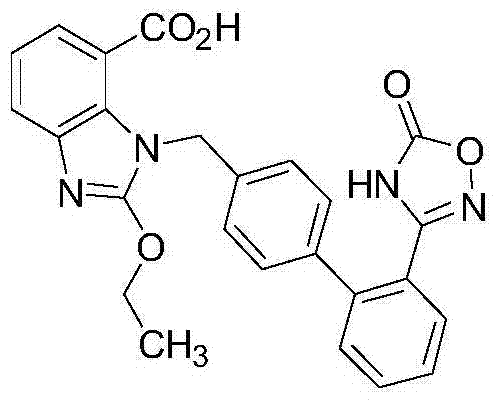
For R&D directors and process chemists, the significance of this patent lies in its ability to simplify the molecular construction of the 1,2,4-oxadiazole-5-one ring, a key pharmacophore in Azilsartan. Traditional methods often struggle with harsh conditions and complex purification requirements, but this novel approach utilizes mild reaction parameters and readily available reagents. The strategic integration of strong alkali hydrolysis followed by controlled carbonylation allows for precise management of reaction intermediates, thereby minimizing the formation of difficult-to-remove impurities. This technical advancement positions the process as a highly viable candidate for reliable azilsartan supplier networks aiming to optimize their production capabilities.
The Limitations of Conventional Methods vs. The Novel Approach
The Limitations of Conventional Methods
Historical synthetic routes for Azilsartan, such as those disclosed in US5583141 and EP0520423, typically involve a four-step sequence starting from methyl esters, necessitating high-temperature reflux in solvents like toluene to achieve ring closure. These legacy processes are fraught with inefficiencies, including excessive energy consumption due to prolonged heating and the generation of significant solvent waste, which complicates downstream processing and increases operational costs. Furthermore, alternative routes reported in literature, such as the six-step process in US20050187269, rely on expensive and hazardous reagents like triethyloxonium tetrafluoroborate, rendering them economically unfeasible for large-scale commercial production. The reliance on volatile organic solvents and harsh gaseous reagents like hydrogen chloride in some variations further exacerbates safety concerns and equipment corrosion issues in manufacturing plants.
The Novel Approach
In stark contrast, the methodology outlined in CN103709155A collapses the synthesis into a concise two-step operation that dramatically enhances process efficiency and safety profiles. The first step involves the conversion of Azilsartan nitrile to a hydroxyoxime intermediate using hydroxylamine hydrochloride and triethylamine in dimethylsulfoxide, a reaction that proceeds with high selectivity. The subsequent step is particularly innovative, employing a strong alkali aqueous solution to hydrolyze the methyl ester into a water-soluble carboxylate before introducing the carbonyl ring-closing reagent. This sequence allows the cyclization to occur at mild temperatures ranging from 20°C to 55°C, eliminating the need for energy-intensive reflux conditions and significantly reducing the risk of thermal degradation or side reactions that compromise product purity.
Mechanistic Insights into Carbonyl-Mediated Cyclization
The core chemical transformation in this novel route is the formation of the 5-oxo-4,5-dihydro-1,2,4-oxadiazole ring through a nucleophilic acyl substitution mechanism facilitated by carbonyl reagents. Upon hydrolysis of the methyl ester group by strong bases such as sodium hydroxide or potassium hydroxide, the resulting carboxylate anion acts as a potent nucleophile. When a carbonyl source like triphosgene or diethyl carbonate is introduced, it reacts with the hydroxyoxime functionality to form the cyclic carbonate structure. The reaction kinetics are carefully managed by controlling the addition rate and maintaining the temperature between 20°C and 30°C for halogenated reagents or 45°C to 55°C for dialkyl carbonates, ensuring complete conversion while suppressing the formation of polymeric byproducts.
Impurity control is intrinsically built into this mechanistic design through the use of aqueous alkaline conditions which solubilize the intermediate carboxylate salt, effectively separating it from non-polar organic impurities prior to the cyclization event. This phase separation capability is a critical advantage over anhydrous methods where impurities often co-precipitate with the product. Additionally, the final acidification step to pH 2-3 triggers the precipitation of the target Azilsartan in a highly crystalline form, facilitating easy filtration and washing. This precise control over pH and solubility parameters ensures that the final API meets stringent purity specifications required for regulatory submission, minimizing the need for costly recrystallization steps.
How to Synthesize Azilsartan Efficiently
The execution of this synthesis requires careful attention to reagent stoichiometry and temperature gradients to maximize yield and minimize waste. The process begins with the preparation of the hydroxyoxime in DMSO, followed by a direct aqueous workup that avoids the use of chlorinated solvents common in older protocols. Manufacturers can choose between various carbonylating agents depending on their specific safety infrastructure and supply chain preferences, with triphosgene offering rapid kinetics and dialkyl carbonates providing a greener alternative. Detailed standard operating procedures regarding mixing speeds, addition times, and quenching protocols are essential for reproducibility.
- React Azilsartan nitrile with hydroxylamine hydrochloride and triethylamine in DMSO to form the hydroxyoxime intermediate.
- Hydrolyze the methyl ester group of the hydroxyoxime using a strong alkali aqueous solution to generate a water-soluble carboxylate.
- Add a carbonyl ring-closing reagent such as triphosgene or diethyl carbonate at controlled temperatures (20-55°C) to form the oxadiazole ring, then adjust pH to precipitate the product.
Commercial Advantages for Procurement and Supply Chain Teams
From a procurement and supply chain perspective, this patented process offers substantial strategic benefits by fundamentally altering the cost structure of Azilsartan manufacturing. The reduction in reaction steps from four or six down to two directly correlates to a decrease in labor hours, equipment occupancy time, and overall utility consumption, leading to significant cost reduction in API manufacturing. By eliminating the need for exotic reagents like tetrafluoroborate salts and replacing high-boiling solvents like toluene with more manageable systems like ethanol or THF, the process simplifies the raw material sourcing strategy and reduces dependency on specialized chemical vendors. This streamlining of the supply chain enhances reliability and mitigates the risk of production delays caused by material shortages.
- Cost Reduction in Manufacturing: The elimination of high-temperature reflux steps results in drastically lower energy costs, as the cyclization proceeds efficiently at near-ambient temperatures. Furthermore, the reduction in solvent volume and the avoidance of expensive transition metal catalysts or boron reagents contribute to a leaner bill of materials, allowing for substantial cost savings that can be passed down the value chain. The simplified workup procedure also reduces the load on waste treatment facilities, lowering environmental compliance costs associated with solvent disposal and hazardous waste management.
- Enhanced Supply Chain Reliability: The reliance on commodity chemicals such as triethylamine, hydroxylamine hydrochloride, and common carbonates ensures a stable and resilient supply chain, free from the volatility associated with proprietary or scarce reagents. The robustness of the aqueous hydrolysis step means that the process is less sensitive to moisture variations, reducing the likelihood of batch failures and ensuring consistent delivery schedules for downstream formulation partners. This stability is crucial for maintaining continuous production runs and meeting the rigorous demands of global pharmaceutical markets.
- Scalability and Environmental Compliance: The mild reaction conditions and the use of water-soluble intermediates make this process inherently safer and easier to scale from pilot plant to commercial tonnage without significant engineering hurdles. The decreased usage of volatile organic compounds (VOCs) aligns with increasingly strict environmental regulations, positioning manufacturers who adopt this technology as leaders in sustainable chemistry. The ability to operate at lower pressures and temperatures also reduces the capital expenditure required for specialized high-pressure reactors, facilitating faster capacity expansion.
Frequently Asked Questions (FAQ)
The following questions address common technical and commercial inquiries regarding the implementation of this synthesis route, derived from the specific advantages detailed in the patent documentation. Understanding these nuances is vital for technical teams evaluating the feasibility of technology transfer and for procurement officers assessing long-term supply viability. The answers reflect the practical realities of scaling this chemistry in a GMP environment.
Q: What are the primary advantages of the two-step Azilsartan synthesis route?
A: The primary advantages include a significantly shortened reaction sequence compared to traditional 4-6 step methods, reduced solvent consumption, and the ability to perform cyclization at mild temperatures (20-30°C) rather than high-temperature reflux, which enhances safety and purity.
Q: Which cyclization reagents are compatible with this novel process?
A: The process demonstrates flexibility by accommodating various carbonyl ring-closing reagents, including triphosgene, trichloromethyl chloroformate, phosgene, dimethyl carbonate, and diethyl carbonate, allowing manufacturers to select based on availability and safety protocols.
Q: How does this method improve impurity control compared to prior art?
A: By avoiding high-temperature reflux in solvents like toluene and utilizing an aqueous hydrolysis step prior to cyclization, the method minimizes thermal degradation and side reactions, resulting in a cleaner crude product profile and simplified purification.
Partnering with NINGBO INNO PHARMCHEM: Your Reliable Azilsartan Supplier
At NINGBO INNO PHARMCHEM, we recognize the critical importance of adopting advanced synthetic methodologies to maintain competitiveness in the global pharmaceutical market. Our team possesses extensive experience scaling diverse pathways from 100 kgs to 100 MT/annual commercial production, ensuring that the theoretical benefits of this two-step Azilsartan process are fully realized in practical manufacturing settings. We are committed to delivering high-purity Azilsartan that adheres to stringent purity specifications, supported by our rigorous QC labs equipped with state-of-the-art analytical instrumentation to verify every batch against international pharmacopoeia standards.
We invite potential partners to engage with our technical procurement team to discuss how this optimized route can drive value for your specific projects. By requesting a Customized Cost-Saving Analysis, you can gain deeper insights into the economic impact of switching to this efficient protocol. We encourage you to contact us today to obtain specific COA data and comprehensive route feasibility assessments tailored to your supply chain requirements, ensuring a seamless transition to a more sustainable and cost-effective sourcing model.