
Advanced Mo/Cu Co-Catalyzed Synthesis of 3-Trifluoromethyl-1,2,4-Triazoles for Commercial Scale-Up
The pharmaceutical and fine chemical industries are constantly seeking robust methodologies to construct nitrogen-containing heterocycles, particularly those incorporating fluorine atoms which significantly enhance metabolic stability and bioavailability. Patent CN113307778A introduces a groundbreaking preparation method for 3-trifluoromethyl substituted 1,2,4-triazole compounds, addressing critical bottlenecks in current synthetic routes. This innovation leverages a synergistic co-catalytic system involving molybdenum hexacarbonyl and cuprous acetate to facilitate the cycloaddition of trifluoroethylimidoyl chloride with functionalized isonitriles. For R&D Directors and Procurement Managers alike, this represents a significant opportunity to streamline the supply chain for high-value API intermediates used in drugs like Sitagliptin and various kinase inhibitors. The ability to access these scaffolds efficiently under mild conditions marks a pivotal shift towards more sustainable and cost-effective manufacturing processes in the realm of specialty chemicals.
The Limitations of Conventional Methods vs. The Novel Approach
The Limitations of Conventional Methods
Historically, the construction of trifluoromethyl-substituted 1,2,4-triazoles has relied on cyclization reactions involving trifluoroacetyl hydrazine and amidine compounds, or the hydrazinolysis of trifluoromethyl-substituted 1,2,4-oxazolinones. These traditional pathways often suffer from severe limitations, including the requirement for harsh reaction conditions that can degrade sensitive functional groups and compromise overall yield. Furthermore, many established methods utilize expensive or hazardous reagents such as diazonium salts or trifluorodiazoethane, which pose significant safety risks and logistical challenges for large-scale operations. The limited substrate scope of these older techniques frequently restricts the structural diversity achievable, forcing chemists to resort to lengthy multi-step syntheses to introduce specific substituents. Consequently, the industry faces elevated production costs and extended lead times, creating a pressing need for a more versatile and operationally simple synthetic strategy.
The Novel Approach
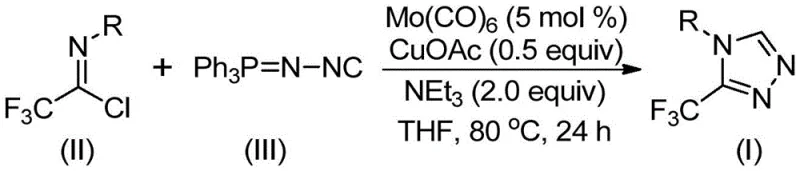
In stark contrast, the methodology disclosed in CN113307778A offers a streamlined solution by employing cheap and easily obtainable starting materials, specifically functionalized isonitriles and trifluoroethylimidoyl chloride. This novel route eliminates the need for dangerous diazo compounds and operates under remarkably mild thermal conditions, typically between 70°C and 90°C. The reaction efficiency is substantially improved through the unique co-catalytic action of molybdenum and copper, which activates the isonitrile species and promotes the [3+2] cycloaddition with high selectivity. This approach not only simplifies the operational procedure but also broadens the applicability of the method, allowing for the synthesis of various官能团 (functional group) substituted derivatives without compromising the integrity of the molecular framework. Such advancements are crucial for reducing the complexity of process development and accelerating the timeline from laboratory discovery to commercial manufacturing.
Mechanistic Insights into Mo/Cu Co-Catalyzed Cyclization
The core of this technological breakthrough lies in the intricate interplay between the molybdenum hexacarbonyl activator and the cuprous acetate catalyst. Mechanistically, the molybdenum species coordinates with the functionalized isonitrile to form a reactive metal complex, effectively lowering the activation energy required for the subsequent bond-forming events. This activation step is critical for enabling the nucleophilic attack on the trifluoroethylimidoyl chloride, initiating the ring closure process. Following this initial interaction, the copper promoter facilitates a [3+2] cycloaddition reaction, constructing the five-membered triazole ring intermediate with high precision. The presence of triethylamine as a base further assists in neutralizing acidic byproducts, driving the equilibrium towards the desired product formation. Understanding this catalytic cycle is essential for process chemists aiming to optimize reaction parameters and ensure consistent quality in bulk production.
Furthermore, the final step of the mechanism involves the elimination of triphenylphosphine oxide under the action of water present in the system, yielding the final 3-trifluoromethyl-substituted 1,2,4-triazole compound. This elimination step is clean and efficient, minimizing the formation of difficult-to-remove impurities that often plague heterocyclic synthesis. The tolerance of the catalytic system towards various substituents on the aryl ring of the starting material is particularly noteworthy, accommodating electron-donating groups like methyl and methoxy as well as electron-withdrawing groups such as fluoro and chloro. This broad substrate scope ensures that the method can be adapted for a wide array of target molecules, providing R&D teams with the flexibility to explore diverse chemical spaces. The robustness of this mechanism against functional group interference significantly reduces the need for protective group strategies, thereby shortening the overall synthetic sequence.
How to Synthesize 3-Trifluoromethyl-1,2,4-Triazole Efficiently
To implement this synthesis in a laboratory or pilot plant setting, operators must adhere to precise stoichiometric ratios and reaction conditions to maximize yield and purity. The process begins with the careful weighing and addition of molybdenum hexacarbonyl, cuprous acetate, triethylamine, molecular sieves, trifluoroethylimidoyl chloride, and the functionalized isonitrile into a suitable organic solvent such as THF. Maintaining an inert atmosphere and controlling the temperature within the specified range of 70°C to 90°C for 18 to 30 hours is critical for ensuring complete conversion of the starting materials. Detailed standardized synthesis steps, including specific work-up procedures and purification protocols via column chromatography, are outlined in the technical guide below to assist your technical team in replicating these results accurately.
- Prepare the reaction mixture by adding molybdenum hexacarbonyl, cuprous acetate, triethylamine, molecular sieves, trifluoroethylimidoyl chloride, and functionalized isonitrile into an organic solvent such as THF.
- Heat the reaction mixture to a temperature range of 70°C to 90°C and maintain stirring for a duration of 18 to 30 hours to ensure complete conversion.
- Upon completion, filter the mixture, mix with silica gel, and perform column chromatography purification to isolate the high-purity 3-trifluoromethyl substituted 1,2,4-triazole product.
Commercial Advantages for Procurement and Supply Chain Teams
From a procurement and supply chain perspective, this patented method offers substantial strategic benefits by fundamentally altering the cost structure and reliability of triazole intermediate production. The reliance on commercially available and inexpensive reagents such as cuprous acetate and triethylamine drastically reduces the raw material expenditure compared to traditional routes requiring specialized organometallic reagents. Additionally, the mild reaction conditions translate to lower energy consumption and reduced wear on reactor equipment, contributing to long-term operational savings. For Supply Chain Heads, the simplicity of the post-processing workflow, which involves standard filtration and chromatography, minimizes the risk of production delays and ensures a steady flow of high-quality materials. This operational efficiency is paramount for maintaining continuity in the supply of critical pharmaceutical intermediates.
- Cost Reduction in Manufacturing: The elimination of expensive transition metal catalysts and hazardous reagents leads to significant cost optimization in the overall manufacturing process. By utilizing earth-abundant copper salts and readily accessible molybdenum complexes, the direct material costs are substantially lowered without sacrificing reaction performance. Furthermore, the high atom economy of the cycloaddition reaction minimizes waste generation, reducing the expenses associated with waste disposal and environmental compliance. These factors collectively contribute to a more competitive pricing structure for the final API intermediates, allowing pharmaceutical companies to improve their profit margins while maintaining high quality standards.
- Enhanced Supply Chain Reliability: The use of stable and commercially sourced starting materials mitigates the risk of supply disruptions often associated with custom-synthesized or unstable reagents. Since trifluoroethylimidoyl chloride and functionalized isonitriles are readily available from multiple vendors, procurement managers can establish redundant supply lines to ensure uninterrupted production. The robustness of the reaction conditions also means that the process is less susceptible to variations in raw material quality, further stabilizing the supply chain. This reliability is crucial for meeting strict delivery schedules and supporting the continuous manufacturing needs of global pharmaceutical clients.
- Scalability and Environmental Compliance: The method's proven scalability from milligram to gram levels indicates a clear pathway for ton-scale commercial production without the need for extensive process re-engineering. The absence of highly toxic reagents and the use of common organic solvents simplify the environmental health and safety (EHS) profile of the manufacturing site. This alignment with green chemistry principles not only reduces regulatory burdens but also enhances the corporate sustainability profile of the manufacturing partner. Consequently, companies adopting this technology can achieve faster regulatory approvals and market entry for their new drug candidates.
Frequently Asked Questions (FAQ)
The following questions address common technical and commercial inquiries regarding the implementation of this synthesis technology. These answers are derived directly from the experimental data and beneficial effects described in the patent documentation, providing clarity on reaction scope, scalability, and product quality. Understanding these details is essential for stakeholders evaluating the feasibility of integrating this method into their existing production workflows.
Q: What are the key advantages of the Mo/Cu co-catalyzed method over traditional triazole synthesis?
A: Unlike traditional methods that often require harsh conditions or expensive reagents, this novel approach utilizes cheap and readily available starting materials like trifluoroethylimidoyl chloride and functionalized isonitriles. The reaction operates under mild conditions (70-90°C) and demonstrates high reaction efficiency with excellent substrate tolerance.
Q: Is this synthesis method suitable for large-scale commercial production?
A: Yes, the patent explicitly states that the method can be extended to gram-level reactions and provides a strong possibility for subsequent scale production. The use of common organic solvents like THF and standard post-processing techniques like column chromatography facilitates easy adaptation for industrial manufacturing.
Q: What types of substituents are tolerated in this triazole synthesis route?
A: The method exhibits a wide tolerance range for substrate functional groups. It successfully accommodates various aryl substituents including methyl, methoxy, fluoro, chloro, and even bulky groups like tert-butyl or naphthyl, allowing for the design and synthesis of diverse 4-substituted 1,2,4-triazole compounds.
Partnering with NINGBO INNO PHARMCHEM: Your Reliable 3-Trifluoromethyl-1,2,4-Triazole Supplier
At NINGBO INNO PHARMCHEM, we recognize the critical role that high-quality intermediates play in the success of modern drug development programs. As a leading CDMO expert, we possess extensive experience scaling diverse pathways from 100 kgs to 100 MT/annual commercial production, ensuring that your project transitions smoothly from the bench to the plant. Our commitment to stringent purity specifications and the operation of rigorous QC labs guarantees that every batch of 3-trifluoromethyl-1,2,4-triazole compounds meets the highest international standards. We leverage advanced catalytic technologies like the one described in CN113307778A to deliver superior value and performance to our global partners.
We invite you to collaborate with us to unlock the full potential of this innovative synthesis route for your specific applications. Please contact our technical procurement team to request a Customized Cost-Saving Analysis tailored to your volume requirements. We are ready to provide specific COA data and comprehensive route feasibility assessments to support your decision-making process and accelerate your time to market.