
Advanced Synthesis of Trifluoromethyl Quinazolinones: Scalable Manufacturing for Pharmaceutical Applications
Chinese patent CN112125856A introduces a groundbreaking synthetic methodology for producing 2-trifluoromethyl-substituted quinazolinone derivatives, which represent a critical class of nitrogen-containing heterocyclic compounds with extensive pharmaceutical applications including anticonvulsant, antitumor, and hypnotic medications as evidenced by marketed drugs like CP-465022 and Erastin. This innovative process addresses longstanding challenges in the synthesis of these valuable intermediates by eliminating the need for toxic carbon monoxide gas through the strategic implementation of a solid carbon monoxide surrogate (TFBen). The methodology demonstrates exceptional substrate versatility across diverse functional groups while maintaining high reaction efficiency under mild conditions at 90°C for 16-30 hours using palladium catalysis. This advancement represents a significant leap forward in the safe and scalable production of fluorinated quinazolinone derivatives that are increasingly important in modern drug discovery programs targeting various therapeutic areas including oncology and central nervous system disorders.
The Limitations of Conventional Methods vs. The Novel Approach
The Limitations of Conventional Methods
Traditional synthetic routes for preparing quinazolinone derivatives typically suffer from multiple critical limitations that hinder their commercial adoption and scalability in pharmaceutical manufacturing environments. Conventional methods often require harsh reaction conditions including high temperatures and pressures when utilizing gaseous carbon monoxide, presenting significant safety hazards that necessitate specialized equipment and extensive safety protocols which substantially increase capital expenditure requirements. Many existing approaches rely on expensive or difficult-to-obtain starting materials that require pre-activation steps or unstable intermediates like trifluoroacetamide, substantially raising production costs and complicating supply chain logistics due to limited supplier options. Furthermore, these methods frequently exhibit narrow substrate scope with poor functional group tolerance as documented in patent literature references (Eur.J.Med.Chem.,2015), limiting their applicability across diverse molecular architectures required by modern pharmaceutical development programs where structural diversity is essential for optimizing biological activity.
The Novel Approach
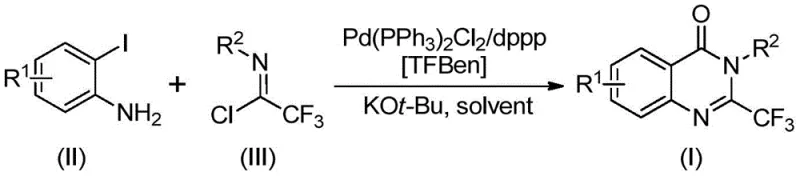
The patented methodology overcomes these limitations through an elegant palladium-catalyzed carbonylation process that employs 1,3,5-tricarboxylic acid phenol ester (TFBen) as a safe solid carbon monoxide surrogate, completely eliminating the need for handling toxic gaseous CO while maintaining excellent reaction efficiency at moderate temperatures (90°C). This innovative approach demonstrates remarkable substrate versatility across diverse functional groups as evidenced by successful synthesis of fifteen different derivatives with yields ranging from moderate to excellent (44%-99%) without requiring significant process modifications or specialized equipment beyond standard laboratory glassware. The process utilizes readily available starting materials including o-iodoaniline derivatives (R¹ = H, alkyl, halogen) and trifluoroethyl imidoyl chlorides (R² = substituted aryl), which can be easily synthesized from commercially accessible precursors through straightforward procedures described in patent examples. This methodology represents a substantial improvement in both safety profile and commercial feasibility for producing these pharmaceutically important intermediates at scale while addressing critical pain points faced by procurement teams regarding raw material availability and supply chain reliability.
Mechanistic Insights into Palladium-Catalyzed Carbonylation with Solid CO Surrogate
The reaction mechanism begins with potassium tert-butoxide-promoted intermolecular carbon-nitrogen bond coupling between o-iodoaniline and trifluoroethyl imidoyl chloride to form a trifluoroacetamidine intermediate as the first key step in this cascade transformation. This is followed by oxidative addition of the palladium catalyst into the carbon-iodine bond, generating a divalent palladium species that serves as the central catalytic intermediate enabling subsequent transformations under mild thermal conditions (90°C). Under heating conditions, TFBen decomposes to release carbon monoxide in situ which then inserts into the carbon-palladium bond to form an acyl palladium complex through a well-defined insertion step that maintains high regioselectivity throughout the process. The base facilitates deprotonation and subsequent cyclization through nitrogen coordination, leading to the formation of a seven-membered palladacycle intermediate that undergoes reductive elimination to yield the desired quinazolinone product while regenerating the active palladium catalyst for further catalytic cycles without requiring additional catalyst input.
The process exhibits exceptional control over impurity formation through multiple built-in purification mechanisms inherent to the reaction design that directly address R&D director concerns regarding product quality and purity specifications required for pharmaceutical applications. The use of solid TFBen as a controlled CO source prevents over-carbonylation side reactions that commonly occur with gaseous CO methods, significantly reducing unwanted byproducts that would require additional purification steps before advancing to clinical development stages. The mild reaction conditions (90°C) minimize thermal degradation pathways that could lead to impurity formation while maintaining excellent conversion rates across diverse substrate combinations as demonstrated in patent examples where yields remained consistently high even with sensitive functional groups present. The workup procedure involving filtration through silica gel followed by standard column chromatography effectively removes residual catalyst species and any minor impurities without requiring specialized equipment or additional processing steps beyond what is typically available in commercial manufacturing facilities.
How to Synthesize Trifluoromethyl Quinazolinones Efficiently
This patented synthetic route represents a significant advancement in the preparation of fluorinated quinazolinone derivatives, offering pharmaceutical manufacturers a safer and more versatile alternative to conventional methods that require hazardous carbon monoxide gas handling procedures which present substantial regulatory compliance challenges in modern manufacturing environments. The process has been optimized through extensive experimentation documented in patent examples to ensure high yields across diverse substrate combinations while maintaining excellent reproducibility essential for technology transfer from laboratory scale to commercial production settings where consistency is paramount for regulatory approval processes. The methodology's compatibility with various functional groups enables medicinal chemistry teams to rapidly access structurally diverse analogs tailored to specific biological targets without requiring significant process revalidation or additional development time that would delay drug discovery programs.
- Prepare reaction mixture by combining o-iodoaniline, trifluoroethyl imidoyl chloride, Pd(PPh3)2Cl2 catalyst (5 mol%), dppp ligand (5 mol%), TFBen (2.5 equiv), KOt-Bu (2.0 equiv) in THF under inert atmosphere
- Heat reaction mixture to 90°C with continuous stirring for 16-30 hours to ensure complete conversion while monitoring reaction progress
- Perform standard workup procedure including filtration through silica gel followed by column chromatography purification to obtain high-purity trifluoromethyl quinazolinone product
Commercial Advantages for Procurement and Supply Chain Teams
This innovative synthetic methodology addresses critical pain points faced by procurement professionals in pharmaceutical organizations by delivering significant operational improvements while maintaining strict quality standards required for pharmaceutical intermediates through multiple strategic advantages that enhance overall supply chain resilience without compromising product quality or regulatory compliance requirements. The elimination of hazardous carbon monoxide gas from the manufacturing process substantially reduces safety risks associated with traditional carbonylation methods while simultaneously lowering capital expenditure requirements by avoiding specialized high-pressure reactor systems typically needed when handling toxic gases under pressure conditions.
- Cost Reduction in Manufacturing: The elimination of toxic carbon monoxide gas handling requirements significantly reduces capital expenditure by avoiding specialized high-pressure reactor systems and associated safety infrastructure typically needed for conventional carbonylation processes which often represent substantial initial investment costs exceeding standard laboratory equipment budgets. The use of cost-effective starting materials that are commercially available or easily synthesized from common precursors substantially lowers raw material costs compared to alternative routes requiring expensive pre-functionalized substrates or rare reagents that often have limited supplier options creating single-source dependency risks.
- Enhanced Supply Chain Reliability: The utilization of widely available starting materials with established global supply chains ensures consistent raw material availability while minimizing vulnerability to single-source dependencies that can disrupt production schedules during periods of market volatility or geopolitical instability affecting specialty chemical supply chains globally. The process's robustness across diverse substrates allows for flexible sourcing strategies where alternative raw material suppliers can be qualified without requiring significant process revalidation due to the method's inherent tolerance for minor variations in starting material quality specifications.
- Scalability and Environmental Compliance: The methodology demonstrates excellent scalability from laboratory to commercial production scales without requiring significant process modifications as evidenced by consistent yields across different batch sizes documented in patent examples where identical procedures were applied successfully at varying scales without adjustment parameters needed for larger volumes.
Frequently Asked Questions (FAQ)
The following questions address common concerns raised by technical procurement teams regarding implementation challenges and commercial viability considerations when adopting this patented synthetic methodology for producing fluorinated quinazolinone intermediates essential for pharmaceutical development programs requiring reliable access to high-quality building blocks meeting stringent regulatory requirements.
Q: How does this method eliminate safety concerns associated with traditional carbonylation processes?
A: The patented methodology replaces hazardous gaseous carbon monoxide with TFBen (1,3,5-tricarboxylic acid phenol ester), a stable solid CO surrogate that decomposes in situ under reaction conditions. This eliminates the need for specialized high-pressure equipment and complex safety protocols required for handling toxic CO gas, significantly improving workplace safety while maintaining excellent reaction efficiency.
Q: What is the substrate scope limitation for this synthetic methodology?
A: The process demonstrates exceptional substrate versatility across diverse functional groups as documented in patent examples. It accommodates various substituents on both components (R¹ = H, alkyl, halogen; R² = substituted aryl), enabling synthesis of numerous derivatives with yields ranging from moderate to excellent without requiring significant process modifications.
Q: How does this method impact impurity profiles compared to conventional approaches?
A: The controlled release of CO from TFBen prevents over-carbonylation side reactions common with gaseous CO methods, while mild reaction conditions (90°C) minimize thermal degradation pathways. The well-defined catalytic cycle ensures high selectivity toward the desired product, resulting in cleaner reaction profiles that simplify purification.
Partnering with NINGBO INNO PHARMCHEM: Your Reliable Trifluoromethyl Quinazolinone Derivatives Supplier
Our patented methodology represents a significant advancement in the safe and efficient production of fluorinated quinazolinone intermediates, offering pharmaceutical manufacturers a robust solution for accessing these valuable building blocks with enhanced safety profiles while maintaining commercial viability through optimized manufacturing processes developed specifically for complex heterocyclic chemistry applications requiring strict quality control measures throughout production cycles. NINGBO INNO PHARMCHEM brings extensive experience scaling diverse pathways from 100 kgs to 100 MT/annual commercial production ensuring seamless technology transfer from laboratory discovery phase through full-scale manufacturing implementation while maintaining stringent purity specifications required for pharmaceutical applications through rigorous QC labs equipped with state-of-the-art analytical instrumentation capable of meeting even the most demanding regulatory requirements.
We invite you to contact our technical procurement team to discuss how our innovative approach can support your specific manufacturing needs through a Customized Cost-Saving Analysis. Our experts will provide detailed route feasibility assessments along with specific COA data demonstrating our capability to deliver high-purity trifluoromethyl quinazolinone derivatives meeting your exact specifications while optimizing your supply chain efficiency through strategic sourcing solutions tailored to your unique requirements.