
Advanced Pd-Catalyzed Synthesis of Carbonyl-Bridged Biheterocyclic Compounds for Commercial Pharmaceutical Applications
Advanced Pd-Catalyzed Synthesis of Carbonyl-Bridged Biheterocyclic Compounds for Commercial Pharmaceutical Applications
The pharmaceutical industry continuously seeks robust synthetic methodologies capable of constructing complex heterocyclic scaffolds with high efficiency and atom economy. Patent CN115353511A introduces a groundbreaking multi-component approach for synthesizing carbonyl-bridged biheterocyclic compounds, specifically targeting the fusion of indolinone and imidazole motifs. These structural frameworks are ubiquitous in bioactive molecules, serving as critical cores for various therapeutic agents ranging from kinase inhibitors to anti-inflammatory drugs. The disclosed method represents a significant leap forward in process chemistry by replacing hazardous gaseous reagents with safe liquid alternatives while maintaining exceptional reaction efficiency under mild conditions. For R&D directors and process chemists, this technology offers a streamlined pathway to access diverse chemical libraries essential for drug discovery campaigns. Furthermore, the operational simplicity and high substrate compatibility make it an attractive candidate for reliable pharmaceutical intermediate supplier networks aiming to optimize their manufacturing portfolios.
The Limitations of Conventional Methods vs. The Novel Approach
The Limitations of Conventional Methods
Historically, the construction of biheterocyclic systems containing carbonyl bridges has been fraught with synthetic challenges that hinder efficient production. Traditional strategies often rely on the direct coupling of two pre-formed heterocyclic substrates, a process that frequently suffers from low convergence and requires harsh reaction conditions to drive the formation of the central carbonyl linkage. Alternatively, oxidative cyclization methods involving bis-nucleophiles and activated methyl-substituted heterocycles often necessitate strong oxidants and elevated temperatures, leading to poor functional group tolerance and significant byproduct formation. Perhaps most critically, classical carbonylation reactions typically depend on the use of toxic carbon monoxide gas, which imposes severe safety regulations, requires specialized high-pressure equipment, and complicates the supply chain logistics for manufacturing facilities. These limitations collectively result in increased operational costs, extended lead times, and reduced overall process safety, creating a bottleneck for the commercial scale-up of complex pharmaceutical intermediates.
The Novel Approach
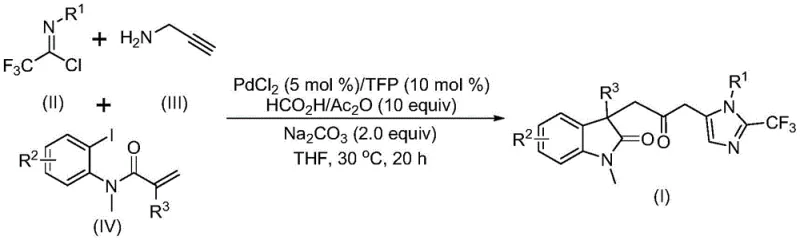
In stark contrast to these legacy methods, the invention described in CN115353511A utilizes a transition metal palladium-catalyzed carbonylation cascade reaction that elegantly assembles the target scaffold in a single pot. This innovative protocol employs cheap and readily available starting materials, specifically trifluoroethylimidoyl chloride, propargylamine, and acrylamide derivatives, which react seamlessly to form the desired carbonyl-bridged biheterocycle. A defining feature of this novel approach is the substitution of dangerous carbon monoxide gas with a safe mixture of formic acid and acetic anhydride, which generates the necessary carbonyl species in situ under ambient pressure. The reaction proceeds efficiently at a mild temperature of 30°C, demonstrating remarkable compatibility with a wide array of functional groups including halogens, nitro groups, and trifluoromethyl moieties. This methodology not only simplifies the synthetic route by reducing the number of isolation steps but also significantly enhances the safety profile of the manufacturing process, making it highly suitable for cost reduction in API manufacturing environments.
Mechanistic Insights into Palladium-Catalyzed Carbonylation Cascade
The mechanistic pathway of this transformation involves a sophisticated sequence of organometallic steps orchestrated by the palladium catalyst system. The cycle initiates with the oxidative addition of zero-valent palladium into the carbon-iodine bond of the acrylamide substrate, generating a reactive aryl-palladium species. This intermediate subsequently undergoes an intramolecular Heck-type insertion into the pendant alkene, forming a stable divalent alkyl-palladium intermediate that sets the stereochemical foundation for the indolinone ring closure. Following this cyclization event, the crucial carbonylation step occurs where the alkyl-palladium species inserts carbon monoxide—released from the decomposition of the formic acid/acetic anhydride mixture—to yield an acyl-palladium intermediate. Concurrently, the trifluoroethylimidoyl chloride and propargylamine undergo a base-promoted intermolecular carbon-nitrogen bond formation to generate a trifluoroacetamidine species, which then isomerizes to a more reactive form. The final stage involves the activation of this amidine by the acyl-palladium complex, triggering an intramolecular cyclization that constructs the imidazole ring and releases the final carbonyl-bridged biheterocyclic product while regenerating the active palladium catalyst.
From an impurity control perspective, the use of tris(2-furyl)phosphine (TFP) as a ligand plays a pivotal role in stabilizing the palladium center and preventing the formation of inactive palladium black aggregates, which are common sources of yield loss in carbonylation reactions. The choice of sodium carbonate as the base ensures effective neutralization of acidic byproducts without promoting unwanted hydrolysis of the sensitive imidoyl chloride or the final amide linkages. Furthermore, the mild reaction temperature of 30°C kinetically suppresses side reactions such as polymerization of the acrylamide component or over-carbonylation, thereby ensuring a clean impurity profile. This high level of selectivity is critical for pharmaceutical applications where stringent purity specifications are mandatory, as it minimizes the burden on downstream purification processes like column chromatography and reduces the risk of genotoxic impurities carrying over into the final active pharmaceutical ingredient.
How to Synthesize Carbonyl-Bridged Biheterocyclic Compounds Efficiently
To implement this synthesis effectively, operators must adhere to precise stoichiometric ratios and mixing protocols to maximize yield and reproducibility. The standard procedure involves charging a reaction vessel with palladium chloride (5 mol%), TFP ligand (10 mol%), sodium carbonate (2.0 equiv), and the CO source mixture (10 equiv of formic acid/acetic anhydride) alongside the three core substrates in tetrahydrofuran (THF) solvent. The detailed standardized synthesis steps are outlined below to ensure consistent quality output.
- Combine palladium chloride (5 mol%), TFP ligand (10 mol%), sodium carbonate, and the CO source (formic acid/acetic anhydride) with the three core substrates in THF solvent.
- Maintain the reaction mixture at a mild temperature of 30°C for a duration of 12 to 20 hours to ensure complete conversion via the carbonylation cascade.
- Upon completion, filter the mixture, adsorb onto silica gel, and purify via column chromatography to isolate the high-purity carbonyl-bridged biheterocyclic product.
Commercial Advantages for Procurement and Supply Chain Teams
For procurement managers and supply chain heads, the adoption of this patented methodology offers substantial strategic benefits that extend beyond mere chemical efficiency. The shift away from high-pressure carbon monoxide infrastructure eliminates the need for expensive safety certifications and specialized storage facilities, directly translating to lower capital expenditure and reduced regulatory overhead. Moreover, the reliance on commodity chemicals such as propargylamine and acrylamide derivatives ensures a stable and resilient supply chain, mitigating the risks associated with sourcing exotic or custom-synthesized building blocks that often face availability bottlenecks. The ability to run the reaction at near-ambient temperatures also drastically reduces energy consumption compared to traditional high-temperature reflux protocols, contributing to both cost savings and sustainability goals within the manufacturing facility.
- Cost Reduction in Manufacturing: The economic viability of this process is driven by the use of inexpensive catalysts and ligands combined with the elimination of hazardous gas handling costs. By utilizing a liquid CO source generated in situ, manufacturers avoid the logistical complexities and premium pricing associated with purchasing and transporting compressed carbon monoxide cylinders. Additionally, the high atom economy of the multi-component reaction means that a greater proportion of the raw material mass is incorporated into the final product, minimizing waste disposal fees and maximizing the return on investment for every kilogram of starting material purchased. The simplified workup procedure, which involves basic filtration and standard chromatography, further reduces labor hours and solvent usage, leading to significant operational cost reductions.
- Enhanced Supply Chain Reliability: The robustness of this synthetic route against variations in substrate electronics ensures consistent production output even when sourcing raw materials from different vendors. Since the starting materials like trifluoroethylimidoyl chloride and various substituted acrylamides are commercially available from multiple global suppliers, the risk of single-source dependency is effectively mitigated. This diversification allows procurement teams to negotiate better pricing and secure longer-term contracts without fear of supply disruption. Furthermore, the short reaction time of 12 to 20 hours enables faster batch turnover rates, allowing manufacturing plants to respond more agilely to fluctuating market demands and urgent customer orders for critical pharmaceutical intermediates.
- Scalability and Environmental Compliance: The patent data confirms successful translation from milligram to gram scales, indicating a clear path toward kilogram and ton-scale production without fundamental process changes. The absence of toxic gas emissions aligns perfectly with increasingly strict environmental regulations regarding volatile organic compounds and hazardous air pollutants. By generating carbon monoxide internally and consuming it immediately within the closed reaction system, the process inherently prevents fugitive emissions, simplifying environmental permitting and compliance reporting. This green chemistry attribute not only protects the corporate reputation but also future-proofs the manufacturing asset against tightening global environmental standards, ensuring long-term operational continuity.
Frequently Asked Questions (FAQ)
The following questions address common technical and commercial inquiries regarding the implementation of this synthesis technology. These answers are derived directly from the experimental data and beneficial effects described in the patent documentation to provide clarity for potential partners.
Q: What is the primary safety advantage of this synthesis method compared to traditional carbonylation?
A: Unlike conventional methods that require toxic and hazardous carbon monoxide gas cylinders, this protocol utilizes a safe liquid mixture of formic acid and acetic anhydride to generate CO in situ, significantly improving operational safety.
Q: What is the substrate compatibility for the R1, R2, and R3 positions?
A: The method demonstrates excellent functional group tolerance, accommodating alkyl, substituted aryl (with methyl, methoxy, halogens, nitro, or trifluoromethyl groups), and benzyl substituents across all variable positions without compromising yield.
Q: Is this process suitable for large-scale industrial production?
A: Yes, the patent explicitly validates the method's scalability through successful gram-scale reactions, utilizing cheap and commercially available starting materials which facilitates cost-effective commercial scale-up.
Partnering with NINGBO INNO PHARMCHEM: Your Reliable Carbonyl-Bridged Biheterocyclic Compounds Supplier
At NINGBO INNO PHARMCHEM, we recognize the transformative potential of this palladium-catalyzed carbonylation technology in accelerating drug development timelines. As a premier CDMO partner, we possess extensive experience scaling diverse pathways from 100 kgs to 100 MT/annual commercial production, ensuring that your transition from laboratory discovery to industrial manufacturing is seamless and efficient. Our state-of-the-art facilities are equipped to handle sensitive organometallic reactions with the highest safety standards, and our rigorous QC labs enforce stringent purity specifications to guarantee that every batch meets the exacting requirements of the global pharmaceutical industry. We are committed to delivering high-purity pharmaceutical intermediates that empower your research and commercial success.
We invite you to collaborate with us to leverage this advanced synthetic route for your specific project needs. Our technical team is ready to provide a Customized Cost-Saving Analysis tailored to your volume requirements, demonstrating exactly how this method can optimize your budget. Please contact our technical procurement team today to request specific COA data for related analogues and comprehensive route feasibility assessments. Let us help you secure a competitive advantage through superior chemistry and reliable supply chain execution.