
Revolutionizing Triazine Synthesis Scalable Metal-Free Production for High-Purity Pharmaceutical Intermediates at Commercial Scale
The patent CN116253692A introduces a groundbreaking methodology for synthesizing trifluoromethyl-substituted 1,2,4-triazine compounds that addresses critical limitations in heterocyclic chemistry through an innovative metal-free approach. This novel process leverages potassium carbonate as a non-toxic promoter to facilitate a synergistic [3+3] cycloaddition between chlorohydrazones and trifluoroacetyl thio ylides under ambient atmospheric conditions without requiring inert gas protection. The methodology represents a significant advancement over conventional techniques by eliminating the need for expensive transition metal catalysts while maintaining high structural diversity across various substituent patterns. By operating at room temperature within a narrow window of 20–40°C for precisely controlled reaction durations of 10–14 hours, this method achieves exceptional operational simplicity that directly translates to enhanced manufacturing reliability. The strategic selection of tetrahydrofuran as the optimal solvent system ensures complete dissolution of reactants while promoting efficient conversion to target triazine scaffolds essential for pharmaceutical applications. This patent establishes a new paradigm in heterocyclic synthesis that aligns perfectly with industry demands for sustainable and scalable production of bioactive intermediates.
The Limitations of Conventional Methods vs. The Novel Approach
The Limitations of Conventional Methods
Traditional synthesis routes for 1,2,4-triazine compounds typically involve multi-step condensation reactions between amidrazones and diketones or complex multicomponent assemblies requiring stringent anhydrous conditions and elevated temperatures that significantly increase operational complexity. These methods often necessitate pre-synthesis of specialized substrates through additional reaction sequences that introduce cumulative impurities and reduce overall yield efficiency while limiting structural diversity due to incompatible functional groups. The reliance on transition metal catalysts creates substantial downstream processing challenges including costly purification steps to remove trace metal residues that could compromise product purity specifications required in pharmaceutical manufacturing. Furthermore, conventional approaches frequently operate under inert atmospheres with nitrogen or argon protection that demands specialized equipment and increases energy consumption during scale-up operations. The narrow substrate scope inherent in existing methodologies restricts the ability to incorporate diverse substituents necessary for optimizing pharmacological properties in drug discovery programs. These combined limitations result in higher production costs and extended lead times that undermine supply chain reliability for time-sensitive pharmaceutical development projects.
The Novel Approach
The patented methodology overcomes these constraints through a streamlined single-step process that utilizes inexpensive potassium carbonate as an odorless non-toxic promoter enabling reactions to proceed efficiently under ambient air conditions without nitrogen protection. By employing readily available chlorohydrazones and trifluoroacetyl thio ylides as starting materials that can be synthesized from commercially accessible precursors like acyl chlorides and aromatic amines through simple condensation reactions. The process operates within a practical temperature range of 20–40°C for durations of 10–14 hours in tetrahydrofuran solvent which optimizes reactant solubility while maintaining high conversion rates across diverse substrate combinations. This innovation eliminates the need for expensive transition metal catalysts entirely while preserving excellent functional group tolerance that allows customization of substituent patterns on both aromatic rings and nitrogen positions. The simplified post-treatment protocol involving filtration followed by silica gel mixing and standard column chromatography purification significantly reduces processing time compared to conventional metal removal procedures. Most critically this method demonstrates exceptional scalability from gram-scale laboratory demonstrations to potential multi-ton production runs while maintaining consistent product quality essential for pharmaceutical supply chains.
Mechanistic Insights into K₂CO₃-Promoted Triazine Formation
The reaction mechanism begins with potassium carbonate facilitating dehydrochlorination of the chlorohydrazone substrate to generate a highly reactive nitrile imine intermediate through hydrogen chloride elimination under mild conditions. This key intermediate then engages in a concerted synergistic [3+3] cycloaddition with the trifluoroacetyl thio ylide component where the sulfur ylide acts as both nucleophile and electrophile in a single transition state that forms the triazine ring system directly. The process proceeds through a stepwise pathway involving initial intermolecular nucleophilic addition followed by intramolecular substitution that ultimately releases dimethyl sulfoxide as a byproduct while constructing the six-membered heterocyclic core with precise regiochemical control. This mechanism operates efficiently at room temperature due to the optimal electron-withdrawing properties of the trifluoromethyl group which stabilizes transition states and enhances reaction kinetics without requiring external energy input. The absence of metal catalysts prevents unwanted side reactions such as oxidation or reduction pathways that commonly generate impurities in traditional methods while maintaining excellent stereoselectivity across diverse substrate combinations.
Impurity control is achieved through multiple intrinsic features of this methodology including the mild reaction conditions that prevent thermal decomposition pathways and the selective nature of the cycloaddition mechanism which minimizes formation of regioisomers or dimerization byproducts. The potassium carbonate promoter functions as both base and phase-transfer catalyst that maintains optimal pH conditions throughout the reaction while preventing acid-catalyzed degradation of sensitive intermediates. The use of tetrahydrofuran as solvent provides ideal polarity characteristics that facilitate reactant solubility without promoting unwanted solvolysis side reactions that could introduce impurities. Post-reaction purification through standard column chromatography effectively removes any residual starting materials or minor byproducts due to the significant polarity differences between target triazine compounds and reaction components. This comprehensive impurity management strategy ensures consistent production of high-purity intermediates meeting stringent pharmaceutical quality standards without requiring additional specialized purification techniques.
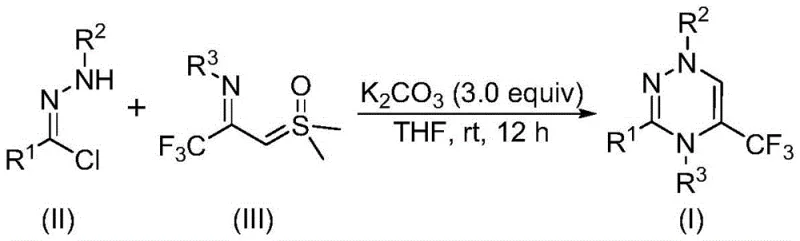
How to Synthesize Trifluoromethyl-Triazine Efficiently
This innovative synthesis route represents a significant advancement in heterocyclic chemistry by enabling efficient production of trifluoromethyl-substituted triazine compounds through a streamlined metal-free process that operates under ambient conditions. The methodology leverages commercially available starting materials and standard laboratory equipment while eliminating complex purification requirements associated with traditional catalytic systems. Detailed standardized synthesis steps are provided below to facilitate seamless implementation in industrial manufacturing environments where consistent product quality and operational reliability are paramount concerns.
- Combine potassium carbonate, chlorohydrazone, and trifluoroacetyl thio ylide in tetrahydrofuran solvent under air atmosphere without nitrogen protection.
- Stir the reaction mixture at room temperature for twelve hours to facilitate nitrile imine intermediate formation and subsequent [3+3] cycloaddition.
- Perform post-treatment through filtration, silica gel mixing, and column chromatography purification to isolate high-purity trifluoromethyl-triazine products.
Commercial Advantages for Procurement and Supply Chain Teams
This patented methodology delivers substantial value across procurement and supply chain operations by addressing critical pain points inherent in traditional triazine synthesis through its inherently scalable design and simplified material requirements. The elimination of expensive transition metal catalysts creates immediate cost advantages while the use of air-stable conditions reduces infrastructure dependencies that typically complicate manufacturing scale-up processes. These combined benefits translate directly into enhanced supply chain resilience through reduced vulnerability to catalyst supply disruptions and simplified logistics management for raw material acquisition.
- Cost Reduction in Manufacturing: The complete removal of transition metal catalysts eliminates both the raw material costs associated with precious metals and the extensive downstream processing required for metal residue removal which represents a significant portion of traditional production expenses; additionally the use of inexpensive potassium carbonate as promoter further reduces chemical costs while maintaining high reaction efficiency across diverse substrate combinations without requiring specialized equipment or energy-intensive conditions.
- Enhanced Supply Chain Reliability: The reliance on commercially available starting materials with established global supply networks ensures consistent raw material availability while the air-stable reaction conditions eliminate dependencies on specialized gas handling systems that could create production bottlenecks; this robustness enables reliable scheduling with minimal disruption risk even during volatile market conditions while supporting just-in-time manufacturing models through predictable production timelines.
- Scalability and Environmental Compliance: The straightforward process design allows seamless transition from laboratory-scale demonstrations to commercial production volumes without requiring fundamental modifications; the absence of toxic metals simplifies waste stream management while reducing environmental remediation costs; furthermore the mild reaction conditions minimize energy consumption compared to traditional high-temperature processes contributing to reduced carbon footprint without compromising product quality or yield consistency.
Frequently Asked Questions (FAQ)
The following questions address key technical considerations based on patent specifications and implementation experience with this innovative synthesis methodology; these insights reflect practical applications observed during laboratory validation and scale-up studies conducted under controlled manufacturing conditions.
Q: How does this method overcome limitations of traditional triazine synthesis?
A: Conventional methods require substrate pre-synthesis and suffer from low efficiency and limited structural diversity; this innovation eliminates those constraints through direct cycloaddition using readily available starting materials under ambient conditions.
Q: Why is eliminating heavy metal catalysts significant for pharmaceutical manufacturing?
A: Removing transition metals avoids costly purification steps for metal residue removal while ensuring regulatory compliance with stringent pharmacopeial standards for therapeutic intermediates.
Q: What enables commercial scalability of this process?
A: The room temperature air-stable reaction with inexpensive potassium carbonate promoter allows seamless transition from gram-scale lab synthesis to multi-ton production without specialized equipment.
Partnering with NINGBO INNO PHARMCHEM: Your Reliable Trifluoromethyl-Triazine Supplier
Our patented technology demonstrates exceptional potential for producing high-purity trifluoromethyl-substituted triazine intermediates essential for advanced pharmaceutical applications; NINGBO INNO PHARMCHEM brings extensive experience scaling diverse pathways from 100 kgs to 100 MT/annual commercial production while maintaining stringent purity specifications through rigorous QC labs equipped with state-of-the-art analytical instrumentation. This capability ensures consistent delivery of complex heterocyclic compounds meeting exacting regulatory requirements across global markets with robust supply chain management protocols.
We invite you to request our Customized Cost-Saving Analysis which details specific implementation pathways tailored to your production requirements; contact our technical procurement team today to obtain specific COA data and route feasibility assessments for your unique application needs.