
Advanced Metal-Free Synthesis of Substituted Pyrroles for Scalable Pharmaceutical Manufacturing
The landscape of organic synthesis for heterocyclic compounds is undergoing a significant transformation, driven by the urgent need for greener, more cost-effective, and scalable manufacturing processes. Patent CN115872914A introduces a groundbreaking methodology for the synthesis of substituted pyrrole compounds that addresses critical bottlenecks in current production capabilities. Pyrrole scaffolds are ubiquitous in medicinal chemistry, serving as core structures for numerous pharmaceutical agents with antifungal, antiviral, and antitumor activities. However, traditional synthetic routes often rely on expensive transition metal catalysts or harsh reaction conditions that limit their industrial applicability. This new patent discloses a robust, metal-free cyclization strategy that utilizes readily available aryl-1-propyne compounds and nitrile derivatives under basic conditions. By eliminating the dependency on precious metals, this technology offers a pathway to high-purity intermediates that are essential for the development of next-generation active pharmaceutical ingredients (APIs) and advanced agrochemicals.
The Limitations of Conventional Methods vs. The Novel Approach
The Limitations of Conventional Methods
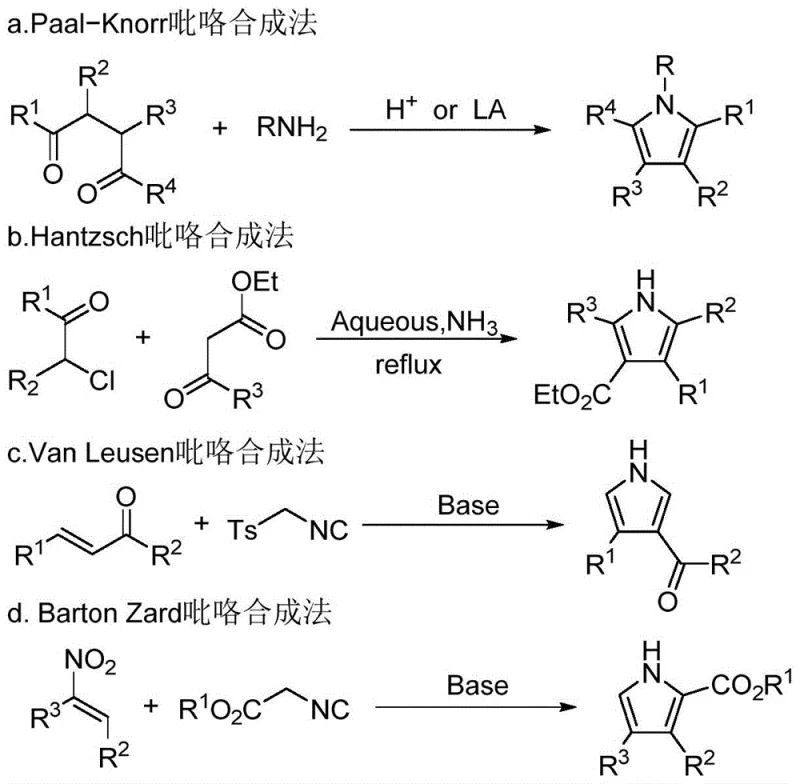
Historically, the construction of the pyrrole ring has relied heavily on classical named reactions such as the Paal-Knorr, Hantzsch, Van Leusen, and Barton-Zard syntheses, as well as modern transition metal-catalyzed cyclizations. While these methods are chemically valid, they present substantial challenges for large-scale commercial manufacturing. Classical methods often require specific, sometimes unstable precursors like 1,4-dicarbonyl compounds, which can be costly and difficult to source in bulk quantities. Furthermore, transition metal-catalyzed approaches, although efficient in laboratory settings, introduce severe complications regarding product purity. The presence of residual metals like copper, rhodium, or palladium in the final product is unacceptable for pharmaceutical applications due to strict regulatory limits on heavy metal impurities. Removing these trace metals requires additional downstream processing steps, such as specialized scavenging resins or repeated recrystallizations, which drastically increase production costs and extend lead times. Additionally, many of these catalytic systems exhibit poor substrate universality, failing to tolerate sensitive functional groups or sterically hindered substrates.
The Novel Approach
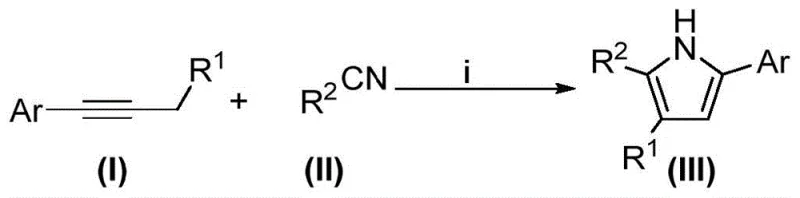
In stark contrast to these legacy technologies, the method described in patent CN115872914A utilizes a direct cyclization between aryl-1-propyne compounds and nitrile compounds mediated by a strong non-nucleophilic base. This approach fundamentally shifts the paradigm from metal-dependent activation to base-promoted nucleophilic addition and subsequent cyclization. The reaction operates under relatively mild thermal conditions, typically between 80°C and 100°C, in common aprotic solvents like toluene. The absence of transition metals not only eliminates the risk of metal contamination but also simplifies the reaction setup and workup procedures significantly. The starting materials, aryl-1-propynes and various nitriles, are commercially abundant and structurally diverse, allowing for the rapid generation of a wide array of substituted pyrrole derivatives. This versatility makes the process highly attractive for process chemists aiming to optimize supply chains for complex heterocyclic intermediates without compromising on yield or purity standards.
Mechanistic Insights into Base-Mediated Cyclization of Aryl-1-Propynes and Nitriles
The core of this innovation lies in the base-mediated activation of the alkyne moiety within the aryl-1-propyne substrate. Under the influence of a strong base such as potassium hexamethyldisilazide (KHMDS) or sodium hexamethyldisilazide (NaHMDS), the terminal or internal alkyne undergoes deprotonation or activation to form a reactive nucleophilic species. This activated alkyne then attacks the electrophilic carbon of the nitrile group, initiating a cascade of intramolecular rearrangements that ultimately close the five-membered pyrrole ring. The mechanism avoids the formation of organometallic intermediates, which are often sensitive to moisture and oxygen, thereby enhancing the operational robustness of the process. The use of bulky silyl-based amide bases ensures high selectivity for the desired cyclization pathway while minimizing side reactions such as polymerization or hydrolysis of the nitrile. This precise control over the reaction trajectory is critical for maintaining high chemical purity, a key requirement for reliable pharmaceutical intermediate suppliers.
From an impurity control perspective, this metal-free mechanism offers distinct advantages over catalytic alternatives. In transition metal catalysis, side products often arise from beta-hydride elimination, homocoupling of the alkyne, or incomplete catalyst turnover, leading to complex impurity profiles that are difficult to separate. In the base-mediated system described here, the primary byproducts are typically derived from unreacted starting materials or simple hydrolysis products, which are far easier to remove during standard aqueous workup and chromatographic purification. The reaction conditions promote a clean conversion, as evidenced by the high yields reported across a broad range of substrates in the patent examples. For instance, electron-rich and electron-deficient aromatic rings on both the alkyne and nitrile components are well-tolerated, demonstrating the electronic flexibility of the mechanism. This robustness ensures consistent batch-to-batch quality, which is paramount for maintaining stringent purity specifications in commercial production environments.
How to Synthesize Substituted Pyrrole Compounds Efficiently
The practical implementation of this synthesis route is straightforward and aligns well with standard organic manufacturing protocols. The process begins with the careful preparation of the reaction mixture under an inert atmosphere to prevent moisture interference with the strong base. The stoichiometry is optimized to ensure complete consumption of the limiting reagent, typically using a slight excess of the nitrile component. Following the reaction period, the quenching step with saturated ammonium chloride effectively neutralizes the base and facilitates the separation of the organic product. The subsequent filtration through silica gel serves as a preliminary purification step, removing inorganic salts and polar byproducts before the final column chromatography. This streamlined workflow minimizes unit operations and solvent usage, contributing to overall process efficiency. For detailed procedural specifics regarding reagent grades, addition rates, and safety precautions, please refer to the standardized synthesis guide below.
- Under inert gas protection, mix aryl-1-propyne compound (Formula I), nitrile compound (Formula II), and a base (such as KHMDS or NaHMDS) in an aprotic solvent like toluene at a molar ratio of 1: 1.2:3.
- Heat the reaction mixture to a temperature between 80°C and 100°C and maintain stirring for 12 to 18 hours to ensure complete cyclization.
- Quench the reaction with saturated aqueous ammonium chloride, filter through silica gel, wash with ethyl acetate, evaporate solvent, and purify the crude product via column chromatography.
Commercial Advantages for Procurement and Supply Chain Teams
For procurement managers and supply chain directors, the adoption of this metal-free synthesis technology translates into tangible strategic benefits that extend beyond simple chemical transformation. The most immediate impact is seen in the reduction of raw material costs. By eliminating the need for expensive transition metal catalysts such as palladium acetate, rhodium complexes, or specialized ligands, the bill of materials for producing these pyrrole derivatives is significantly lowered. Furthermore, the removal of metal scavenging agents and the associated disposal costs for heavy metal waste streams contributes to substantial cost savings in manufacturing. The simplicity of the workup procedure, which avoids complex extraction sequences or specialized filtration equipment required for catalyst removal, allows for faster turnaround times in production facilities. This efficiency gain directly supports the goal of reducing lead time for high-purity pharmaceutical intermediates, enabling quicker response to market demands and clinical trial timelines.
- Cost Reduction in Manufacturing: The elimination of precious metal catalysts represents a major driver for cost optimization in fine chemical production. Transition metals are subject to volatile market pricing and supply constraints, creating financial uncertainty for long-term projects. By switching to a base-mediated system using commodity chemicals like KHMDS and toluene, manufacturers can stabilize their cost structure and achieve significant cost reduction in pharmaceutical intermediate manufacturing. Additionally, the simplified purification process reduces solvent consumption and labor hours associated with extensive metal removal protocols, further enhancing the economic viability of the process on a commercial scale.
- Enhanced Supply Chain Reliability: The starting materials for this reaction, aryl-1-propynes and nitriles, are widely available from multiple global suppliers, reducing the risk of single-source dependency. Unlike specialized catalysts that may have long lead times or limited availability, these bulk chemicals can be sourced reliably, ensuring continuity of supply. The robustness of the reaction conditions also means that the process is less susceptible to variations in raw material quality, providing a more stable production output. This reliability is crucial for maintaining the integrity of the supply chain for critical drug substances, where interruptions can have severe downstream consequences for patient access and regulatory compliance.
- Scalability and Environmental Compliance: Scaling chemical processes from the laboratory to pilot and commercial plants often reveals hidden challenges, particularly with exothermic metal-catalyzed reactions. The base-mediated cyclization described in this patent operates under controlled thermal conditions that are easier to manage in large reactors, facilitating the commercial scale-up of complex pyrrole derivatives. Moreover, the absence of heavy metals simplifies environmental compliance and waste treatment. Disposing of metal-contaminated waste requires specialized handling and incurs high regulatory fees. By generating waste streams that are primarily organic and free of toxic metals, this process aligns better with green chemistry principles and reduces the environmental footprint of the manufacturing operation, supporting corporate sustainability goals.
Frequently Asked Questions (FAQ)
The following questions address common technical and commercial inquiries regarding the implementation of this novel pyrrole synthesis method. These answers are derived directly from the experimental data and technical specifications outlined in the patent documentation, providing clarity on reaction scope, operational parameters, and potential applications. Understanding these details is essential for R&D teams evaluating the feasibility of integrating this technology into their existing pipelines and for procurement specialists assessing the long-term value proposition of this manufacturing route.
Q: What are the primary advantages of this metal-free pyrrole synthesis over traditional transition metal catalysis?
A: The primary advantage is the complete elimination of expensive transition metal catalysts such as palladium, rhodium, or copper. This removes the risk of heavy metal contamination in the final API, significantly simplifies the post-reaction workup by avoiding complex metal scavenging steps, and reduces raw material costs associated with precious metal catalysts.
Q: What is the substrate scope for the aryl-1-propyne and nitrile components in this reaction?
A: The method demonstrates excellent substrate universality. The aryl group (Ar) can be phenyl, substituted phenyl, naphthyl, or aromatic heterocycles. The R2 group on the nitrile can similarly be phenyl, substituted phenyl, naphthyl, aromatic heterocycles, or alkyl groups, allowing for the synthesis of a diverse library of pyrrole derivatives suitable for various medicinal chemistry applications.
Q: What are the optimal reaction conditions for maximizing yield in this cyclization process?
A: Optimal results are achieved using toluene as the aprotic solvent and potassium hexamethyldisilazide (KHMDS) or sodium hexamethyldisilazide (NaHMDS) as the base. The reaction should be conducted under inert gas protection at temperatures between 80°C and 100°C for a duration of 12 to 18 hours, followed by quenching with saturated ammonium chloride solution.
Partnering with NINGBO INNO PHARMCHEM: Your Reliable Substituted Pyrrole Supplier
The technological advancements detailed in patent CN115872914A represent a significant leap forward in the efficient production of high-value heterocyclic building blocks. At NINGBO INNO PHARMCHEM, we recognize the critical importance of translating such innovative academic and patent literature into robust, commercial-grade manufacturing processes. As a dedicated CDMO partner, we possess extensive experience scaling diverse pathways from 100 kgs to 100 MT/annual commercial production, ensuring that the theoretical benefits of metal-free synthesis are fully realized in practical, large-volume outputs. Our facility is equipped with rigorous QC labs and advanced analytical instrumentation capable of meeting stringent purity specifications required by top-tier pharmaceutical clients. We are committed to delivering substituted pyrrole compounds that not only meet but exceed the quality expectations necessary for modern drug development programs.
We invite you to explore how this cost-effective and environmentally friendly synthesis route can enhance your supply chain resilience and reduce your overall project costs. Our technical team is ready to conduct a Customized Cost-Saving Analysis tailored to your specific molecule requirements. Please contact our technical procurement team today to request specific COA data for our existing pyrrole inventory or to discuss route feasibility assessments for your custom synthesis projects. Together, we can accelerate the delivery of life-saving medicines to the market through superior chemical manufacturing excellence.