
Advanced Synthesis of 3-Trifluoromethyl-1,2,4-Triazoles for Scalable Pharmaceutical Manufacturing
Advanced Synthesis of 3-Trifluoromethyl-1,2,4-Triazoles for Scalable Pharmaceutical Manufacturing
The pharmaceutical industry continuously seeks robust and scalable methodologies for constructing nitrogen-containing heterocycles, particularly those bearing fluorinated motifs which are pivotal for enhancing metabolic stability and bioavailability. Patent CN114920707B introduces a groundbreaking preparation method for 3-trifluoromethyl substituted 1,2,4-triazole compounds, addressing critical bottlenecks in current synthetic routes. This technology leverages the ubiquitous solvent N,N-dimethylformamide (DMF) not merely as a medium, but as an active carbon source, thereby streamlining the synthetic pathway. The significance of this scaffold is underscored by its presence in high-value therapeutic agents, ranging from anticonvulsants to Factor IXa inhibitors, making the development of efficient access routes a priority for any reliable pharmaceutical intermediate supplier.
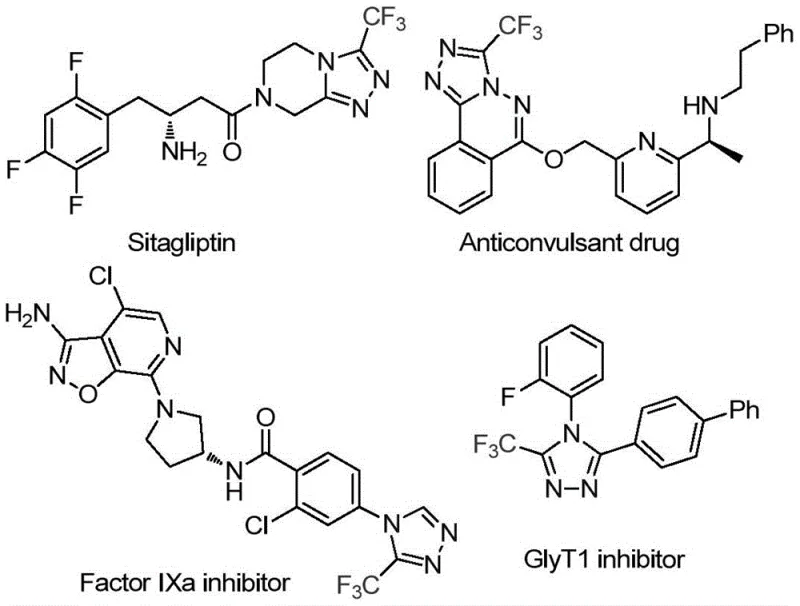
By utilizing a molecular iodine-promoted tandem cyclization strategy, this invention eliminates the dependency on complex, moisture-sensitive catalysts often required in traditional heterocycle synthesis. The process operates under remarkably mild constraints regarding atmospheric conditions, functioning effectively in air rather than requiring inert gas shielding. For R&D teams focused on process chemistry, this represents a substantial shift towards greener and more operationally simple protocols. The ability to generate diverse 1,2,4-triazole derivatives with varying functional groups through simple substrate design further enhances the utility of this method, positioning it as a versatile tool for the rapid generation of compound libraries in drug discovery pipelines.
The Limitations of Conventional Methods vs. The Novel Approach
The Limitations of Conventional Methods
Historically, the construction of trifluoromethyl-substituted 1,2,4-triazoles has been plagued by synthetic inefficiencies that hinder large-scale production. Traditional routes often necessitate the use of specialized, expensive reagents to introduce the triazole ring and the trifluoromethyl group separately, leading to multi-step sequences with poor atom economy. Furthermore, many existing protocols demand stringent anhydrous and anaerobic conditions, requiring specialized equipment such as gloveboxes or Schlenk lines, which drastically increases capital expenditure and operational complexity in a manufacturing setting. The reliance on transition metal catalysts in some conventional methods also introduces significant downstream purification challenges, as removing trace metal residues to meet pharmaceutical purity standards can be both time-consuming and costly. These factors collectively contribute to extended lead times and inflated production costs, creating a supply chain vulnerability for high-purity pharmaceutical intermediates.
The Novel Approach
In stark contrast, the methodology disclosed in CN114920707B offers a paradigm shift by integrating the solvent and reactant roles into a single component, DMF. This dual-functionality approach drastically simplifies the reaction matrix, reducing the number of input variables and potential impurities. The reaction proceeds via an iodine-promoted mechanism that activates the DMF molecule, allowing it to participate directly in the ring-closing event. This innovation means that manufacturers can utilize standard reactor setups without the need for exotic atmosphere controls, as the reaction tolerates the presence of air. The operational simplicity extends to the workup phase, where standard filtration and chromatography techniques suffice to isolate the target compounds. For procurement managers, this translates to cost reduction in API manufacturing by minimizing the inventory of specialized reagents and reducing the energy overhead associated with maintaining inert environments.
Mechanistic Insights into Iodine-Promoted Tandem Cyclization
The mechanistic elegance of this transformation lies in the versatility of DMF as a C1 synthon. Depending on the specific pathway taken, either the formyl group or the N-methyl group of DMF can serve as the carbon source for the triazole ring construction. When the formyl group acts as the donor, it undergoes condensation with the trifluoroethyliminohydrazide to form a hydrazone intermediate, which subsequently cyclizes with the elimination of dimethylamine. Alternatively, when the N-methyl group is utilized, molecular iodine first activates the DMF to generate an amine salt species. This activated intermediate then engages in nucleophilic addition with the hydrazide, followed by elimination and oxidative aromatization to yield the final 3-trifluoromethyl-1,2,4-triazole product. This dual-pathway capability ensures high reaction efficiency across a broad range of substrates.
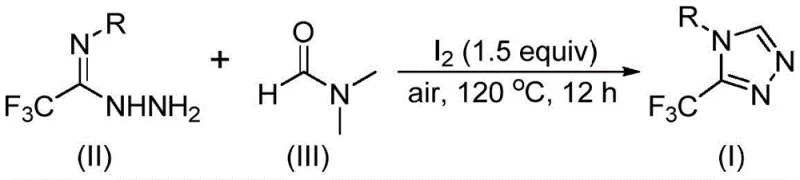
From an impurity control perspective, the use of molecular iodine as a promoter is particularly advantageous. Unlike heavy metal catalysts that can persist through purification stages, iodine and its byproducts are generally easier to remove via aqueous washing or sublimation. The reaction conditions, typically maintained between 110°C and 130°C, provide sufficient thermal energy to drive the cyclization to completion while avoiding the decomposition of sensitive functional groups on the aromatic ring. The tolerance for various substituents, including electron-withdrawing groups like trifluoromethyl and halogens, as well as electron-donating groups like methoxy and alkyl chains, indicates a robust catalytic cycle that is not easily poisoned by substrate variations. This mechanistic resilience is critical for ensuring consistent batch-to-batch quality in commercial production.
How to Synthesize 3-Trifluoromethyl-1,2,4-Triazole Efficiently
The execution of this synthesis is designed for practicality, utilizing readily available starting materials such as trifluoroethyliminohydrazide and commercial grade DMF. The protocol involves a straightforward mixing of reagents followed by a heating period, making it highly amenable to automation and scale-up. The detailed standardized synthesis steps, including precise molar ratios and purification parameters, are outlined in the technical guide below to ensure reproducibility for process chemists.
- Combine molecular iodine, trifluoroethyliminohydrazide, and DMF solvent in a reaction vessel under air atmosphere.
- Heat the mixture to 110-130°C and maintain reaction for 10-15 hours to ensure complete conversion.
- Perform post-treatment including filtration, washing, and column chromatography to isolate the pure triazole product.
Commercial Advantages for Procurement and Supply Chain Teams
For supply chain leaders, the adoption of this synthetic route offers tangible strategic benefits beyond mere chemical yield. The primary advantage stems from the drastic simplification of the raw material list. By employing DMF, a commodity chemical available in bulk quantities globally, the process mitigates the risk of supply disruptions associated with niche reagents. This commonality also drives down the unit cost of goods sold, as there is no need to source expensive, custom-synthesized carbon donors. The elimination of strict inert atmosphere requirements further reduces the barrier to entry for contract manufacturing organizations (CMOs), allowing for a wider pool of potential manufacturing partners and enhancing supply chain reliability.
- Cost Reduction in Manufacturing: The economic impact of this method is profound due to the dual role of DMF. By serving as both solvent and reactant, the process eliminates the need for purchasing separate carbon-source reagents, which are often costly and hazardous. Additionally, the avoidance of transition metal catalysts removes the necessity for expensive metal scavenging resins and the associated validation testing for residual metals. This streamlined reagent profile leads to substantial cost savings in raw material procurement and waste disposal, directly improving the gross margin for the final API intermediate.
- Enhanced Supply Chain Reliability: Operational resilience is significantly improved because the reaction does not depend on fragile anhydrous or anaerobic conditions. This robustness allows for production in standard facilities without specialized infrastructure, reducing the lead time for high-purity pharmaceutical intermediates. The starting materials, including the hydrazide precursors and molecular iodine, are commercially available from multiple global suppliers, preventing single-source bottlenecks. This diversification of the supply base ensures continuity of supply even during market fluctuations or geopolitical disruptions.
- Scalability and Environmental Compliance: Scaling this reaction from gram to kilogram or tonne scale is facilitated by the use of standard polar aprotic solvents and simple thermal inputs. The absence of pyrophoric reagents or high-pressure hydrogenation steps simplifies the safety profile of the manufacturing process, lowering insurance and compliance costs. Furthermore, the simplified workup procedure generates less hazardous waste compared to multi-step traditional routes, aligning with modern green chemistry principles and reducing the environmental footprint of the manufacturing site.
Frequently Asked Questions (FAQ)
The following questions address common technical inquiries regarding the implementation of this patented technology. These answers are derived directly from the experimental data and specifications provided in the patent documentation, ensuring accuracy for technical decision-makers evaluating this route for their own pipelines.
Q: What is the primary advantage of using DMF in this synthesis?
A: DMF serves a dual role as both the reaction solvent and the carbon source (providing either the formyl or methyl group), which significantly simplifies the reagent list and reduces raw material costs compared to traditional methods requiring separate carbon donors.
Q: Does this reaction require strict anhydrous or anaerobic conditions?
A: No, one of the key operational benefits of this patented method (CN114920707B) is that it proceeds efficiently under standard air atmosphere without the need for rigorous anhydrous or oxygen-free environments, facilitating easier scale-up.
Q: What types of substituents are tolerated on the aromatic ring?
A: The method demonstrates broad substrate scope, successfully accommodating various substituents including alkyl, alkoxy, alkylthio, halogens (fluorine, chlorine), and trifluoromethyl groups at ortho, meta, or para positions.
Partnering with NINGBO INNO PHARMCHEM: Your Reliable 3-Trifluoromethyl-1,2,4-Triazole Supplier
At NINGBO INNO PHARMCHEM, we recognize the critical importance of efficient heterocycle synthesis in the development of next-generation therapeutics. Our team possesses extensive experience scaling diverse pathways from 100 kgs to 100 MT/annual commercial production, ensuring that the transition from lab bench to manufacturing plant is seamless. We adhere to stringent purity specifications and operate rigorous QC labs to guarantee that every batch of 3-trifluoromethyl-1,2,4-triazole meets the exacting standards required for pharmaceutical applications. Our commitment to quality assurance ensures that your supply chain remains robust and compliant with international regulatory bodies.
We invite you to leverage our technical expertise to optimize your specific manufacturing needs. Please contact our technical procurement team to request a Customized Cost-Saving Analysis tailored to your project volume. We are prepared to provide specific COA data and comprehensive route feasibility assessments to demonstrate how our implementation of this iodine-promoted technology can enhance your production efficiency and reduce overall costs.