
Revolutionizing Inactive Olefin Arylation: A Mechanochemical Approach for Scalable Pharma Intermediates
Revolutionizing Inactive Olefin Arylation: A Mechanochemical Approach for Scalable Pharma Intermediates
The landscape of organic synthesis is undergoing a paradigm shift towards greener, more efficient methodologies, exemplified by the groundbreaking technology disclosed in patent CN109761810B. This intellectual property introduces a novel preparation method for inactive olefin aryl compounds, utilizing a solvent-free mechanical grinding mode to drive oxidative Heck reactions. Traditionally, the arylation of electron-rich or sterically hindered olefins has been a formidable challenge, often plagued by low reactivity and poor selectivity in conventional solution-phase systems. By leveraging high-energy ball milling, this invention achieves remarkable yields ranging from 49% to 85% for substrates that previously afforded negligible conversion (0-35%) or required harsh conditions. For R&D directors and process chemists seeking robust routes to complex molecular scaffolds, this mechanochemical protocol represents a significant advancement in synthetic efficiency and environmental compliance.
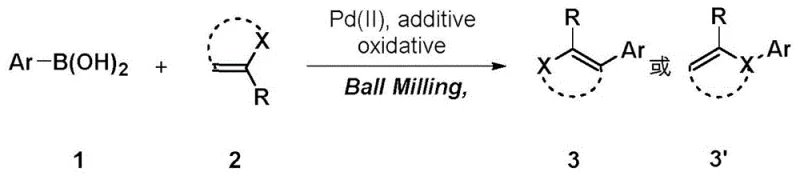
The Limitations of Conventional Methods vs. The Novel Approach
The Limitations of Conventional Methods
Historically, the construction of arylated olefin derivatives has relied heavily on classical Heck coupling or oxidative Heck coupling performed in liquid media. These traditional solution-phase methods frequently necessitate the use of aryl halides, which generate stoichiometric amounts of halogenated waste, posing significant environmental and disposal challenges for large-scale manufacturing. Moreover, when targeting inactive olefins—defined as electron-rich olefins directly connected with alkyl groups or substituted by multiple alkyl chains—the reaction kinetics are notoriously sluggish due to the difficulty of the olefinic bond insertion process. To overcome these kinetic barriers, conventional protocols often resort to excessive heating, prolonged stirring times spanning several hours to days, and the utilization of high-boiling, toxic solvents such as DMF, 1,4-dioxane, or toluene. Even with these aggressive conditions, the selectivity remains difficult to control, frequently resulting in complex mixtures of regioisomers rather than the desired single-structure olefin arylate, thereby complicating downstream purification and reducing overall process economy.
The Novel Approach
In stark contrast to the limitations of liquid-phase chemistry, the patented mechanochemical strategy utilizes mechanical force to activate the reactants in a solvent-free solid-state environment. This approach fundamentally alters the reaction landscape by eliminating the solvent cage effect and enhancing mass transfer through direct physical impact between the grinding media and the reagents. The invention demonstrates that inactive olefins, which are typically recalcitrant in solution, undergo smooth oxidative Heck coupling with arylboronic acids under mild mechanical agitation. The reaction system is remarkably simple, requiring only a palladium catalyst, an oxidant, and potentially a solid or liquid additive, without the need for specialized ligands that often drive up costs in traditional catalysis. By reducing the reaction time to a mere 25 to 40 minutes and operating at ambient temperatures without external heating, this method not only accelerates the synthesis timeline but also inherently improves safety profiles by removing flammable solvent hazards and thermal runaway risks associated with exothermic coupling reactions.
Mechanistic Insights into Mechanochemical Oxidative Heck Coupling
The efficacy of this ball milling protocol lies in its unique ability to facilitate the catalytic cycle of palladium under solvent-free conditions, a phenomenon that differs mechanistically from solution-phase counterparts. In the proposed mechanism, the mechanical energy input likely promotes the formation of reactive surface species on the palladium catalyst, enhancing the oxidative addition or transmetallation steps involving the arylboronic acid. The presence of oxidants such as DDQ, copper acetate, or potassium persulfate is critical for regenerating the active Pd(II) species from the Pd(0) intermediate formed after reductive elimination, thus sustaining the catalytic turnover without the need for excess catalyst loading. The mechanical impacts continuously expose fresh catalyst surfaces and ensure intimate mixing of the solid reagents, effectively overcoming the diffusion limitations that typically hinder solid-state reactions. This continuous renewal of reactive interfaces allows for the successful activation of the C-H bond in the inactive olefin, a step that is usually the rate-determining bottleneck in solution chemistry due to the high electron density of the double bond repelling electrophilic palladium species.
Furthermore, the selectivity observed in this mechanochemical system provides crucial insights into the control of impurity profiles, a key concern for pharmaceutical intermediate manufacturing. The absence of bulk solvent minimizes side reactions such as homocoupling of the boronic acid or polymerization of the olefin, which are often solvent-mediated processes. The specific interaction between the grinding balls and the reaction mixture creates localized high-pressure and high-temperature zones (hot spots) that are transient but sufficient to drive the desired transformation while suppressing thermal degradation pathways. The use of acidic additives, such as trichloroacetic acid or acetic acid, further modulates the reaction environment, potentially protonating intermediate species to favor the formation of the thermodynamically stable E-isomer or specific regioisomer as indicated by the patent examples. This level of control ensures that the final crude product contains fewer byproducts, simplifying the purification workflow and enhancing the overall purity of the high-purity pharmaceutical intermediates produced via this route.
How to Synthesize Inactive Olefin Aryl Compounds Efficiently
The operational simplicity of this mechanochemical synthesis makes it an attractive candidate for rapid process development and scale-up in industrial settings. The general procedure involves charging a stainless steel grinding jar with the arylboronic acid substrate, the inactive olefin partner, a palladium source like Pd(OAc)2, and a suitable oxidant system. Detailed standardized synthesis steps see the guide below.
- Charge a stainless steel grinding jar with arylboronic acid, inactive olefin, palladium catalyst (e.g., Pd(OAc)2), oxidant (e.g., DDQ or Copper Acetate), and acidic additive.
- Add stainless steel grinding balls to the jar and secure the lid tightly to ensure a sealed environment for the mechanical impact.
- Operate the vibratory or planetary mill at frequencies between 10-30 Hz or speeds of 200-800 rpm for 25-40 minutes until TLC indicates completion.
- Unload the mixture, remove grinding media, and purify the crude product via silica gel column chromatography using petroleum ether and ethyl acetate.
Commercial Advantages for Procurement and Supply Chain Teams
For procurement managers and supply chain heads, the transition from solution-phase to mechanochemical synthesis offers tangible strategic benefits beyond mere technical novelty. The elimination of organic solvents represents a direct reduction in raw material procurement costs and removes the logistical burden associated with the storage, handling, and disposal of hazardous volatile organic compounds (VOCs). This shift aligns perfectly with global sustainability mandates and reduces the regulatory overhead related to environmental compliance, thereby de-risking the supply chain for long-term production contracts. Additionally, the drastic reduction in reaction time from hours to minutes translates into significantly increased throughput capacity for existing manufacturing equipment, allowing for faster fulfillment of customer orders without the need for capital-intensive expansion of reactor farms.
- Cost Reduction in Manufacturing: The economic implications of this solvent-free methodology are profound, primarily driven by the complete removal of expensive and toxic high-boiling solvents like DMF and dioxane from the bill of materials. By eliminating the need for solvent recovery systems and the energy-intensive distillation steps required to remove these high-boiling liquids, the overall utility consumption per kilogram of product is substantially decreased. Furthermore, the ligand-free nature of the catalytic system removes the cost burden associated with purchasing and handling sensitive phosphine ligands, which are often prone to oxidation and require cold storage. The simplified workup procedure, which involves basic column chromatography without extensive aqueous washes to remove solvent residues, further drives down labor and processing costs, resulting in a leaner and more cost-competitive manufacturing process for complex fine chemicals.
- Enhanced Supply Chain Reliability: Adopting this robust mechanochemical route enhances supply chain resilience by reducing dependency on specialized solvent supply chains that can be volatile due to petrochemical market fluctuations. The reagents used, such as arylboronic acids and simple palladium salts, are commodity chemicals with stable availability, ensuring consistent production schedules even during raw material shortages. The rapid reaction kinetics mean that production batches can be turned over much faster, reducing the work-in-progress inventory holding time and improving cash flow dynamics for the manufacturing entity. This agility allows suppliers to respond more quickly to sudden spikes in demand from downstream pharmaceutical clients, securing their position as a reliable partner capable of meeting tight deadlines without compromising on quality or delivery performance.
- Scalability and Environmental Compliance: From a scalability perspective, the mechanochemical process avoids the heat transfer limitations often encountered when scaling up exothermic reactions in large liquid-filled reactors, as the solid-state grinding dissipates heat differently and efficiently. The absence of solvent waste streams significantly reduces the volume of hazardous waste generated per unit of product, simplifying the environmental permitting process and lowering waste treatment fees. This green chemistry profile is increasingly becoming a prerequisite for inclusion in the supply chains of major multinational corporations who have strict carbon footprint and sustainability targets. Consequently, manufacturers utilizing this technology are better positioned to win long-term contracts with environmentally conscious clients, ensuring business continuity and growth in a regulatory landscape that is progressively tightening around chemical manufacturing emissions.
Frequently Asked Questions (FAQ)
The following questions address common technical and commercial inquiries regarding the implementation of this mechanochemical oxidative Heck reaction technology. These answers are derived directly from the experimental data and beneficial effects described in the patent documentation to provide clarity on process feasibility. Understanding these details is essential for evaluating the potential integration of this method into existing production workflows for high-value intermediates.
Q: What are the primary advantages of using ball milling for oxidative Heck reactions compared to solution-phase methods?
A: The mechanochemical approach eliminates the need for high-boiling, environmentally unfriendly solvents like DMF or dioxane, significantly reducing waste disposal costs. Furthermore, it drastically shortens reaction times from several hours to under 40 minutes while achieving superior yields (49-85%) for inactive olefins that typically fail in solution.
Q: Does this method require expensive phosphine ligands for the palladium catalyst?
A: No, one of the key economic benefits of this patented process is that it operates effectively without the need for complex or expensive phosphine ligands. The mechanical energy input facilitates the catalytic cycle using simple palladium salts like Pd(OAc)2, thereby lowering raw material costs.
Q: Is this synthesis method scalable for industrial production of pharmaceutical intermediates?
A: Yes, the solvent-free nature and short reaction cycles make it highly amenable to scale-up. The absence of large solvent volumes simplifies downstream processing and purification, addressing common bottlenecks in the commercial scale-up of complex pharmaceutical intermediates.
Partnering with NINGBO INNO PHARMCHEM: Your Reliable Inactive Olefin Aryl Compound Supplier
At NINGBO INNO PHARMCHEM, we recognize the transformative potential of mechanochemical synthesis in delivering high-value pharmaceutical intermediates with superior efficiency and sustainability. As a dedicated CDMO partner, we possess extensive experience scaling diverse pathways from 100 kgs to 100 MT/annual commercial production, ensuring that innovative laboratory protocols like the one described in CN109761810B can be seamlessly translated into robust industrial processes. Our facilities are equipped with state-of-the-art milling technology and rigorous QC labs capable of maintaining stringent purity specifications required by the global pharmaceutical industry. We are committed to leveraging such advanced green chemistry techniques to provide our clients with cost-effective and environmentally responsible manufacturing solutions that meet the highest standards of quality and reliability.
We invite you to collaborate with us to explore how this solvent-free arylation technology can optimize your specific project requirements and reduce your overall cost of goods. Please contact our technical procurement team to request a Customized Cost-Saving Analysis tailored to your target molecule. We are ready to provide specific COA data and comprehensive route feasibility assessments to demonstrate how our expertise in mechanochemical processing can accelerate your development timelines and secure your supply chain for the future.