
Advanced Stereoselective Synthesis of (Z)-3-Alkenylphthalide Derivatives for Pharmaceutical Applications
Introduction to Next-Generation Phthalide Synthesis
The pharmaceutical industry continuously seeks robust and efficient pathways for constructing complex heterocyclic scaffolds, particularly those exhibiting significant biological activity such as the (Z)-3-alkenylphthalide core. Patent CN113004235B discloses a groundbreaking stereoselective synthesis method that addresses long-standing challenges in producing these vital intermediates. This technology leverages a Lewis acid-catalyzed cyclization strategy, specifically utilizing aluminum-based catalysts to transform 2-acylbenzoic acid derivatives into high-purity (Z)-3-alkenylphthalides. The significance of this molecular skeleton cannot be overstated, as it serves as a precursor for compounds with potent anti-inflammatory, antioxidant, anti-HIV, and cardiovascular protective properties. By shifting away from harsh classical conditions, this innovation offers a streamlined route that aligns perfectly with modern green chemistry principles while maintaining the rigorous purity standards required for active pharmaceutical ingredient (API) manufacturing.
For R&D directors and process chemists, the ability to access these derivatives with high stereocontrol is paramount. The patent details a methodology that not only simplifies the synthetic sequence but also ensures exceptional geometric selectivity, predominantly favoring the biologically relevant Z-configuration. This represents a substantial leap forward from earlier techniques that often struggled with isomeric mixtures or required prohibitively expensive reagents. As a reliable pharmaceutical intermediate supplier, understanding and implementing such advanced methodologies allows us to offer clients superior quality materials with reduced impurity profiles. The following analysis delves into the technical nuances of this process, highlighting its potential to redefine cost structures and supply chain reliability for global drug development programs targeting metabolic and infectious diseases.
The Limitations of Conventional Methods vs. The Novel Approach
The Limitations of Conventional Methods
Historically, the construction of the 3-alkenylphthalide framework has relied on several established but flawed methodologies that pose significant hurdles for commercial scale-up. The classic Perkin reaction, involving the condensation of phthalic anhydride with acid anhydrides, typically necessitates high-temperature conditions that can lead to thermal degradation of sensitive functional groups and poor energy efficiency. Similarly, the Julia olefination approach, while useful, often involves the generation and handling of reactive lithium reagents, introducing safety hazards and moisture sensitivity that complicate large-batch processing. Furthermore, transition metal-catalyzed cyclizations of 2-alkynyl benzoic acids, though effective, depend heavily on precious metals like Palladium or Copper. These metals not only drive up raw material costs but also impose strict regulatory burdens regarding residual metal limits in final drug substances, necessitating additional and costly purification steps.
Another notable prior art method reported by Takaishi et al. utilized thionyl chloride (SOCl2) for cyclization; however, this approach suffered from a critical lack of stereoselectivity, producing mixtures of (E) and (Z) isomers that are difficult and expensive to separate. The formation of such byproducts directly impacts overall yield and complicates the isolation of the desired pharmacological agent. Additionally, methods mediated by coupling reagents like TSTU (2-succinimidyl-1,1,3,3-tetramethyluronium tetrafluoroborate) are limited by the high cost of the reagent itself, rendering them economically unviable for multi-kilogram or ton-scale production. These cumulative limitations underscore the urgent need for a catalytic system that is both economically accessible and capable of delivering high stereochemical fidelity without compromising operational safety or environmental compliance.
The Novel Approach
The methodology outlined in CN113004235B introduces a paradigm shift by employing inexpensive and readily available aluminum salts, specifically anhydrous aluminum trichloride (AlCl3), as the primary catalyst. This Lewis acid-mediated pathway facilitates the dehydration condensation of 2-acylbenzoic acids under remarkably mild conditions, typically around 60°C in acetonitrile. Unlike the high-energy inputs required for Perkin reactions or the stringent inert atmosphere needs of organolithium chemistry, this process can be conducted in air, significantly simplifying reactor setup and operational protocols. The use of AlCl3 eliminates the dependency on precious transition metals, thereby removing the associated supply chain volatility and cost premiums linked to Palladium or Rhodium markets. This accessibility makes the process inherently more stable and predictable for long-term manufacturing contracts.
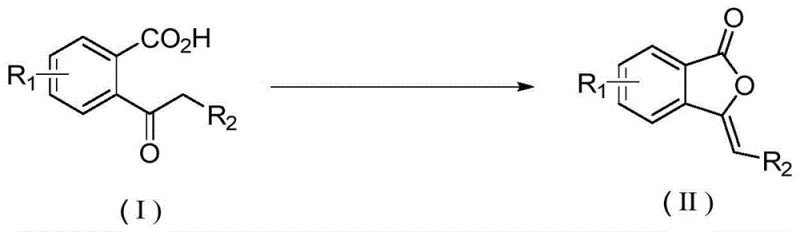
Moreover, the novel approach excels in stereoselectivity, consistently achieving Z/E ratios greater than 99:1 across a broad substrate scope. This high level of geometric control means that the desired (Z)-isomer is formed almost exclusively, drastically reducing the burden on downstream purification processes. For procurement managers, this translates to higher effective yields and lower waste generation, as less material is lost during chromatographic separation of isomers. The versatility of the method is further demonstrated by its tolerance to various substituents on the aromatic ring and the alkyl side chain, including halogens, methoxy groups, and even bulky benzyl moieties. This robustness ensures that the process can be adapted for a wide array of derivative syntheses without requiring extensive re-optimization, providing a flexible platform for generating diverse chemical libraries for drug discovery.
Mechanistic Insights into AlCl3-Catalyzed Cyclization
The core of this technological advancement lies in the activation of the carboxylic acid moiety by the aluminum cation (Al3+), which acts as a potent Lewis acid. In the reaction medium, the aluminum species coordinates with the carbonyl oxygen of the carboxylic acid group in the 2-acylbenzoic acid substrate. This coordination increases the electrophilicity of the carbonyl carbon, facilitating a nucleophilic attack by the adjacent ketone oxygen or promoting an intramolecular dehydration pathway that leads to lactonization. The specific interaction between the aluminum catalyst and the substrate stabilizes the transition state in a conformation that favors the formation of the (Z)-alkene geometry. This stereochemical outcome is likely driven by steric interactions within the cyclic transition state, where the bulky substituents are oriented to minimize repulsion, naturally leading to the cis-arrangement of the alkenyl side chain relative to the lactone ring.
From an impurity control perspective, the mechanism inherently suppresses the formation of the (E)-isomer, which is a common contaminant in non-selective acid-catalyzed dehydrations. The high selectivity observed (Z/E > 99:1) suggests that the energy barrier for forming the (Z)-product is significantly lower than that for the (E)-product under these specific catalytic conditions. This mechanistic preference is crucial for ensuring batch-to-batch consistency and meeting stringent regulatory specifications for chiral and geometric purity. Furthermore, the use of acetonitrile as a solvent plays a dual role: it solubilizes the polar intermediates effectively and may also participate in stabilizing the aluminum complex, ensuring a homogeneous reaction environment. The absence of radical pathways or harsh oxidative conditions further minimizes the risk of side reactions such as polymerization or over-oxidation, resulting in a cleaner crude reaction profile that simplifies the final isolation of the high-purity pharmaceutical intermediate.
How to Synthesize (Z)-3-Alkenylphthalide Efficiently
Implementing this synthesis route requires careful attention to stoichiometry and reaction monitoring to maximize yield and selectivity. The process begins with the dissolution of the 2-acylbenzoic acid starting material in anhydrous acetonitrile, followed by the addition of the aluminum catalyst. Maintaining the reaction temperature at approximately 60°C is critical; while the reaction can proceed at room temperature, moderate heating accelerates the kinetics without compromising the stereoselectivity. Reaction progress is typically monitored via Thin Layer Chromatography (TLC), allowing operators to quench the reaction precisely upon completion to prevent any potential degradation. The workup procedure is notably straightforward, involving solvent evaporation and direct purification, which streamlines the workflow compared to multi-step extraction protocols.
- Dissolve the 2-acylbenzoic acid substrate in anhydrous acetonitrile within a reaction vessel equipped with stirring capabilities.
- Add anhydrous aluminum trichloride (AlCl3) at a molar ratio of 1: 1 relative to the substrate and heat the mixture to 60°C.
- Maintain stirring for approximately 10 hours until TLC indicates completion, then concentrate and purify via column chromatography.
Commercial Advantages for Procurement and Supply Chain Teams
For procurement managers and supply chain heads, the adoption of this AlCl3-catalyzed methodology presents a compelling value proposition centered on cost stability and operational efficiency. The primary driver of cost reduction is the substitution of expensive transition metal catalysts with commodity-grade aluminum salts. Palladium and Copper prices are subject to significant market fluctuations and geopolitical supply risks, whereas aluminum trichloride is abundant, inexpensive, and globally sourced. This switch not only lowers the direct material cost per kilogram of the intermediate but also mitigates the financial risk associated with volatile metal markets. Additionally, the elimination of heavy metals from the process removes the necessity for specialized scavenging resins or complex filtration steps designed to meet ppm-level metal specifications, further reducing processing time and consumable expenses.
Enhanced supply chain reliability is another critical benefit derived from the mild reaction conditions and simple reagent profile. The ability to run the reaction in air rather than under strict inert gas atmospheres reduces the complexity of reactor requirements and allows for faster turnaround times between batches. The robustness of the catalyst system means that raw material quality variations have less impact on the final outcome, ensuring consistent production schedules. Moreover, the high stereoselectivity directly correlates to improved throughput; since the desired isomer is produced predominantly, less capacity is tied up in recycling off-spec material or performing extensive recrystallizations. This efficiency gain allows manufacturers to respond more agilely to demand spikes from downstream API producers, securing the supply continuity essential for clinical trial material and commercial launch phases.
- Cost Reduction in Manufacturing: The replacement of precious metal catalysts with aluminum trichloride results in substantial savings on raw material expenditures. By avoiding the use of Palladium or Copper, manufacturers eliminate the high licensing fees and recovery costs associated with noble metals. Furthermore, the simplified workup procedure reduces solvent consumption and labor hours, contributing to a lower overall cost of goods sold (COGS) for the final intermediate.
- Enhanced Supply Chain Reliability: The reliance on widely available, non-hazardous reagents ensures that production is not bottlenecked by the scarcity of specialized chemicals. The mild operating conditions reduce equipment wear and tear, leading to lower maintenance downtime and higher asset utilization rates. This stability allows for more accurate forecasting and inventory planning, crucial for maintaining uninterrupted supply to pharmaceutical partners.
- Scalability and Environmental Compliance: The process generates minimal hazardous waste compared to methods using thionyl chloride or strong bases. The absence of heavy metal residues simplifies wastewater treatment and disposal, aligning with increasingly strict environmental regulations. The scalability is proven by the linear relationship between lab-scale and pilot-scale results, ensuring that technology transfer to multi-ton reactors is seamless and risk-free.
Frequently Asked Questions (FAQ)
The following questions address common technical and commercial inquiries regarding the implementation of this stereoselective synthesis technology. These insights are derived directly from the experimental data and beneficial effects reported in the patent literature, providing a transparent view of the process capabilities. Understanding these details helps stakeholders make informed decisions about integrating this route into their existing manufacturing portfolios.
Q: How does this AlCl3 method compare to traditional Palladium-catalyzed routes?
A: Unlike traditional methods requiring expensive transition metals like Palladium or Copper and high-temperature conditions, this novel approach utilizes inexpensive Aluminum Trichloride under mild conditions (60°C), significantly reducing raw material costs and eliminating the need for rigorous heavy metal removal steps.
Q: What is the stereoselectivity profile of this synthesis?
A: The process demonstrates exceptional stereoselectivity, consistently yielding the (Z)-isomer with Z/E ratios exceeding 99:1 across various substrates, thereby minimizing the formation of unwanted (E)-isomer byproducts and simplifying downstream purification.
Q: Is this method suitable for large-scale industrial production?
A: Yes, the method is highly scalable due to the use of common solvents like acetonitrile, mild reaction temperatures that reduce energy consumption, and a simple workup procedure involving solvent evaporation and standard chromatography, making it ideal for commercial manufacturing.
Partnering with NINGBO INNO PHARMCHEM: Your Reliable (Z)-3-Alkenylphthalide Supplier
At NINGBO INNO PHARMCHEM, we recognize the critical role that high-quality intermediates play in the successful development of new therapeutics. Our technical team has thoroughly evaluated the AlCl3-catalyzed synthesis route described in CN113004235B and confirmed its viability for large-scale production. We possess extensive experience scaling diverse pathways from 100 kgs to 100 MT/annual commercial production, ensuring that the transition from benchtop discovery to industrial manufacturing is smooth and efficient. Our facilities are equipped with rigorous QC labs and stringent purity specifications to guarantee that every batch of (Z)-3-alkenylphthalide derivative meets the exacting standards required by global regulatory bodies. We are committed to delivering materials that support your R&D timelines and commercial goals with unwavering consistency.
We invite you to collaborate with us to leverage this advanced synthetic technology for your next project. Our experts are ready to provide a Customized Cost-Saving Analysis tailored to your specific volume requirements and purity needs. By partnering with us, you gain access to a supply chain that prioritizes both economic efficiency and technical excellence. Please contact our technical procurement team today to request specific COA data and route feasibility assessments. Let us help you optimize your synthesis strategy and secure a reliable source for these vital pharmaceutical building blocks.