
Advanced Mo/Cu Co-Catalyzed Synthesis of 3-Trifluoromethyl-1,2,4-Triazole Intermediates for Commercial Scale
The pharmaceutical industry continuously seeks robust synthetic routes for heterocyclic scaffolds that possess high metabolic stability and bioavailability, particularly those incorporating fluorine atoms. Patent CN113307778A discloses a groundbreaking preparation method for 3-trifluoromethyl substituted 1,2,4-triazole compounds, a structural motif prevalent in numerous blockbuster drugs such as Sitagliptin and various antifungal agents. The introduction of a trifluoromethyl group significantly enhances the lipophilicity and electronegativity of the parent molecule, thereby optimizing its pharmacokinetic profile. This novel methodology represents a significant leap forward in organic synthesis, offering a streamlined pathway to access these valuable intermediates with high efficiency and operational simplicity. By leveraging a unique dual-metal catalytic system, this process addresses long-standing challenges in triazole construction, providing a reliable foundation for the development of next-generation therapeutic agents.
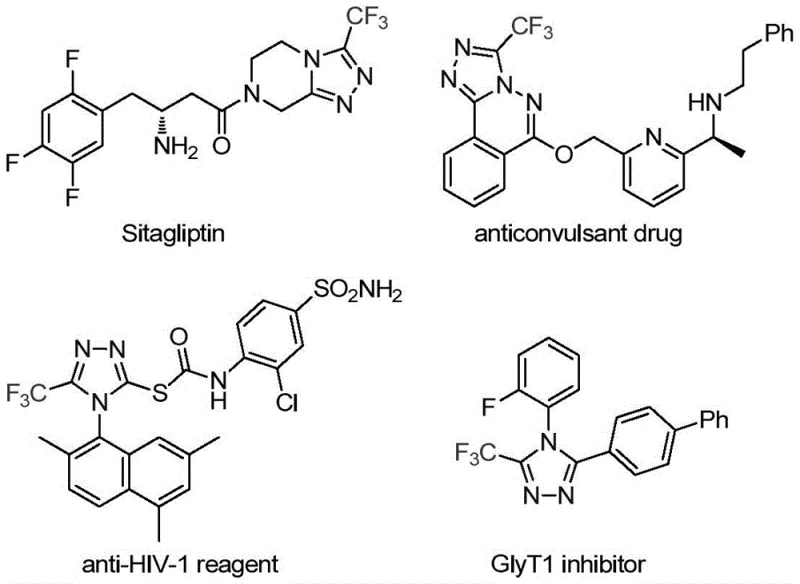
The Limitations of Conventional Methods vs. The Novel Approach
The Limitations of Conventional Methods
Historically, the synthesis of trifluoromethyl-substituted 1,2,4-triazoles has relied on methodologies that are often fraught with significant safety and efficiency drawbacks. Traditional routes frequently involve the cyclization of trifluoroacetyl hydrazine with amidine compounds or the hydrazinolysis of trifluoromethyl-substituted 1,2,4-oxazolinones, processes that typically require harsh reaction conditions and generate substantial chemical waste. Furthermore, alternative multi-component reactions utilizing diazonium salts and trifluorodiazoethane pose severe safety risks due to the explosive nature of diazo compounds, making them unsuitable for large-scale commercial manufacturing. These conventional approaches often suffer from limited substrate scope, poor atom economy, and the necessity for complex purification steps to remove toxic byproducts, ultimately driving up the cost of goods and extending lead times for critical pharmaceutical intermediates.
The Novel Approach
In stark contrast to these legacy methods, the invention described in CN113307778A introduces a highly efficient and safe cycloaddition reaction co-catalyzed by molybdenum and copper. This innovative strategy utilizes cheap and easily obtainable functionalized isonitriles and trifluoroethylimidoyl chloride as starting materials, reacting under mild thermal conditions between 70°C and 90°C. The process eliminates the need for hazardous diazonium salts and unstable hydrazines, replacing them with stable, commercially available reagents that facilitate a cleaner reaction profile. As illustrated in the reaction scheme below, the transformation proceeds smoothly in common organic solvents like THF, yielding the desired 3-trifluoromethyl-1,2,4-triazole products with impressive efficiency. This shift towards milder, safer chemistry not only enhances operator safety but also drastically simplifies the downstream processing requirements.
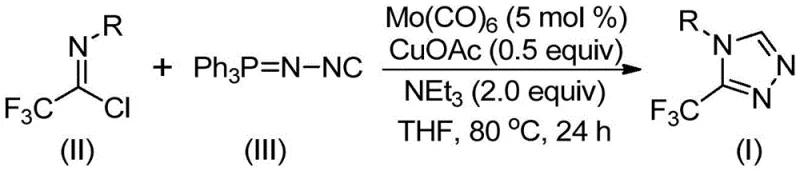
Mechanistic Insights into Mo/Cu Co-Catalyzed Cycloaddition
The success of this synthetic route lies in the synergistic interaction between molybdenum hexacarbonyl and cuprous acetate, which orchestrates a precise [3+2] cycloaddition mechanism. The molybdenum species acts as a potent activator for the functionalized isonitrile, forming a reactive metal-isocyanide complex that primes the molecule for nucleophilic attack. Simultaneously, the copper catalyst promotes the cycloaddition of this activated species to the trifluoroethylimidoyl chloride, facilitating the formation of the five-membered triazole ring intermediate. This dual-catalyst system ensures high regioselectivity and minimizes the formation of unwanted isomers, a common pitfall in heterocyclic synthesis. The subsequent elimination of triphenylphosphine oxide under the reaction conditions drives the equilibrium towards the final product, ensuring high conversion rates without the need for excessive reagent loading.
From an impurity control perspective, the mild reaction temperature of 70-90°C plays a crucial role in maintaining product integrity. High-temperature processes often lead to the decomposition of sensitive functional groups or the polymerization of reactive intermediates, resulting in complex impurity profiles that are difficult to separate. By operating within this moderate thermal window, the process preserves the stability of the trifluoromethyl group and the aromatic substituents, leading to a cleaner crude reaction mixture. This inherent selectivity reduces the burden on purification teams, allowing for simpler workup procedures such as filtration and standard column chromatography. The result is a high-purity final product that meets the stringent specifications required for pharmaceutical applications, minimizing the risk of genotoxic impurities or heavy metal contamination often associated with transition metal catalysis.
How to Synthesize 3-Trifluoromethyl-1,2,4-Triazole Efficiently
The synthesis of these valuable intermediates is designed to be operationally simple, requiring standard laboratory equipment and readily available reagents. The procedure involves mixing the catalysts, base, and substrates in an aprotic solvent, followed by heating and standard workup. This accessibility makes the technology highly attractive for both process research and development teams looking to optimize existing routes and for manufacturing units aiming to implement new supply chains. The detailed standardized synthesis steps, including precise molar ratios and specific workup protocols, are outlined in the guide below to ensure reproducibility and consistency across different batches.
- Combine molybdenum hexacarbonyl, cuprous acetate, triethylamine, molecular sieves, trifluoroethylimidoyl chloride, and functionalized isonitrile in an organic solvent such as THF.
- Heat the reaction mixture to a temperature range of 70-90°C and maintain stirring for a duration of 18 to 30 hours to ensure complete conversion.
- Upon completion, filter the mixture, mix with silica gel, and perform column chromatography purification to isolate the high-purity 3-trifluoromethyl-substituted 1,2,4-triazole product.
Commercial Advantages for Procurement and Supply Chain Teams
For procurement managers and supply chain directors, the adoption of this Mo/Cu co-catalyzed method offers transformative benefits in terms of cost structure and supply reliability. The shift away from exotic or hazardous reagents towards commodity chemicals like cuprous acetate and triethylamine significantly de-risks the supply chain, ensuring that raw material availability is not a bottleneck for production schedules. Furthermore, the high reaction efficiency and mild conditions translate directly into lower energy consumption and reduced waste disposal costs, contributing to a more sustainable and economically viable manufacturing process. This alignment with green chemistry principles not only lowers operational expenditures but also enhances the corporate sustainability profile of the manufacturing entity.
- Cost Reduction in Manufacturing: The utilization of inexpensive and abundant starting materials, such as functionalized isonitriles and trifluoroethylimidoyl chloride, drastically reduces the raw material cost compared to traditional methods relying on specialized hydrazines. Additionally, the high catalytic efficiency means that lower loadings of precious or transition metals are required, further optimizing the cost per kilogram of the final API intermediate. The simplified post-treatment process, which avoids complex extraction or distillation steps, also contributes to substantial savings in labor and utility costs, making the overall production economics highly favorable for commercial scale-up.
- Enhanced Supply Chain Reliability: By relying on commercially available reagents that are produced in large volumes by the global chemical industry, this method mitigates the risk of supply disruptions often associated with custom-synthesized precursors. The robustness of the reaction conditions allows for flexible manufacturing scheduling, as the process is less sensitive to minor variations in temperature or reagent quality. This resilience ensures a consistent and uninterrupted flow of high-quality intermediates to downstream formulation units, safeguarding against production delays and ensuring timely delivery of finished pharmaceutical products to the market.
- Scalability and Environmental Compliance: The process is explicitly designed to be scalable from gram-level laboratory synthesis to multi-ton commercial production without significant re-engineering. The use of common solvents like THF and the absence of highly toxic byproducts simplify waste management and regulatory compliance, reducing the environmental footprint of the manufacturing facility. This scalability ensures that the supply chain can rapidly respond to increased market demand for trifluoromethyl-containing drugs, providing a competitive advantage in a fast-paced pharmaceutical landscape.
Frequently Asked Questions (FAQ)
The following questions address common technical and commercial inquiries regarding the implementation of this novel synthesis technology. These answers are derived directly from the experimental data and beneficial effects reported in the patent documentation, providing clarity on the practical aspects of adopting this method. Understanding these details is crucial for technical teams evaluating the feasibility of integrating this route into their existing manufacturing portfolios.
Q: What are the key advantages of the Mo/Cu co-catalytic system over traditional methods?
A: The Mo/Cu co-catalytic system offers significantly milder reaction conditions (70-90°C) compared to traditional harsh cyclization methods. It utilizes cheap and readily available starting materials like functionalized isonitriles and avoids the use of hazardous diazonium salts or unstable hydrazines, leading to a safer and more cost-effective process.
Q: What is the substrate scope for the R group in this synthesis?
A: The method demonstrates excellent tolerance for various functional groups. The R group can be phenethyl or substituted/unsubstituted aryl groups, including those with methyl, methoxy, fluoro, or chloro substituents at ortho, meta, or para positions, allowing for the synthesis of a diverse library of triazole derivatives.
Q: Is this process suitable for large-scale commercial production?
A: Yes, the patent explicitly states that the method can be easily expanded to gram-level reactions and provides the possibility for subsequent scale production. The use of common solvents like THF and standard post-treatment procedures like column chromatography facilitates scalability.
Partnering with NINGBO INNO PHARMCHEM: Your Reliable 3-Trifluoromethyl-1,2,4-Triazole Supplier
At NINGBO INNO PHARMCHEM, we recognize the critical importance of high-quality intermediates in the development of life-saving medications. Our team of expert chemists has extensive experience scaling diverse pathways from 100 kgs to 100 MT/annual commercial production, ensuring that your project transitions smoothly from the bench to the plant. We adhere to stringent purity specifications and utilize rigorous QC labs to guarantee that every batch of 3-trifluoromethyl-1,2,4-triazole intermediate meets the highest international standards. Our commitment to excellence ensures that you receive a product that is not only chemically pure but also consistent in quality, supporting your regulatory filings and clinical trials with confidence.
We invite you to collaborate with us to leverage this advanced synthetic technology for your specific drug development needs. Our technical procurement team is ready to provide a Customized Cost-Saving Analysis tailored to your volume requirements, demonstrating how this efficient route can optimize your budget. Please contact us today to request specific COA data and route feasibility assessments, and let us partner with you to accelerate your journey from discovery to commercial success.