
Advanced Synthesis of Benzimidazole-Phosphine Platinum Complexes for High-Efficiency OLEDs
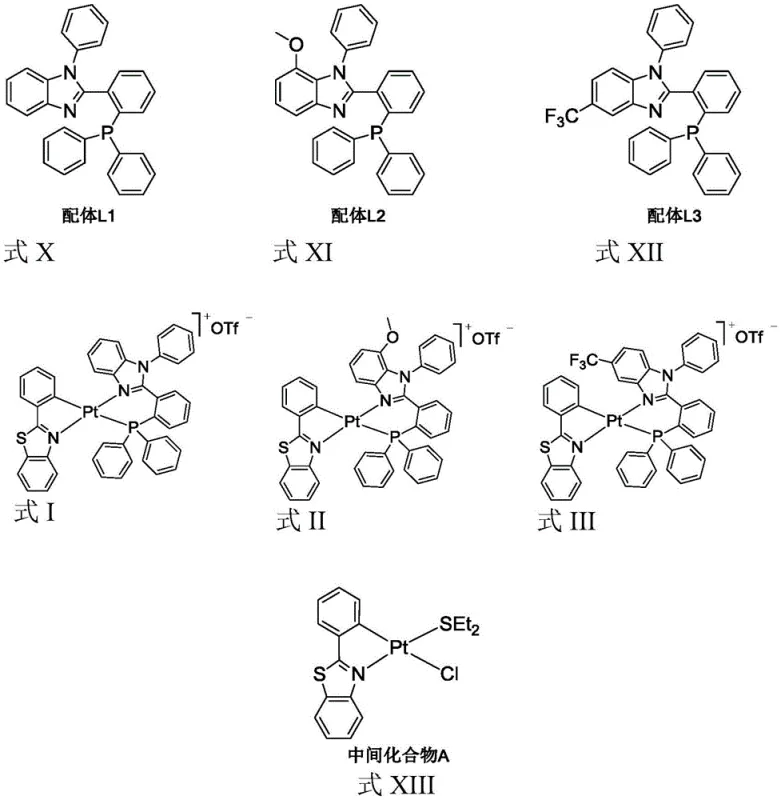
The rapid evolution of the organic light-emitting diode (OLED) industry has created an urgent demand for next-generation emissive materials that balance high efficiency with manufacturability. Patent CN113292607B introduces a groundbreaking class of ionic luminescent platinum complexes based on benzimidazole-phosphine ligands, offering a compelling alternative to traditional iridium-based emitters. These novel compounds, characterized by molecular formulas such as [C44H31N3PPtS]OTF, demonstrate exceptional photophysical properties, including strong absorption coefficients exceeding 5×10^4 L·mol⁻¹·cm⁻¹ near 230nm and remarkable luminescence quantum efficiencies reaching up to 86.6% in solution. For R&D directors and procurement specialists in the electronic chemical sector, this technology represents a significant leap forward in designing stable, high-performance materials for full-color displays and energy-saving lighting applications.
The Limitations of Conventional Methods vs. The Novel Approach
The Limitations of Conventional Methods
Historically, the development of phosphorescent OLED materials has been dominated by organometallic complexes of heavy metals like iridium, which, while efficient, suffer from high raw material costs and resource scarcity. Furthermore, conventional platinum(II) complexes often possess a planar quadrilateral structure that predisposes them to detrimental intermolecular interactions. In the solid state, these planar molecules tend to form pi-pi stacks and engage in platinum-platinum interactions, leading to concentration quenching and triplet-triplet annihilation. This phenomenon drastically reduces the luminous efficiency of the device, limiting their practical utility in high-brightness commercial displays. Additionally, many existing synthetic routes for phosphorescent emitters involve harsh reaction conditions, expensive catalysts, and complex purification steps that hinder cost reduction in electronic chemical manufacturing and complicate supply chain reliability.
The Novel Approach
The innovation disclosed in patent CN113292607B overcomes these structural and economic barriers through the strategic design of bulky benzimidazole-phosphine ligands. By incorporating sterically demanding groups around the platinum center, the new complexes effectively suppress the aggregation-caused quenching that plagues traditional planar Pt(II) systems. This structural modification allows the material to maintain high luminous efficiency even in the solid powder state, with quantum efficiencies reaching 69.1%. The synthetic strategy is equally robust, utilizing a modular approach where ligands L1, L2, and L3 are synthesized via accessible intermediates before being coordinated to the platinum center. This method not only enhances the photophysical performance but also streamlines the production workflow, making it a highly attractive option for a reliable OLED material supplier seeking to optimize their product portfolio.
Mechanistic Insights into Benzimidazole-Phosphine Ligand Coordination
The core of this technology lies in the precise coordination chemistry between the platinum center and the tailored ligand system. The synthesis begins with the formation of the benzimidazole backbone through a condensation reaction involving o-nitroaniline derivatives and 2-fluorobenzaldehyde, followed by a nucleophilic substitution with potassium diphenylphosphite to install the phosphine moiety. This creates a rigid, chelating environment that stabilizes the platinum ion in a specific geometry favorable for intersystem crossing (ISC). The strong spin-orbit coupling induced by the heavy platinum atom facilitates the harvesting of both singlet and triplet excitons, theoretically enabling 100% internal quantum efficiency. The presence of the triflate counterion (OTf-) further enhances the ionic character of the complex, improving solubility in polar organic solvents and facilitating film formation during device fabrication.
From an impurity control perspective, the stepwise synthesis allows for rigorous purification at each stage. The intermediate ligands are purified via column chromatography and recrystallization, ensuring that metal contaminants from the copper-catalyzed Ullmann-type coupling are removed before the final metallation step. The final complexation occurs under mild conditions—stirring at room temperature in dichloromethane under light shielding—which minimizes thermal degradation and side reactions. This controlled environment ensures that the final product possesses a narrow emission spectrum and consistent color coordinates, which are critical parameters for high-purity OLED material specifications. The crystallographic data confirms the distorted square planar geometry that prevents close packing, validating the design hypothesis regarding steric hindrance.
How to Synthesize Ionic Luminescent Platinum Complex Efficiently
The preparation of these high-efficiency emitters follows a logical five-step sequence that balances yield with purity. The process initiates with the synthesis of the o-nitroaniline intermediate, followed by cyclization to form the benzimidazole core. Subsequent phosphorylation yields the active ligand, which is then reacted with a pre-formed platinum-thioether intermediate. The detailed standardized synthesis steps below outline the specific molar ratios, solvent systems, and temperature controls required to achieve the reported quantum efficiencies and structural integrity.
- Synthesize the benzimidazole-phosphine ligand by reacting o-nitroaniline derivatives with iodobenzene using a cuprous catalyst, followed by cyclization with 2-fluorobenzaldehyde and phosphorylation.
- Prepare the platinum intermediate (Compound A) by refluxing 2-phenylbenzothiazole with potassium chloroplatinite, followed by substitution with diethyl sulfide.
- React the prepared ligand with Intermediate A and silver triflate in dichloromethane at room temperature under light shielding to obtain the final ionic platinum complex crystals.
Commercial Advantages for Procurement and Supply Chain Teams
For procurement managers and supply chain heads, the transition to this benzimidazole-phosphine platinum chemistry offers substantial strategic benefits beyond mere performance metrics. The reliance on platinum rather than iridium immediately addresses the volatility associated with rare earth metal pricing, providing a more stable cost basis for long-term production planning. Furthermore, the synthetic route utilizes commodity chemicals such as iodobenzene, o-nitroaniline, and 2-fluorobenzaldehyde, which are readily available from multiple global suppliers, thereby enhancing supply chain reliability and reducing the risk of single-source bottlenecks.
- Cost Reduction in Manufacturing: The elimination of expensive iridium precursors and the use of mild reaction conditions significantly lower the overall cost of goods sold. The final complexation step proceeds at room temperature, eliminating the need for energy-intensive heating or cooling infrastructure during the critical crystallization phase. Additionally, the purification process relies on standard techniques like solvent volatilization and washing with anhydrous methanol, avoiding the need for specialized preparative HPLC or complex distillation setups that drive up operational expenditures.
- Enhanced Supply Chain Reliability: The modular nature of the ligand synthesis allows for the stockpiling of key intermediates, such as the benzimidazole derivatives, which can be produced in bulk and stored until needed for final metallation. This decoupling of the synthesis stages provides flexibility in production scheduling and inventory management. Since the starting materials are common organic building blocks rather than proprietary custom synthons, the risk of supply disruption is minimized, ensuring continuous availability for commercial scale-up of complex electronic chemicals.
- Scalability and Environmental Compliance: The process demonstrates excellent scalability, with examples showing successful replication from milligram to gram scales without loss of efficiency. The use of solvents like dichloromethane and tetrahydrofuran, while requiring careful handling, allows for established recovery and recycling protocols in modern chemical plants. The high yield and selectivity of the reaction reduce the generation of hazardous waste streams, aligning with increasingly stringent environmental regulations and supporting sustainable manufacturing practices in the specialty chemical industry.
Frequently Asked Questions (FAQ)
The following questions address common technical and commercial inquiries regarding the implementation of this patented technology. These insights are derived directly from the experimental data and structural analysis provided in the patent documentation, offering clarity on performance metrics and process feasibility for potential partners and licensees.
Q: What are the photoluminescence advantages of these ionic platinum complexes?
A: These complexes exhibit high luminescence quantum efficiency up to 86.6% in solution and 69.1% in solid state, with strong absorption near 230nm and tunable emission wavelengths suitable for yellow to orange-yellow OLED applications.
Q: How does the benzimidazole-phosphine ligand improve performance?
A: The bulky steric hindrance provided by the benzimidazole-phosphine ligand effectively prevents pi-pi stacking and platinum-platinum interactions, thereby reducing triplet annihilation and maintaining high luminous efficiency.
Q: Is the synthesis process scalable for industrial production?
A: Yes, the process utilizes mild reaction conditions, such as room temperature complexation and standard solvent systems like dichloromethane and tetrahydrofuran, which facilitates straightforward purification and potential scale-up.
Partnering with NINGBO INNO PHARMCHEM: Your Reliable Ionic Luminescent Platinum Complex Supplier
As the global demand for high-resolution displays and energy-efficient lighting continues to surge, the need for advanced emissive materials has never been more critical. NINGBO INNO PHARMCHEM stands at the forefront of this technological shift, leveraging deep expertise in organometallic synthesis to deliver cutting-edge solutions. Our team possesses extensive experience scaling diverse pathways from 100 kgs to 100 MT/annual commercial production, ensuring that laboratory breakthroughs like those in CN113292607B are seamlessly translated into industrial reality. We maintain stringent purity specifications and operate rigorous QC labs to guarantee that every batch of our electronic chemicals meets the exacting standards required by top-tier OLED manufacturers.
We invite you to collaborate with us to unlock the full potential of these ionic platinum complexes for your next-generation display projects. Our technical procurement team is ready to provide a Customized Cost-Saving Analysis tailored to your specific volume requirements and application needs. Contact us today to request specific COA data and route feasibility assessments, and let us help you secure a competitive advantage in the rapidly evolving landscape of optoelectronic materials.