
Scalable Stereoselective Synthesis of Hyphantria Cunea Sex Pheromones for Global Agrochemical Supply Chains
Scalable Stereoselective Synthesis of Hyphantria Cunea Sex Pheromones for Global Agrochemical Supply Chains
The development of effective pest management strategies relies heavily on the availability of high-purity semiochemicals, specifically sex pheromones that disrupt mating cycles without environmental toxicity. A significant breakthrough in this domain is detailed in patent CN101798293B, which discloses a simple yet highly efficient stereoselective synthesis method for the sex pheromones of Hyphantria cunea, commonly known as the fall webworm. This invasive species poses a severe threat to forestry and agriculture globally, necessitating robust monitoring and control solutions. The patented technology focuses on the preparation of two critical epoxy-containing components: Compound III [(9S,10R)-9,10-epoxy-(3Z,6Z)-3,6-heneicosadiene] and Compound IV [(9S,10R)-9,10-epoxy-(3Z,6Z)-1,3,6-heneicosatriene]. By utilizing cheap and readily available 2-propargyl alcohol as the starting material, this eight-step protocol achieves remarkable efficiency, delivering total yields of 36 percent for Compound III and 33 percent for Compound IV, with an enantiomeric excess exceeding 99 percent. This represents a substantial advancement over prior art, offering a viable pathway for the reliable agrochemical intermediate supplier to meet growing demand for eco-friendly pest control agents.
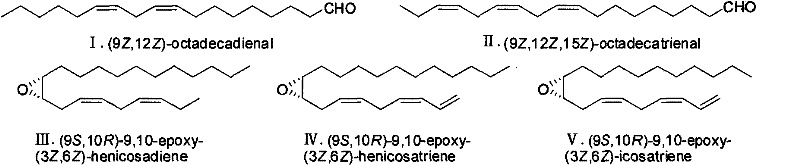
The historical context of synthesizing these complex lipid molecules reveals a trajectory of increasing sophistication aimed at overcoming stereochemical and stability challenges. Early efforts, such as those by Kovalev, utilized parallel synthesis strategies involving Wittig reactions to construct the carbon backbone. However, these initial approaches were plagued by significant drawbacks, including low overall yields and poor stereoselectivity, which rendered them impractical for large-scale manufacturing. Subsequent work by K. Mori in the 1980s attempted to address these issues but resulted in excessively long synthetic routes. For instance, the synthesis of Compound III required multiple steps to achieve a mere 7 percent overall yield, while Compound IV was even more inefficient at 1.5 percent. A major bottleneck in these conventional methods was the reliance on polyyne intermediates, which are notoriously unstable and prone to isomerization or oxidation during processing. Furthermore, the use of specialized reagents and the necessity for protecting groups added layers of complexity and cost that hindered industrial adoption.
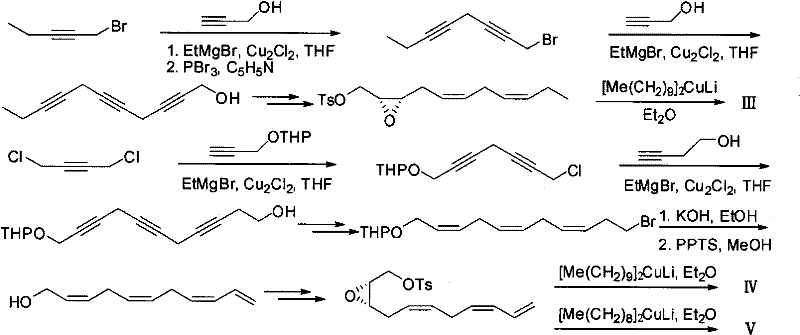
In stark contrast to the limitations of conventional methods, the novel approach outlined in CN101798293B introduces a streamlined strategy that eliminates the need for protecting groups entirely. This "protecting-group-free" philosophy drastically reduces the number of unit operations, thereby minimizing material loss and solvent consumption. The new route capitalizes on the stability of saturated carbon chains introduced early in the synthesis, avoiding the handling of sensitive polyyne species until the final coupling stages. By starting from 2-propargyl alcohol, a commodity chemical, the process ensures a consistent and cost-effective supply of raw materials. The strategic design allows for the convergent assembly of the molecule, where the chiral epoxy segment and the unsaturated chain are coupled efficiently. This methodology not only simplifies the operation and separation procedures at each step but also significantly enhances the overall throughput. The result is a robust process capable of delivering high-purity products with consistent stereochemistry, addressing the critical pain points of yield and scalability that hampered previous generations of synthesis technology.
Mechanistic Insights into Sharpless Asymmetric Epoxidation and Sulfonate Coupling
The cornerstone of the stereochemical integrity in this synthesis lies in the application of the Sharpless asymmetric epoxidation reaction. This transformation is pivotal for establishing the (9S,10R) configuration found in the natural pheromones, which is essential for biological activity. In the patented process, a Z-alkene precursor, derived from the partial hydrogenation of an alkyne, serves as the substrate for this enantioselective oxidation. The reaction employs a chiral catalyst system typically comprising tetraisopropyl titanate, a chiral tartrate ester (such as L-(+)-diisopropyl tartrate), and tert-butyl hydroperoxide as the oxidant. The mechanism involves the formation of a chiral titanium-tartrate complex that directs the delivery of the oxygen atom to a specific face of the alkene double bond. This precise control ensures that the resulting epoxy alcohol possesses the desired absolute configuration with an enantiomeric excess greater than 99 percent. The use of molecular sieves, such as 3Å or 4Å types, is often critical in this step to maintain anhydrous conditions, preventing catalyst deactivation and ensuring high conversion rates. This level of stereocontrol is superior to non-catalytic methods and provides a reliable foundation for the subsequent chain elongation steps.
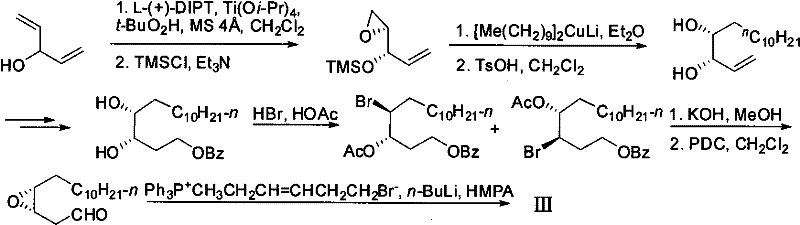
Following the establishment of chirality, the synthesis proceeds through a crucial coupling phase involving an epoxy sulfonate intermediate. The chiral epoxy alcohol is activated by conversion into a trifluoromethanesulfonate (triflate), a superb leaving group that facilitates nucleophilic substitution. This activated species is then reacted with a lithium acetylide derived from 3,6-diyn-1-ol. The coupling reaction is conducted under strictly controlled low-temperature conditions, typically between -100°C and 0°C, in ether solvents like THF or diethyl ether, often with the addition of hexamethylphosphoramide (HMPA) as a complexing agent to enhance the reactivity of the organolithium species. This step effectively merges the chiral head group with the unsaturated tail, constructing the full 21-carbon skeleton of the pheromone. A key mechanistic advantage here is the avoidance of side reactions; the specific choice of reagents and conditions minimizes elimination or rearrangement of the sensitive epoxy ring. Subsequent steps involve the selective reduction of the triple bonds to Z-double bonds using Lindlar catalysts, ensuring the correct geometric isomerism required for the pheromone's function. The final differentiation between Compound III and IV is achieved through distinct functional group manipulations on a common bromo-intermediate, showcasing the versatility and efficiency of this unified synthetic platform.
How to Synthesize (9S,10R)-9,10-epoxy-(3Z,6Z)-heneicosadiene Efficiently
The execution of this synthesis requires precise adherence to the reaction parameters defined in the patent to ensure optimal yield and purity. The process begins with the alkylation of 2-propargyl alcohol to extend the carbon chain, followed by semi-hydrogenation to set the Z-alkene geometry required for the epoxidation. Once the chiral epoxy alcohol is secured, it is activated and coupled with the diyne fragment. The detailed standardized synthesis steps involve careful temperature control during the organometallic coupling and the use of specific catalysts for the final reductions. For a comprehensive guide on the exact molar ratios, solvent choices, and workup procedures for each of the nine operational steps, please refer to the structured protocol below.
- Construct the chiral epoxy-alcohol backbone via Sharpless asymmetric epoxidation of a Z-alkene precursor derived from 2-propargyl alcohol.
- Activate the chiral alcohol as a triflate and couple it with a 3,6-diyn-1-ol fragment using strong base mediation to form the carbon skeleton.
- Perform selective hydrogenation to establish Z-alkene geometry, followed by final functional group manipulation to yield pheromones III and IV.
Commercial Advantages for Procurement and Supply Chain Teams
From a procurement and supply chain perspective, the adoption of this patented synthesis method offers transformative benefits that directly impact the bottom line and operational resilience. Traditional methods for producing these complex pheromones were often characterized by fragile supply chains due to the reliance on unstable intermediates and multi-step sequences that amplified lead times. The new approach mitigates these risks by utilizing a short, eight-step linear sequence that starts from abundant commodity chemicals. This reduction in synthetic complexity translates to a drastic simplification of the manufacturing workflow, reducing the potential for bottlenecks and equipment downtime. Furthermore, the elimination of protecting group chemistry removes entire categories of reagents and purification steps, which significantly lowers the consumption of solvents and auxiliary materials. This streamlining not only accelerates the production cycle but also reduces the environmental footprint associated with waste generation, aligning with modern sustainability mandates in the chemical industry.
- Cost Reduction in Manufacturing: The economic viability of this process is driven by the strategic selection of raw materials and the efficiency of the reaction sequence. By starting with 2-propargyl alcohol, a widely available and inexpensive feedstock, the baseline material costs are kept minimal compared to routes requiring specialized natural product derivatives. Additionally, the high overall yields of 33 to 36 percent mean that less starting material is required to produce a kilogram of the final active ingredient, directly improving the cost of goods sold. The absence of protecting groups further contributes to cost optimization by eliminating the reagents needed for protection and deprotection, as well as the associated purification costs. This lean manufacturing approach ensures that the final agrochemical intermediate is produced with substantial cost savings, making it competitive in the global market without compromising on quality.
- Enhanced Supply Chain Reliability: Supply continuity is a critical concern for manufacturers of pest control agents, especially given the seasonal nature of agricultural demand. This synthesis method enhances reliability by relying on common, off-the-shelf reagents such as n-butyllithium, titanium tetraisopropide, and standard hydrogenation catalysts. Unlike processes that depend on scarce or custom-synthesized building blocks, this route ensures that raw material sourcing is robust and less susceptible to market volatility. The simplicity of the operation and separation procedures at each step also means that the process is less prone to technical failures or batch-to-batch variability. This stability allows for more accurate production planning and inventory management, ensuring that customers receive their orders on time, every time, thereby strengthening the trust between the supplier and the end-user.
- Scalability and Environmental Compliance: Scaling chemical processes from the laboratory to industrial production often introduces unforeseen challenges, particularly regarding heat transfer and safety. This patented method is designed with scalability in mind, utilizing reaction conditions that are manageable in large-scale reactors, such as moderate temperatures and standard pressure hydrogenation. The high selectivity of the reactions minimizes the formation of by-products, simplifying the downstream purification and reducing the load on waste treatment facilities. Moreover, the reduced use of hazardous reagents and the shorter process timeline contribute to a safer working environment and lower regulatory compliance burdens. This makes the technology not only commercially attractive but also environmentally responsible, facilitating easier approval for commercial scale-up of complex agrochemical intermediates in regions with strict environmental regulations.
Frequently Asked Questions (FAQ)
Understanding the technical nuances of this synthesis is vital for stakeholders evaluating its implementation. The following questions address common inquiries regarding the process capabilities, quality control, and strategic advantages. These answers are derived directly from the technical specifications and experimental data provided in the patent documentation, ensuring accuracy and relevance for decision-makers.
Q: How does this new synthesis method improve upon previous routes like Mori's?
A: Unlike earlier methods that suffered from low yields (1.5-7%) and unstable polyyne intermediates, this patented route achieves total yields of 33-36% in only 8 steps without requiring protecting groups.
Q: What ensures the high stereochemical purity of the final pheromones?
A: The process utilizes Sharpless asymmetric epoxidation to establish the critical (9S,10R) chiral centers with >99% enantiomeric excess, ensuring biological activity matches the natural pheromone.
Q: Is this process suitable for large-scale industrial production?
A: Yes, the method relies on cheap, readily available raw materials like 2-propargyl alcohol and common reagents, avoiding complex purification steps, which facilitates commercial scale-up.
Partnering with NINGBO INNO PHARMCHEM: Your Reliable Hyphantria Cunea Pheromone Supplier
The technological advancements described in patent CN101798293B represent a significant leap forward in the field of semiochemical manufacturing, offering a pathway to high-purity products with exceptional stereochemical fidelity. At NINGBO INNO PHARMCHEM, we recognize the value of such innovations and possess the extensive experience scaling diverse pathways from 100 kgs to 100 MT/annual commercial production. Our state-of-the-art facilities are equipped to handle the specific requirements of this synthesis, including low-temperature organometallic reactions and sensitive hydrogenation steps, ensuring that stringent purity specifications are met consistently. With our rigorous QC labs and commitment to process excellence, we are uniquely positioned to translate this patented methodology into a reliable supply source for your agrochemical formulations.
We invite you to explore the potential of this advanced synthesis route for your product portfolio. By partnering with us, you gain access to a Customized Cost-Saving Analysis tailored to your specific volume requirements and quality standards. We encourage you to contact our technical procurement team today to request specific COA data and route feasibility assessments. Let us collaborate to bring this efficient, high-yield solution to the market, enhancing your supply chain resilience and driving value for your customers through superior pest control technologies.