
Advanced Pd-Catalyzed Carbonylation for Scalable Aryl Acetamide Production and Commercial Supply
The landscape of amide synthesis is undergoing a significant transformation driven by the need for safer, more efficient, and atom-economical processes. Patent CN111978194B introduces a groundbreaking methodology for the preparation of aryl acetamide compounds, a critical scaffold found in numerous pharmaceutical agents and bioactive molecules. This technology leverages a palladium-catalyzed carbonylation strategy that uniquely utilizes benzyl formate as both a carbon monoxide source and a reactant. Unlike traditional methods that often rely on hazardous gaseous CO or harsh oxidative conditions, this approach operates under relatively mild thermal conditions without requiring external oxidants for the challenging C-N bond cleavage of tertiary amines. For R&D directors and process chemists, this represents a paradigm shift towards greener chemistry, offering a robust pathway to access complex amide architectures with high purity and minimal environmental footprint.
The Limitations of Conventional Methods vs. The Novel Approach
The Limitations of Conventional Methods
Historically, the synthesis of aryl acetamides has predominantly relied on the direct amidation of phenylacetic acid derivatives or transition metal-catalyzed carbonylation using primary and secondary amines. These conventional routes present substantial logistical and safety hurdles, particularly when scaling up for industrial production. The use of gaseous carbon monoxide requires specialized high-pressure equipment and rigorous safety protocols due to its extreme toxicity and flammability. Furthermore, existing methods for activating the C-N bonds of tertiary amines often necessitate the use of stoichiometric amounts of strong oxidants, which not only increases the cost of goods but also generates significant quantities of toxic waste streams that complicate downstream purification. The limited substrate scope of older methodologies often fails to accommodate sensitive functional groups, leading to lower yields and forcing chemists to employ tedious protecting group strategies that extend development timelines.
The Novel Approach
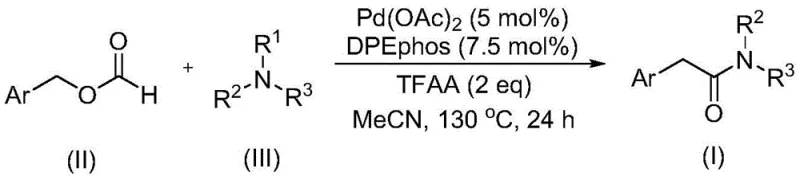
The methodology disclosed in CN111978194B elegantly circumvents these challenges by employing benzyl formate as a stable, liquid CO surrogate. This innovation allows the reaction to proceed in standard laboratory glassware or standard industrial reactors without the need for high-pressure CO infrastructure. The catalytic system, comprising palladium acetate and the bidentate ligand DPEphos, facilitates the efficient insertion of the carbonyl group while simultaneously activating the tertiary amine. Crucially, the reaction design eliminates the requirement for external oxidants, thereby streamlining the workup procedure and significantly reducing the E-factor of the process. This novel approach not only enhances operational safety but also broadens the chemical space accessible to synthetic chemists, allowing for the incorporation of diverse aryl and heteroaryl motifs with excellent functional group tolerance.
Mechanistic Insights into Pd-Catalyzed Carbonylative C-N Cleavage
The core of this transformative synthesis lies in the sophisticated interplay between the palladium catalyst and the specific ligand environment. The reaction initiates with the oxidative addition of the benzyl formate to the palladium center, effectively generating a palladium-hydride species and releasing carbon monoxide in situ. This in situ generation of CO is pivotal, as it maintains a low, steady concentration of the reactive gas, minimizing side reactions such as homocoupling while ensuring efficient carbonylation. The presence of trifluoroacetic anhydride (TFAA) plays a dual role: it acts as a dehydrating agent to drive the equilibrium forward and potentially activates the amine substrate for nucleophilic attack. The bulky and electron-rich DPEphos ligand stabilizes the active palladium species, preventing catalyst deactivation and facilitating the difficult C-N bond cleavage step of the tertiary amine.
From an impurity control perspective, this mechanism offers distinct advantages over oxidative pathways. By avoiding strong external oxidants, the formation of over-oxidized byproducts, such as N-oxides or degraded amine fragments, is virtually eliminated. The reaction conditions, typically maintained at 130°C in acetonitrile, provide sufficient thermal energy to overcome the activation barrier for C-N scission without promoting thermal decomposition of the sensitive aryl acetamide product. The high selectivity observed across various substrates, including those with electron-withdrawing groups like trifluoromethyl or cyano, suggests a robust catalytic cycle that is insensitive to electronic perturbations on the aromatic ring. This mechanistic stability ensures consistent product quality, a critical parameter for reliable aryl acetamide supplier operations targeting regulated markets.
How to Synthesize Aryl Acetamide Efficiently
To implement this synthesis effectively, precise control over reaction parameters is essential to maximize yield and minimize impurities. The protocol involves charging a sealed vessel with the palladium catalyst, ligand, trifluoroacetic anhydride, benzyl formate, and the desired tertiary amine in an aprotic solvent. The mixture is then heated to promote the carbonylation and C-N cleavage sequence. While the general procedure is straightforward, optimization of the molar ratios—specifically maintaining an excess of benzyl formate relative to the amine—is crucial for driving the reaction to completion. The detailed standardized synthesis steps see the guide below.
- Combine palladium catalyst (Pd(OAc)2), ligand (DPEphos), trifluoroacetic anhydride, benzyl formate, and tertiary amine in an organic solvent like acetonitrile.
- Heat the reaction mixture to 130°C in a sealed tube and maintain stirring for 24 hours to ensure complete conversion.
- Upon completion, filter the mixture, mix with silica gel, and purify via column chromatography to isolate the target aryl acetamide compound.
Commercial Advantages for Procurement and Supply Chain Teams
For procurement managers and supply chain heads, the adoption of this patented technology translates into tangible strategic benefits regarding cost, safety, and reliability. The shift from gaseous CO to liquid benzyl formate drastically simplifies the raw material logistics, removing the need for specialized gas handling infrastructure and reducing the associated regulatory burden. This simplification directly contributes to cost reduction in pharmaceutical intermediate manufacturing by lowering capital expenditure on safety systems and reducing the complexity of operator training. Furthermore, the use of commercially available and inexpensive starting materials, such as formic acid derivatives and common tertiary amines, ensures a stable and resilient supply chain that is less susceptible to market volatility compared to specialized reagents.
- Cost Reduction in Manufacturing: The elimination of external oxidants and the use of a simplified catalyst system significantly lower the raw material costs per kilogram of product. By avoiding expensive and hazardous reagents, the overall cost of goods sold (COGS) is optimized, allowing for more competitive pricing in the global market. Additionally, the streamlined post-treatment process, which typically involves simple filtration and chromatography, reduces solvent consumption and labor hours, further enhancing the economic viability of large-scale production runs.
- Enhanced Supply Chain Reliability: The robustness of the reaction conditions, which tolerate a wide range of functional groups and moisture levels better than sensitive organometallic alternatives, ensures high batch-to-batch consistency. This reliability is paramount for maintaining continuous supply to downstream API manufacturers. The ability to source key reagents like benzyl formate and palladium catalysts from multiple global vendors mitigates the risk of single-source bottlenecks, ensuring that production schedules remain uninterrupted even during periods of global supply chain stress.
- Scalability and Environmental Compliance: The absence of toxic gas feeds and strong oxidants makes this process inherently safer and easier to scale from pilot plant to commercial tonnage. The reduced generation of hazardous waste aligns with increasingly stringent environmental regulations, minimizing disposal costs and facilitating smoother regulatory approvals. This green chemistry profile not only protects the corporate reputation but also future-proofs the manufacturing asset against evolving sustainability mandates in the chemical industry.
Frequently Asked Questions (FAQ)
The following questions address common technical and commercial inquiries regarding this synthesis method, derived from the specific advantages outlined in the patent documentation. Understanding these nuances helps stakeholders evaluate the feasibility of integrating this technology into their existing portfolios. The answers reflect the practical realities of running this chemistry at scale.
Q: What is the primary advantage of using benzyl formate in this synthesis?
A: Benzyl formate serves as a safe, liquid surrogate for carbon monoxide, eliminating the need for handling hazardous CO gas while simultaneously acting as a reactant in the carbonylation process.
Q: Does this method require external oxidants for C-N bond cleavage?
A: No, a key innovation of this patent is that the cleavage of the tertiary amine C-N bond occurs without the need for additional external oxidants, simplifying the reaction profile and reducing waste.
Q: What types of substrates are compatible with this catalytic system?
A: The system demonstrates broad functional group tolerance, successfully accommodating aryl groups with substituents such as alkyl, alkoxy, trifluoromethyl, cyano, and halogens, as well as heterocycles like furan and thiophene.
Partnering with NINGBO INNO PHARMCHEM: Your Reliable Aryl Acetamide Supplier
At NINGBO INNO PHARMCHEM, we recognize the immense potential of this Pd-catalyzed carbonylation technology to redefine the production of high-value amide intermediates. As a premier CDMO partner, we possess extensive experience scaling diverse pathways from 100 kgs to 100 MT/annual commercial production, ensuring that your transition from lab bench to market is seamless. Our state-of-the-art facilities are equipped to handle the specific requirements of this chemistry, including high-temperature sealed reactions and rigorous purification protocols. We adhere to stringent purity specifications and operate rigorous QC labs to guarantee that every batch of aryl acetamide meets the exacting standards required by the global pharmaceutical industry.
We invite you to collaborate with us to leverage this innovative synthesis route for your next project. Our technical team is ready to provide a Customized Cost-Saving Analysis tailored to your specific molecule, demonstrating how this oxidant-free approach can optimize your budget. Please contact our technical procurement team today to request specific COA data and comprehensive route feasibility assessments, and let us help you secure a sustainable and cost-effective supply of these critical building blocks.