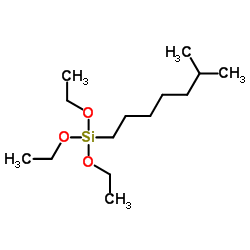
Triethoxy(2,4,4-trimethylpentyl)silane
- CAS No.35435-21-3
- GradeIndustrial / Pharmaceutical
- Availability● In Stock
High-purity triethoxy(2,4,4-trimethylpentyl)silane for advanced water-repellent formulations in construction and polymer composites.
Request Bulk PricingProduct Technical Details
Product Overview
Triethoxy(2,4,4-trimethylpentyl)silane, also known as (2,4,4-trimethylpentyl)triethoxysilane or iso-octyltriethoxysilane, is a high-performance specialty silane widely used in construction protection and polymer modification. This colorless transparent liquid features excellent hydrophobic properties and deep substrate penetration capabilities, making it ideal for formulating durable water-repellent treatments for cementitious materials.
Specifications
| Molecular Formula | C₁₄H₃₂O₃Si |
|---|---|
| Molecular Weight | 276.49 g/mol |
| Density | 0.878 g/cm³ |
| Boiling Point | 215.8°C at 760 mmHg |
| Flash Point | 95.9°C |
| Refractive Index | 1.426 |
| Assay | ≥95% |
| UN Number | UN1993 |
| Proper Shipping Name | Flammable Liquid, N.O.S. |
Industrial Applications
This silane functions as a reactive coupling agent that chemically bonds to mineral substrates upon exposure to moisture, forming a hydrophobic barrier without altering surface appearance. Key applications include:
- Water-repellent treatments for commercial buildings, parking decks, highways, and bridge structures
- Surface modification of mineral fillers and pigments to enhance compatibility in polyolefin matrices
- Improvement of dispersion stability in nonpolar polymer systems
In alkaline environments—such as fresh concrete—the hydrolysis and condensation reactions are catalyzed, accelerating the formation of a robust, water-resistant network within the substrate.
Handling and Application Guidelines
For optimal performance, triethoxy(2,4,4-trimethylpentyl)silane is typically diluted to 20–40% concentration using compatible solvents such as alcohols, aliphatic hydrocarbons, chlorinated solvents, or low-molecular-weight cyclic silicones (e.g., cyclotetrasiloxane). Blended solvent systems may be employed to fine-tune evaporation rates. Application methods include airless spraying, rolling, or brushing, with repeated passes recommended until the surface remains wet for several minutes. Substrates must be clean, dry, and free of contaminants; while damp surfaces are acceptable, dry conditions maximize penetration depth. Always conduct a small-scale test prior to full-scale treatment.
Packaging and Storage
Supplied in 210 L steel drums (180 kg) or 1,000 L IBC containers (880 kg), with custom packaging available upon request. Store in a cool, dry, well-ventilated area with containers tightly sealed to prevent moisture ingress and maintain product integrity.