
Revolutionizing Oseltamivir Phosphate Production: A Novel 4-Step Ritter Reaction Route for Commercial Scale
Revolutionizing Oseltamivir Phosphate Production: A Novel 4-Step Ritter Reaction Route for Commercial Scale
The global demand for effective antiviral therapeutics remains a critical priority for public health infrastructure, with Oseltamivir Phosphate standing as a cornerstone treatment for Influenza A and B. Addressing the urgent need for accessible and cost-effective manufacturing pathways, patent CN110563600B discloses a groundbreaking preparation method that fundamentally重构 s the synthetic landscape of this vital API. Unlike traditional multi-step sequences that suffer from yield attrition and operational complexity, this innovation introduces a streamlined 4-step process anchored by a novel application of the Ritter reaction. By strategically bypassing the intellectual property constraints of earlier patents while simultaneously enhancing process efficiency, this technology offers a robust solution for reliable oseltamivir phosphate supplier networks seeking to optimize their production capabilities. The methodology not only achieves a commendable total yield but also aligns with modern green chemistry principles through simplified operations and milder reaction conditions.
The Limitations of Conventional Methods vs. The Novel Approach
The Limitations of Conventional Methods
Historically, the industrial synthesis of Oseltamivir Phosphate has been dominated by routes derived from the original Roche patents, such as CN100545145C, which typically involve a cumbersome 6-step sequence starting from complex bicyclic precursors. These conventional pathways are plagued by inherent inefficiencies, including multiple ring-closing and ring-opening maneuvers that necessitate rigorous protection and deprotection strategies. Each additional synthetic transformation introduces opportunities for yield loss, impurity accumulation, and increased consumption of expensive reagents and solvents. Furthermore, the reliance on specific chiral starting materials and the need for precise stereochemical control at multiple stages often result in prolonged cycle times and elevated manufacturing costs. For procurement managers and supply chain heads, these factors translate into higher raw material expenses, extended lead times, and a fragile supply chain vulnerable to bottlenecks at any of the numerous intermediate stages.
The Novel Approach
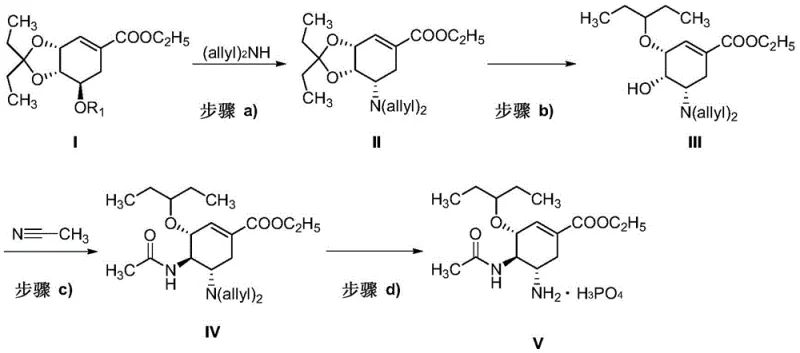
In stark contrast, the methodology outlined in CN110563600B represents a paradigm shift by condensing the synthesis into a concise 4-step trajectory that begins with a shikimic acid-derived precursor closer to the natural product end. The most significant breakthrough lies in the strategic omission of redundant cyclization steps, replaced instead by a direct and highly efficient construction of the molecular framework. This approach leverages a unique sequence involving nucleophilic substitution, silane-mediated reduction, a pivotal Ritter reaction, and a final catalytic deallylation. By reducing the step count, the process inherently minimizes unit operations, thereby drastically simplifying the workflow and reducing the cumulative environmental footprint. This streamlined architecture not only circumvents existing patent barriers but also establishes a new benchmark for cost reduction in API manufacturing, offering a scalable alternative that maintains high fidelity to the required stereochemistry without the burden of excessive processing.
Mechanistic Insights into the Ritter Reaction Acetylation
The centerpiece of this innovative synthesis is the application of the Ritter reaction in Step c, a transformation that elegantly installs the critical acetamido functionality directly onto the cyclohexene scaffold. Mechanistically, this process begins with the protonation of the hydroxyl group in Compound III under acidic conditions, generating an oxonium intermediate (III-A) which subsequently undergoes dehydration to form a highly reactive carbocation species (III-B). In a display of exquisite chemoselectivity, the nitrogen lone pair of the acetonitrile solvent attacks this carbocation center, forming the nitrilium ion intermediate (III-C). This step is crucial as it dictates the stereochemical outcome of the molecule; the presence of bulky substituents at the 3-position and 5-position creates a steric environment that forces the incoming acetonitrile to approach from the less hindered face, ensuring the formation of the desired (3R,4R,5S) configuration. Following the nucleophilic attack, the system reacts with trace water to form a transition state (III-D), which upon deprotonation yields the stable amide tautomer (III-E) and ultimately the target Compound IV.
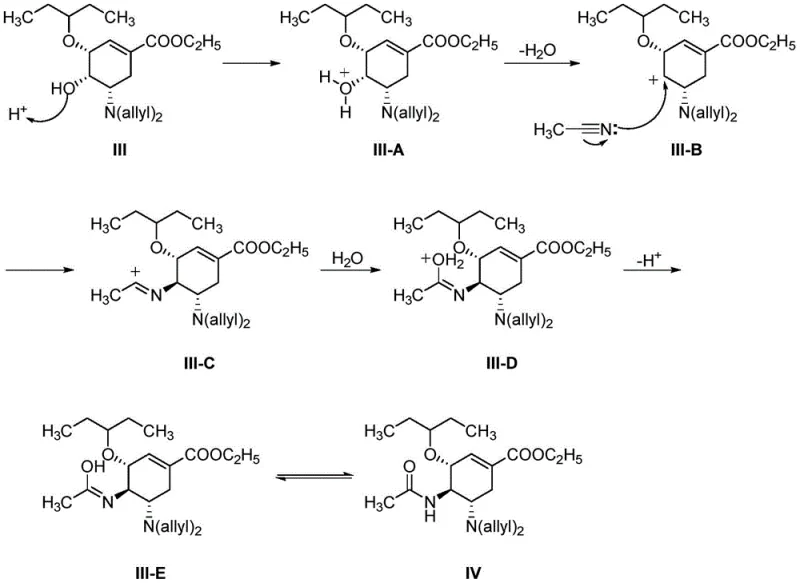
Beyond the primary transformation, the impurity control mechanism inherent in this route is equally sophisticated. The strong steric hindrance mentioned previously acts as a natural filter against the formation of unwanted diastereomers, as alternative attack vectors are energetically unfavorable. Furthermore, the use of mild acidic conditions (such as a mixture of sulfuric and acetic acid) prevents the degradation of the sensitive ester moiety and the double bond, which are often susceptible to harsh acidic environments in other protocols. The subsequent hydrolysis of the nitrilium intermediate proceeds smoothly to the amide without requiring extreme temperatures or prolonged reaction times, thereby minimizing the generation of thermal degradation byproducts. This high degree of intrinsic selectivity means that downstream purification burdens are significantly reduced, allowing for the isolation of high-purity intermediates with minimal chromatographic intervention, a key factor for maintaining economic viability in large-scale pharmaceutical intermediates production.
How to Synthesize Oseltamivir Phosphate Efficiently
The execution of this synthesis requires precise control over reaction parameters to maximize the benefits of the novel pathway. The process initiates with the dissolution of the starting material in a polar aprotic solvent, followed by the careful addition of base and diallylamine to effect the initial amine installation. Subsequent steps involve low-temperature reductions using silane reagents and the critical acid-mediated Ritter rearrangement. The final stage employs a palladium-catalyzed deprotection strategy that is both gentle and effective. For R&D teams looking to implement this technology, the detailed standardized operating procedures, including specific stoichiometric ratios, temperature ramps, and workup protocols, are essential for reproducibility. Please refer to the structured guide below for the comprehensive step-by-step synthesis instructions.
- Perform nucleophilic substitution on Compound I using diallylamine and cesium carbonate in DMF at 90-100°C to yield Compound II.
- Execute reductive deprotection of Compound II using triethylsilane and titanium tetrachloride in dichloromethane at -40 to -35°C to obtain Compound III.
- Conduct the key Ritter reaction by treating Compound III with acetonitrile and acid (sulfuric/acetic) at 0-20°C to introduce the acetamido group, forming Compound IV.
- Finalize synthesis via palladium-catalyzed deallylation of Compound IV using 1,3-dimethyl barbituric acid, followed by phosphoric acid salt formation to crystallize Oseltamivir Phosphate.
Commercial Advantages for Procurement and Supply Chain Teams
From a commercial perspective, the adoption of this 4-step synthesis offers profound advantages that extend well beyond the laboratory bench, directly addressing the core concerns of procurement and supply chain leadership. The reduction in synthetic steps translates immediately into a leaner manufacturing process, where fewer unit operations mean lower consumption of utilities, solvents, and labor hours. This structural efficiency drives a substantial reduction in the Cost of Goods Sold (COGS), making the final API more competitive in price-sensitive markets without compromising on quality. Moreover, the reliance on readily available reagents such as acetonitrile, triethylsilane, and standard palladium catalysts ensures that the supply chain remains resilient against raw material shortages, unlike routes that depend on exotic or single-source chiral auxiliaries.
- Cost Reduction in Manufacturing: The elimination of two entire synthetic steps compared to the legacy 6-step route results in a significant decrease in material throughput and waste generation. By avoiding complex ring-closing and opening sequences, the process removes the need for expensive reagents associated with those transformations, leading to direct savings on raw material procurement. Additionally, the high yield of each individual step—ranging from 85% to 95%—compounds to a superior overall yield, meaning more product is obtained per kilogram of starting material, effectively lowering the unit cost of production.
- Enhanced Supply Chain Reliability: The robustness of this synthetic route enhances supply continuity by simplifying the logistics of intermediate storage and transport. With fewer intermediates to manage and characterize, the risk of batch failure due to intermediate instability is markedly reduced. The use of common industrial solvents like dichloromethane and ethyl acetate further ensures that the process can be easily transferred between different manufacturing sites globally, providing flexibility in sourcing and mitigating regional supply disruptions.
- Scalability and Environmental Compliance: The mild reaction conditions, particularly the avoidance of cryogenic temperatures in the key Ritter step (operating at 0-20°C), facilitate easier scale-up from pilot plant to commercial tonnage. The process generates less hazardous waste compared to routes requiring heavy metal oxidants or extreme acidic conditions, aligning with increasingly stringent environmental regulations. This eco-friendly profile not only reduces waste disposal costs but also strengthens the sustainability credentials of the supply chain, a growing priority for multinational pharmaceutical partners.
Frequently Asked Questions (FAQ)
The following questions address common technical and commercial inquiries regarding the implementation of this novel Oseltamivir Phosphate synthesis. These insights are derived directly from the experimental data and advantageous effects reported in the patent literature, providing a clear understanding of the technology's capabilities and limitations. Understanding these details is crucial for technical teams evaluating the feasibility of adopting this route for their specific manufacturing needs.
Q: How does this new route improve upon the original Roche synthesis?
A: The novel route shortens the synthesis from 6 steps to just 4 steps by utilizing a direct Ritter reaction to introduce the acetamido group, eliminating complex ring-closing and opening sequences found in the original patent CN100545145C.
Q: What represents the key stereochemical advantage of the Ritter reaction step?
A: Due to the significant steric hindrance at the 3-position and 5-position of the cyclohexene ring, the acetonitrile attack on the carbocation intermediate exhibits strong chemoselectivity, ensuring the oriented generation of the target configuration with high purity.
Q: Is this process suitable for large-scale commercial manufacturing?
A: Yes, the process utilizes mild reaction conditions, common solvents like DMF and dichloromethane, and achieves a high total yield of approximately 63%, making it highly viable for industrial scale-up and cost-effective bulk drug production.
Partnering with NINGBO INNO PHARMCHEM: Your Reliable Oseltamivir Phosphate Supplier
At NINGBO INNO PHARMCHEM, we recognize the strategic importance of securing a stable and high-quality supply of critical antiviral APIs like Oseltamivir Phosphate. As a premier CDMO partner, we possess extensive experience scaling diverse pathways from 100 kgs to 100 MT/annual commercial production, ensuring that our clients receive consistent supply regardless of market fluctuations. Our state-of-the-art facilities are equipped with rigorous QC labs capable of meeting stringent purity specifications, guaranteeing that every batch of Oseltamivir Phosphate delivered adheres to the highest international pharmacopoeial standards. We are committed to leveraging advanced synthetic technologies, such as the Ritter reaction route described herein, to drive value for our partners.
We invite global pharmaceutical companies and procurement leaders to engage with our technical team to explore how this optimized synthesis can benefit your specific supply chain. By requesting a Customized Cost-Saving Analysis, you can gain a detailed projection of the economic advantages tailored to your volume requirements. We encourage you to contact our technical procurement team today to索取 specific COA data and route feasibility assessments, ensuring that your next project is built on a foundation of scientific excellence and commercial reliability.