
Advanced Manufacturing of Anhydrous Aziridines: A Technical Breakthrough for Global Supply Chains
The chemical industry is constantly seeking more efficient pathways to synthesize high-value heterocyclic intermediates, and the technology disclosed in patent CN102627594A represents a significant leap forward in the production of anhydrous aziridine compounds. Aziridines are pivotal three-membered nitrogen-containing heterocycles that serve as versatile building blocks in the synthesis of complex pharmaceuticals, agrochemicals, and functional materials due to their high ring strain and reactivity. However, achieving high purity and yield in their manufacture has historically been plagued by challenges related to catalyst selectivity and energy-intensive dehydration steps. This specific patent introduces a robust, liquid-phase methodology that utilizes concentrated sulfuric acid and a water-carrying agent to drive esterification to completion, followed by a controlled alkaline cyclization. By addressing the fundamental thermodynamic limitations of previous gas-phase methods, this approach delivers a product with purity levels exceeding 99% and yields greater than 85%, establishing a new benchmark for reliability in the supply of fine chemical intermediates.
The Limitations of Conventional Methods vs. The Novel Approach
The Limitations of Conventional Methods
Historically, the primary industrial route for generating aziridine compounds involved the gas-phase dehydration of alkanolamines over solid catalysts at elevated temperatures. While conceptually straightforward, this legacy technology suffers from severe inherent drawbacks that impact both economic viability and product quality. The selectivity of the solid catalysts employed in gas-phase reactions is often insufficient, leading to the formation of numerous by-products such as piperazines and higher oligomers, which complicates downstream purification and reduces the overall yield of the desired monomeric aziridine. Furthermore, the operational lifespan of these catalysts is frequently unsatisfactory, necessitating frequent regeneration or replacement cycles that interrupt production continuity and increase maintenance costs. From an energy perspective, the requirement to vaporize the entire feed stream and maintain high reaction temperatures results in substantial energy consumption, making the process increasingly unsustainable in the face of rising global energy prices and stricter environmental regulations regarding carbon footprints.
The Novel Approach
In stark contrast to the inefficiencies of gas-phase dehydration, the novel approach detailed in CN102627594A employs a sophisticated liquid-phase strategy that fundamentally alters the reaction kinetics and thermodynamics. By introducing concentrated sulfuric acid dropwise into the alcohol amine compound in the presence of a water-carrying agent, the process ensures that the esterification equilibrium is driven decisively towards the formation of the intermediate sulfate ester. The use of a water-carrying agent, such as sym-trimethylbenzene, allows for the continuous removal of water via azeotropic distillation during the reflux stage, effectively preventing the hydrolysis of the intermediate and ensuring a thorough degree of esterification that is difficult to achieve in gas-phase systems. Subsequent thermal curing at 110-180°C further stabilizes the intermediate before the crucial cyclization step, where the addition of an alkaline solution induces ring closure under mild conditions (100-120°C). This multi-stage liquid-phase protocol not only enhances selectivity but also dramatically shortens reaction times and lowers the overall energy burden of the synthesis.
Mechanistic Insights into Sulfuric Acid-Catalyzed Cyclization
The core of this technological advancement lies in the precise manipulation of the reaction pathway through acid-base catalysis and thermal control. The mechanism initiates with the protonation of the hydroxyl group of the alkanolamine by concentrated sulfuric acid, facilitating the elimination of water and the formation of an amino-alkyl hydrogen sulfate intermediate. This step is critical because it converts a poor leaving group (hydroxyl) into an excellent leaving group (sulfate), thereby activating the molecule for the subsequent intramolecular nucleophilic attack. The presence of the water-carrying agent is mechanistically vital here; by continuously stripping water from the reaction milieu, the system prevents the reverse reaction (hydrolysis), ensuring that the concentration of the activated sulfate ester remains high throughout the curing phase. This thorough activation is what enables the high conversion rates observed in the final product, distinguishing it from methods where incomplete activation leads to residual starting materials.
Following the curing phase, the introduction of a strong base, such as a 10-30wt% sodium hydroxide or potassium hydroxide solution, triggers the cyclization event. The base serves a dual purpose: it neutralizes the acidic protons and generates the free amine nucleophile in situ, which then attacks the adjacent carbon bearing the sulfate leaving group. This intramolecular $S_N2$-type displacement results in the formation of the strained three-membered aziridine ring. 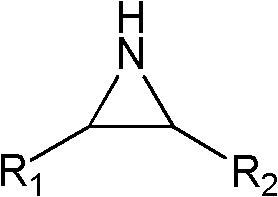 As illustrated in the general structure, the versatility of this mechanism allows for the synthesis of various substituted aziridines depending on the starting alkanolamine (e.g., ethanolamine, isopropanolamine). The final purification step involving normal pressure distillation and the use of solid drying agents ensures that the resulting organic phase is essentially water-free, which is crucial for the stability of aziridines, as they are prone to ring-opening polymerization in the presence of moisture.
How to Synthesize Anhydrous Aziridine Efficiently
Implementing this synthesis route requires careful attention to the stoichiometry of reagents and the control of thermal parameters to maximize safety and yield. The process is designed to be operationally simple yet chemically rigorous, relying on standard chemical engineering unit operations that are easily scalable from pilot plants to full commercial production facilities. The key to success lies in the complete removal of water during the esterification phase and the precise temperature control during the curing and cyclization stages to prevent thermal degradation or polymerization of the sensitive aziridine product. For R&D teams looking to replicate or adapt this chemistry, the following standardized workflow outlines the critical operational phases derived directly from the patent specifications, ensuring a reproducible pathway to high-purity material.
- Perform esterification by adding concentrated sulfuric acid to an alcohol amine compound with a water-carrying agent, refluxing until no water is generated, and curing at 110-180°C.
- Add a 10-30wt% alkaline solution to the cured substance, heat to melt, and conduct a cyclization reaction at 100-120°C.
- Distill the product at normal pressure, add a solid drying agent to the distillate to induce layering, and collect the upper organic phase.
Commercial Advantages for Procurement and Supply Chain Teams
For procurement managers and supply chain directors, the adoption of this patented synthesis method offers tangible strategic advantages that extend beyond mere technical performance. The shift from energy-intensive gas-phase processes to this optimized liquid-phase protocol translates directly into a more resilient and cost-effective supply chain. By utilizing reagents and solvents that can be recovered and recycled, the process minimizes the consumption of raw materials and reduces the volume of waste streams requiring treatment. This efficiency is particularly valuable in the current economic climate, where volatility in raw material pricing and stringent environmental compliance costs are major drivers of total landed cost. The ability to produce high-purity intermediates with reduced energy input positions this method as a superior choice for long-term sourcing strategies aimed at sustainability and margin protection.
- Cost Reduction in Manufacturing: The economic model of this process is heavily favored by the recyclability of key process aids. The water-carrying agent, typically an aromatic solvent like sym-trimethylbenzene, is distilled off and can be reused in subsequent batches, significantly lowering the variable cost per kilogram of product. Furthermore, the use of solid drying agents for the final purification step eliminates the need for complex and expensive vacuum drying protocols or extensive solvent exchanges often required to meet anhydrous specifications. By removing the dependency on short-lived, expensive solid catalysts used in gas-phase methods, the operational expenditure (OPEX) is drastically simplified, allowing for substantial cost savings that can be passed down the supply chain or retained as improved margin.
- Enhanced Supply Chain Reliability: Supply continuity is often threatened by the complexity of manufacturing processes that rely on specialized catalysts or extreme conditions. This method mitigates those risks by using commodity chemicals—sulfuric acid, caustic soda, and common aromatic solvents—that are readily available in the global market, reducing the risk of supply bottlenecks. The robustness of the liquid-phase reaction, which tolerates standard stainless steel equipment rather than requiring specialized metallurgy for high-temperature gas reactors, means that a broader base of qualified manufacturers can produce this intermediate. This diversification of potential supply sources enhances the security of supply for downstream pharmaceutical and agrochemical customers, ensuring that production schedules are met without interruption.
- Scalability and Environmental Compliance: From an environmental, health, and safety (EHS) perspective, this process offers a cleaner profile that facilitates easier regulatory approval and permitting. The closed-loop nature of the reflux and distillation steps minimizes volatile organic compound (VOC) emissions, while the recycling of solvents reduces the overall hazardous waste footprint. The reaction conditions, operating primarily at atmospheric pressure and moderate temperatures (below 180°C), present lower safety risks compared to high-pressure gas-phase alternatives. This inherent safety and environmental compatibility makes the process highly scalable, allowing manufacturers to ramp up production volumes from hundreds of kilograms to multi-tonne scales without encountering the exponential increase in safety barriers that often plagues more hazardous chemistries.
Frequently Asked Questions (FAQ)
To assist technical decision-makers in evaluating the feasibility of integrating this technology into their supply chains, we have compiled answers to the most pertinent questions regarding the process capabilities and product specifications. These insights are derived directly from the experimental data and technical disclosures within the patent documentation, providing a transparent view of what can be expected from this manufacturing route. Understanding these details is essential for aligning project timelines and quality expectations with the actual performance characteristics of the anhydrous aziridine produced via this method.
Q: How does this method improve upon traditional gas-phase dehydration for aziridines?
A: Traditional gas-phase dehydration often suffers from low catalyst selectivity and short catalyst life, leading to poor yields and high energy consumption. This patented liquid-phase method utilizes a water-carrying agent and specific thermal curing to ensure thorough esterification, resulting in significantly higher purity (>99%) and yield (>85%) while reducing overall energy requirements.
Q: What are the key advantages regarding solvent and reagent recovery?
A: A major economic advantage of this process is the recyclability of both the water-carrying agent (such as sym-trimethylbenzene) and the solid drying agents. Unlike processes that generate significant aqueous waste or consume stoichiometric amounts of non-recoverable solvents, this method allows for the distillation and reuse of key components, drastically lowering the variable costs associated with large-scale production.
Q: Can this synthesis method be scaled for industrial production?
A: Yes, the patent explicitly states suitability for large-scale industrialized production. The use of standard unit operations such as reflux, distillation, and phase separation, combined with moderate temperature ranges (100-180°C) and atmospheric pressure distillation steps, makes the process highly adaptable to existing chemical manufacturing infrastructure without requiring specialized high-pressure equipment.
Partnering with NINGBO INNO PHARMCHEM: Your Reliable Aziridine Supplier
The technical potential of the synthesis method described in CN102627594A is immense, offering a pathway to high-purity intermediates that are critical for next-generation drug discovery and agricultural innovation. At NINGBO INNO PHARMCHEM, we possess the extensive experience scaling diverse pathways from 100 kgs to 100 MT/annual commercial production, ensuring that the transition from laboratory bench to industrial reactor is seamless and efficient. Our facility is equipped with rigorous QC labs and adheres to stringent purity specifications, guaranteeing that every batch of aziridine intermediate meets the exacting standards required by global pharmaceutical and fine chemical clients. We understand that consistency is key, and our process engineering team is dedicated to maintaining the tight control parameters necessary to achieve the >99% purity levels promised by this advanced chemistry.
We invite you to leverage our technical expertise to optimize your supply chain for these critical heterocyclic building blocks. Whether you require a Customized Cost-Saving Analysis to compare this route against your current sourcing strategy or need to verify specific technical parameters, our team is ready to assist. We encourage you to contact our technical procurement team today to request specific COA data and route feasibility assessments tailored to your project needs, ensuring a partnership built on transparency, quality, and shared success.