
Revolutionizing Bremelanotide Production: A Deep Dive into Solid-Liquid Hybrid Synthesis Technology
Revolutionizing Bremelanotide Production: A Deep Dive into Solid-Liquid Hybrid Synthesis Technology
The pharmaceutical industry continuously seeks robust manufacturing pathways for complex peptide therapeutics, and the recent disclosure in patent CN110950933B represents a significant leap forward in the production of Bremelanotide. This cyclic heptapeptide, structurally analogous to alpha-melanocyte stimulating hormone, presents formidable synthetic challenges due to its constrained ring structure and the propensity for aggregation during cyclization. The patented technology introduces a sophisticated solid-liquid phase combination strategy that effectively circumvents the limitations of traditional standalone methods. By integrating the precision of liquid-phase fragment synthesis with the operational efficiency of solid-phase assembly, this approach offers a compelling solution for manufacturers aiming to secure a reliable bremelanotide supplier status. The core innovation lies in the strategic construction of the peptide backbone, specifically utilizing a lysine side-chain anchoring technique that minimizes steric hindrance during the critical ring-closing step.
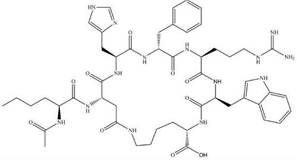
For R&D directors evaluating process feasibility, the implications of this patent are profound. The method avoids the use of hazardous hydrofluoric acid (HF) typically associated with older Boc-chemistry routes, replacing it with safer Fmoc-based protocols and TFA cleavage. Furthermore, the specific sequence of deprotection and coupling ensures that the cyclization occurs between sites that are spatially proximate, drastically reducing the entropy penalty associated with ring closure. This technical refinement not only enhances the overall yield but also simplifies the downstream purification process, a critical factor for cost reduction in peptide manufacturing. As we delve deeper into the mechanistic nuances, it becomes clear that this hybrid methodology sets a new benchmark for the commercial scale-up of complex cyclic peptides.
The Limitations of Conventional Methods vs. The Novel Approach
The Limitations of Conventional Methods
Historically, the synthesis of cyclic peptides like bremelanotide has been plagued by two distinct sets of challenges depending on the chosen methodology. In traditional liquid-phase synthesis, the cyclization step is notoriously inefficient because it competes with intermolecular polymerization. To mitigate the formation of dimers, trimers, and higher-order oligomers, chemists are forced to operate under extreme high-dilution conditions. This requirement necessitates the use of vast volumes of organic solvents, leading to substantial environmental burdens through wastewater generation and significantly inflating production costs due to solvent recovery and disposal. Moreover, the isolation of the desired monomeric cyclic product from a mixture of linear oligomers often requires multiple, yield-eroding purification steps. Conversely, conventional solid-phase synthesis, while eliminating the need for high dilution, introduces severe steric hindrance issues. When a full-length linear peptide is assembled on a resin, the bulky protecting groups and the resin matrix itself create a rigid environment that prevents the N- and C-termini from approaching each other closely enough for efficient cyclization. This often results in incomplete reactions and difficult-to-remove deletion sequences.
The Novel Approach
The methodology outlined in patent CN110950933B ingeniously bridges the gap between these two extremes by employing a solid-liquid phase hybrid strategy. Instead of attempting to cyclize a full-length linear chain on the resin or in solution, the process begins with the liquid-phase synthesis of a specific dipeptide fragment, AC-Nle-Asp-O-2-Phipr. This fragment is then coupled to the side chain of a lysine residue that is already anchored to a Wang resin. By building the rest of the peptide sequence (His-D-Phe-Arg-Trp) onto the main chain of this lysine anchor, the cyclization sites (the N-terminus of Histidine and the side chain of Aspartic Acid) are brought into close proximity before the final ring closure. This "pre-organization" of the peptide chain significantly reduces the conformational freedom that leads to failed cyclization events. Consequently, the reaction proceeds with higher efficiency and fewer side products, effectively solving the steric hindrance problem inherent in standard solid-phase cyclization while avoiding the dilution penalties of liquid-phase methods.
Mechanistic Insights into Solid-Liquid Phase Hybrid Cyclization
The success of this synthesis route hinges on the precise orchestration of orthogonal protecting group strategies and the unique reactivity of the lysine side chain. The process initiates with the preparation of the AC-Nle-Asp-O-2-Phipr fragment, where the carboxyl group of Aspartic Acid is protected as an o-2-phenylisopropyl ester. This specific protecting group is crucial because it is stable under the basic conditions used for Fmoc removal but can be selectively cleaved later to expose the carboxyl group for cyclization. Once this fragment is coupled to the epsilon-amino group of a resin-bound lysine (protected with an acid-labile or hydrazine-labile group like Dde or IVDde on the side chain prior to coupling), the stage is set for chain elongation. The subsequent coupling of Fmoc-Trp(Boc)-OH, Fmoc-Arg(pbf)-OH, Fmoc-D-Phe-OH, and Fmoc-His(Boc)-OH extends the main chain. The mechanistic elegance is revealed during the cyclization step: after selectively removing the Fmoc group from Histidine and the O-2-Phipr group from Aspartic Acid, the free amine and carboxyl groups are positioned ideally for intramolecular amidation. This proximity effect drives the equilibrium towards the cyclic product, minimizing the formation of linear byproducts.
Impurity control is another area where this mechanism excels. In traditional solid-phase synthesis, the difficulty of folding the peptide often leads to "failure sequences" where the cyclization simply does not occur, leaving a linear peptide that is structurally very similar to the target and hard to separate. By ensuring the cyclization sites are close and reactive, the patented method maximizes the conversion to the cyclic form. Additionally, the avoidance of strong bases for hydrolysis prevents racemization of the chiral centers, a common pitfall in peptide synthesis that can compromise biological activity. The use of mild deprotection conditions, such as hydrazine hydrate for the Lys side chain and dilute TFA for the Asp side chain, preserves the integrity of the sensitive peptide backbone. This rigorous control over reaction conditions ensures that the resulting crude peptide possesses a purity profile that is far superior to historical methods, facilitating easier downstream processing.
How to Synthesize Bremelanotide Efficiently
The implementation of this solid-liquid phase synthesis requires strict adherence to the optimized reaction parameters detailed in the patent to ensure reproducibility and high yield. The process involves a sequence of activation, coupling, and selective deprotection steps that must be monitored carefully, typically using ninhydrin tests to confirm reaction completion. Below is a structured overview of the critical operational phases involved in transforming raw amino acids into the high-purity cyclic peptide.
- Synthesize the AC-Nle-Asp-O-2-Phipr dipeptide fragment using liquid phase methods involving AC-Nle-OSu and H-Asp-O-2-Phipr.
- Couple Fmoc-Lys(R1)-OH to Wang resin and selectively remove the Lys side chain protecting group.
- Couple the pre-synthesized dipeptide fragment to the Lys side chain, then extend the main chain with Trp, Arg, D-Phe, and His.
- Remove specific protecting groups (O-2-Phipr and Fmoc) and perform on-resin cyclization to form the cyclic peptide structure.
- Cleave the peptide from the resin using a TFA-based cocktail, followed by purification and freeze-drying.
Commercial Advantages for Procurement and Supply Chain Teams
For procurement managers and supply chain heads, the transition to this advanced synthesis protocol offers tangible benefits that extend beyond mere technical superiority. The primary advantage lies in the drastic simplification of the manufacturing workflow, which directly translates to enhanced supply chain reliability. By eliminating the need for high-dilution cyclization, the process significantly reduces the volume of solvents required per kilogram of product. This reduction not only lowers the direct cost of raw materials but also diminishes the logistical burden associated with solvent storage, handling, and waste disposal. Furthermore, the improved crude purity means that fewer chromatography cycles are needed during purification, shortening the overall production lead time and increasing the throughput of existing manufacturing facilities. These efficiencies make the supply of high-purity bremelanotide more resilient to market fluctuations and raw material shortages.
- Cost Reduction in Manufacturing: The economic impact of this technology is driven by the elimination of expensive and hazardous reagents alongside the optimization of resource usage. Traditional methods often rely on corrosive reagents like hydrofluoric acid or require massive amounts of solvent to drive cyclization, both of which incur high operational costs. This new method utilizes standard Fmoc chemistry and TFA cleavage, which are widely available and cost-effective. Moreover, by preventing the formation of intermolecular polymers, the yield of the desired product is maximized, meaning less starting material is wasted. The qualitative improvement in process efficiency allows for a substantial reduction in the cost of goods sold (COGS), enabling competitive pricing strategies without compromising margin.
- Enhanced Supply Chain Reliability: Supply continuity is often threatened by complex processes that are prone to failure or batch-to-batch variability. The robust nature of this solid-liquid hybrid method mitigates these risks by providing a more predictable reaction outcome. The use of stable intermediates like the AC-Nle-Asp-O-2-Phipr fragment allows for quality control checks before the costly solid-phase assembly begins. If the liquid-phase fragment does not meet specifications, it can be rejected early, preventing the loss of valuable resin and amino acids. This "quality at the source" approach ensures that the final API intermediate is consistently available, reducing the risk of stockouts for downstream drug formulation.
- Scalability and Environmental Compliance: Scaling peptide synthesis from grams to kilograms is notoriously difficult, particularly when dealing with cyclization steps. This method is inherently scalable because it avoids the physical limitations of high-dilution reactors, which become impractical at large volumes. The on-resin cyclization can be performed in standard solid-phase reactors without modification, facilitating a seamless transition from pilot plant to commercial production. Additionally, the reduced solvent usage and avoidance of heavy metal catalysts or highly corrosive acids align with modern environmental, social, and governance (ESG) goals. This compliance reduces the regulatory burden and potential fines associated with waste management, further securing the long-term viability of the supply chain.
Frequently Asked Questions (FAQ)
The following questions address common technical and commercial inquiries regarding the production of bremelanotide using this patented methodology. These insights are derived directly from the experimental data and beneficial effects described in the patent documentation, providing clarity for stakeholders evaluating this technology for potential integration into their supply networks.
Q: Why is the solid-liquid phase method superior to traditional liquid phase cyclization for bremelanotide?
A: Traditional liquid phase cyclization requires high dilution to prevent intermolecular coupling (dimer/trimer formation), which generates excessive wastewater and lowers yield. The solid-liquid hybrid method anchors the peptide on resin, allowing cyclization at higher effective concentrations without intermolecular side reactions.
Q: How does this patent address the steric hindrance issues common in solid-phase cyclization?
A: Conventional solid-phase cyclization often fails due to the rigid structure of the protected peptide chain preventing folding. This method solves this by synthesizing a key dipeptide fragment (AC-Nle-Asp) in liquid phase first and attaching it to the Lys side chain on the resin, bringing the cyclization sites closer together and reducing spatial resistance.
Q: What are the purity levels achievable with this synthesis route?
A: According to the patent examples, this method achieves a crude peptide purity of approximately 97.5% and a refined purity exceeding 99.6% after HPLC purification, demonstrating excellent control over impurities compared to older HF-based or purely liquid-phase methods.
Partnering with NINGBO INNO PHARMCHEM: Your Reliable Bremelanotide Supplier
At NINGBO INNO PHARMCHEM, we recognize that the adoption of advanced synthesis technologies like the one described in CN110950933B is critical for maintaining a competitive edge in the pharmaceutical market. Our team of expert chemists has extensive experience scaling diverse pathways from 100 kgs to 100 MT/annual commercial production, ensuring that the theoretical benefits of this solid-liquid phase method are fully realized in a GMP-compliant environment. We understand that achieving stringent purity specifications requires not just a good recipe, but rigorous QC labs and state-of-the-art analytical equipment to monitor every step of the process. Our commitment to quality ensures that every batch of bremelanotide we produce meets the highest international standards for safety and efficacy.
We invite global partners to collaborate with us to leverage this cutting-edge technology for your peptide development projects. By choosing NINGBO INNO PHARMCHEM, you gain access to a Customized Cost-Saving Analysis tailored to your specific volume requirements and quality needs. We encourage you to contact our technical procurement team today to request specific COA data and route feasibility assessments. Let us help you optimize your supply chain and bring high-quality therapeutic peptides to market faster and more efficiently.