
Scaling 3-Aminomethyl Tetrahydrofuran Production: A Novel Furan-Based Route for Dinotefuran Intermediates
The global demand for third-generation neonicotinoid insecticides, particularly dinotefuran, has necessitated the development of more efficient synthetic routes for key intermediates like 3-aminomethyl tetrahydrofuran. Patent CN109851594B introduces a groundbreaking methodology that shifts the synthetic paradigm from expensive, specialized precursors to commodity-grade furan. This innovation addresses critical bottlenecks in the agrochemical supply chain by leveraging a concise five-step sequence that begins with the oxidative ring-opening of furan. By utilizing hydrogen peroxide and a TS-1 catalyst, the process achieves high selectivity in generating 1,4-butenedial, setting the stage for a streamlined downstream synthesis. This technical advancement represents a significant leap forward for manufacturers seeking to optimize cost structures while maintaining rigorous purity standards required for pesticide active ingredients.
The Limitations of Conventional Methods vs. The Novel Approach
The Limitations of Conventional Methods
Historically, the synthesis of 3-aminomethyl tetrahydrofuran has been plagued by economic and operational inefficiencies inherent in traditional pathways. One prevalent method relies on 2,3-dihydrofuran reacting with dichloroacetyl chloride, a process that involves hazardous halogenated reagents and multiple purification stages to remove chlorine-containing byproducts. Another common route utilizes malic acid, which, while bio-based, suffers from high raw material costs and requires complex catalytic hydrogenation and chlorination steps that are difficult to control on a multi-ton scale. Furthermore, routes based on acrylonitrile often yield poor overall conversion rates, sometimes as low as 19 percent, leading to excessive waste generation and inflated production costs. These legacy methods impose a heavy burden on procurement teams due to the volatility of specialized starting material prices and the environmental compliance costs associated with halogenated waste streams.
The Novel Approach
In stark contrast, the novel approach detailed in the patent data utilizes furan, a widely available and economically attractive feedstock derived from biomass or petrochemical sources. This route bypasses the need for halogenated intermediates entirely, replacing them with a cleaner oxidative strategy followed by a Michael addition with nitromethane. The transition to this chemistry simplifies the molecular construction of the tetrahydrofuran ring, effectively reducing the number of unit operations required to reach the final amine. By eliminating the reliance on expensive chiral pools or complex halogenation chemistries, this method offers a direct path to cost reduction in agrochemical intermediate manufacturing. The strategic use of proline as an organocatalyst in the Michael addition step further enhances the green chemistry profile of the process, aligning with modern sustainability goals while ensuring high reaction efficiency.
Mechanistic Insights into TS-1 Catalyzed Oxidative Ring Opening and Cyclization
The cornerstone of this synthetic strategy is the initial oxidative ring-opening of furan, which is meticulously controlled using a TS-1 (Titanium Silicalite-1) catalyst in the presence of hydrogen peroxide. This heterogeneous catalytic system facilitates the selective cleavage of the furan ring to form 1,4-butenedial without over-oxidizing the aldehyde groups to carboxylic acids, a common side reaction in non-catalyzed oxidations. The microporous structure of TS-1 provides a specific environment that favors the formation of the dialdehyde, ensuring high atom economy and minimizing the formation of polymeric tars that often plague furan chemistry. Following this, the subsequent Michael addition of nitromethane to the dialdehyde is catalyzed by proline, which activates the nitroalkane through enamine or iminium intermediates, ensuring regioselective addition to the conjugated system. This precise control over the carbon-carbon bond formation is critical for establishing the correct carbon skeleton required for the final tetrahydrofuran structure.
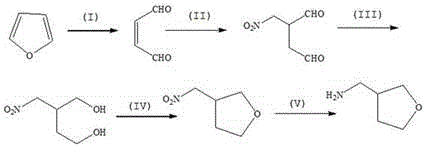
Following the carbon skeleton assembly, the process employs a robust reduction and cyclization sequence to finalize the heterocyclic core. The reduction of the nitro-dialdehyde intermediate using sodium borohydride is conducted under mild conditions to selectively reduce the aldehyde groups to alcohols while leaving the nitro group intact, yielding 2-nitromethyl-1,4-butanediol. This chemoselectivity is paramount, as premature reduction of the nitro group would complicate the subsequent cyclization step. The final ring closure is achieved through acid-catalyzed dehydration, where strong acid catalysts like perfluorosulfonic acid resin promote the intramolecular nucleophilic attack of the hydroxyl group onto the adjacent carbon, expelling water to form the stable tetrahydrofuran ring. The final catalytic hydrogenation step then cleanly reduces the nitro group to the primary amine, completing the synthesis with high fidelity and minimal impurity generation, which is essential for meeting the stringent specifications of pharmaceutical and agrochemical clients.
How to Synthesize 3-Aminomethyl Tetrahydrofuran Efficiently
The synthesis of 3-aminomethyl tetrahydrofuran via this furan-based route requires careful attention to reaction parameters to maximize yield and purity at each stage. The process begins with the preparation of the TS-1 catalyst and the optimization of the oxidation step, followed by a sequential cascade of organic transformations that build molecular complexity efficiently. Operators must maintain strict control over stoichiometry, particularly the ratio of hydrogen peroxide to furan, to prevent over-oxidation, and manage the exothermic nature of the reduction steps. The detailed standardized synthesis steps, including specific molar ratios, solvent choices, and temperature profiles for each of the five reaction stages, are outlined in the technical guide below to ensure reproducible results in a pilot or plant setting.
- Oxidize furan using hydrogen peroxide and TS-1 catalyst to generate 1,4-butenedial.
- Perform Michael addition with nitromethane under alkaline conditions using proline catalyst.
- Reduce the dialdehyde intermediate with sodium borohydride, followed by acid-catalyzed dehydration cyclization and final catalytic hydrogenation.
Commercial Advantages for Procurement and Supply Chain Teams
For procurement managers and supply chain directors, the adoption of this furan-based synthesis route offers transformative benefits that extend beyond simple chemical yield improvements. The primary driver of value is the drastic reduction in raw material costs, as furan is a commodity chemical with a stable and abundant global supply, unlike the specialized and often imported precursors used in legacy methods. This shift mitigates the risk of supply disruptions caused by the limited production capacity of niche starting materials, thereby enhancing the overall resilience of the supply chain for dinotefuran production. Furthermore, the elimination of halogenated reagents and the use of aqueous hydrogen peroxide significantly lower the environmental compliance burden, reducing the costs associated with hazardous waste disposal and wastewater treatment facilities.
- Cost Reduction in Manufacturing: The economic advantage of this process is rooted in the substitution of high-cost starting materials with low-cost furan, which fundamentally alters the cost basis of the final intermediate. By removing the need for expensive chlorinating agents and complex multi-step protections found in older routes, the overall variable cost of production is significantly decreased. Additionally, the use of heterogeneous catalysts like TS-1 and recoverable acid resins allows for potential catalyst recycling, further driving down the cost per kilogram of the active intermediate. This structural cost advantage provides manufacturers with greater pricing flexibility and improved margins in a competitive agrochemical market.
- Enhanced Supply Chain Reliability: Relying on furan as a feedstock decouples the production of 3-aminomethyl tetrahydrofuran from the volatile supply chains of specialized fine chemicals. Furan is produced on a massive industrial scale for various applications, ensuring a consistent and reliable flow of raw materials even during periods of market fluctuation. This stability allows for long-term production planning and inventory management without the fear of sudden raw material shortages that frequently plague routes dependent on custom-synthesized precursors. Consequently, lead times for high-purity agrochemical intermediates can be stabilized, fostering stronger relationships with downstream formulators and end-users.
- Scalability and Environmental Compliance: The process design inherently supports commercial scale-up due to its reliance on standard chemical engineering unit operations such as liquid-phase oxidation and filtration. The absence of extreme high-pressure or high-temperature conditions in the critical bond-forming steps reduces the capital expenditure required for specialized reactor vessels. Moreover, the cleaner reaction profile, characterized by the absence of heavy metal contaminants and halogenated byproducts, simplifies the purification workflow and ensures that the final product meets rigorous environmental and safety standards. This alignment with green chemistry principles not only future-proofs the manufacturing site against tightening regulations but also enhances the brand reputation of the supplier as a sustainable partner.
Frequently Asked Questions (FAQ)
The following questions address common technical and commercial inquiries regarding the implementation of this furan-based synthesis route. These insights are derived directly from the experimental data and process descriptions found in the patent literature, providing a factual basis for evaluating the technology's viability. Understanding these nuances is essential for R&D teams assessing process transfer and procurement teams evaluating supplier capabilities.
Q: What are the primary advantages of using furan as a starting material for 3-aminomethyl tetrahydrofuran?
A: Using furan significantly lowers raw material costs compared to traditional precursors like 2,3-dihydrofuran or malic acid. The route described in patent CN109851594B utilizes inexpensive, commodity-grade furan and avoids complex halogenation steps, streamlining the supply chain.
Q: How does the TS-1 catalyzed oxidation step impact process safety and efficiency?
A: The use of TS-1 (Titanium Silicalite-1) with hydrogen peroxide allows for mild oxidative ring opening at room temperature. This eliminates the need for hazardous chlorinating agents or extreme temperatures found in older methods, enhancing operational safety and reducing energy consumption.
Q: Is this synthesis route suitable for large-scale commercial manufacturing?
A: Yes, the process is designed for scalability. It employs standard unit operations such as liquid-phase oxidation, reduction, and catalytic hydrogenation, avoiding exotic reagents. The high selectivity of the TS-1 catalyst and the robustness of the cyclization step support consistent quality in large-batch production.
Partnering with NINGBO INNO PHARMCHEM: Your Reliable 3-Aminomethyl Tetrahydrofuran Supplier
At NINGBO INNO PHARMCHEM, we recognize the strategic importance of efficient intermediate synthesis in the global agrochemical landscape. Our technical team possesses extensive experience scaling diverse pathways from 100 kgs to 100 MT/annual commercial production, ensuring that the innovative furan-based route described in patent CN109851594B can be seamlessly translated from the laboratory to full-scale manufacturing. We are committed to delivering high-purity 3-aminomethyl tetrahydrofuran that adheres to stringent purity specifications, supported by our rigorous QC labs equipped with advanced analytical instrumentation to monitor every batch for impurities and residual solvents.
We invite industry partners to collaborate with us to leverage this cost-effective technology for their dinotefuran supply chains. Our technical procurement team is ready to provide a Customized Cost-Saving Analysis tailored to your specific volume requirements, demonstrating exactly how this route can optimize your bill of materials. Please contact us today to request specific COA data and route feasibility assessments, and let us demonstrate how our manufacturing expertise can secure your supply of this critical insecticide intermediate.