
Scalable Synthesis of High-Performance Phosphorus-Bromine Flame Retardants for Industrial Polymers
Scalable Synthesis of High-Performance Phosphorus-Bromine Flame Retardants for Industrial Polymers
The development of advanced flame retardant intermediates is critical for meeting stringent global fire safety standards in the polymer and electronics industries. Patent CN102731575A introduces a groundbreaking methodology for synthesizing a novel phosphorus-bromine flame retardant by chemically modifying 9,10-dihydro-9-oxa-10-phosphaphenanthrene-10-oxide (DOPO). Unlike traditional additive flame retardants that suffer from migration issues and low thermal stability, this invention leverages the reactive P-H bond within the DOPO structure to form a robust covalent linkage with brominated styrene derivatives. This strategic molecular design not only integrates the synergistic flame-retarding effects of phosphorus and bromine but also significantly enhances the thermal decomposition profile of the final material. For R&D directors and procurement specialists seeking reliable specialty chemical suppliers, this technology represents a pivotal shift towards high-efficiency, thermally stable additives that can be seamlessly integrated into complex polymer matrices without compromising mechanical properties.
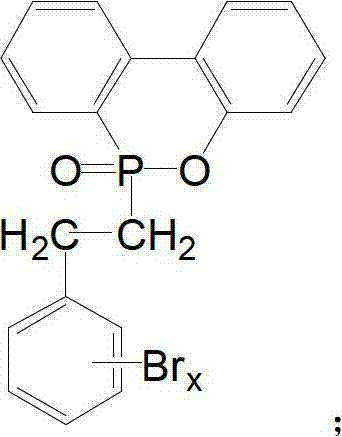
The Limitations of Conventional Methods vs. The Novel Approach
The Limitations of Conventional Methods
Historically, the direct utilization of DOPO as an additive flame retardant has been plagued by significant technical and economic inefficiencies that hinder its widespread adoption in high-performance applications. As noted in prior art such as CN 101376665A, achieving the desired UL-94 V-0 flammability rating often necessitates the incorporation of excessively high loadings of unmodified DOPO, which adversely affects the physical integrity and processing characteristics of the host polymer. Furthermore, the relatively low initial decomposition temperature of pure DOPO restricts its utility in engineering plastics that undergo high-temperature processing, leading to premature degradation and the release of volatile phosphorus species before the material is even formed. These limitations force manufacturers to compromise on either cost, by using large quantities of expensive additive, or performance, by accepting lower thermal stability, creating a persistent bottleneck in the supply chain for premium flame-retardant materials.
The Novel Approach
The innovative synthesis route detailed in the patent overcomes these historical barriers through a clever atom-economic addition reaction that permanently locks the flame-retardant elements into a single, thermally robust molecule. By reacting the active hydrogen on the phosphorus atom of DOPO with the unsaturated carbon-carbon double bond of brominated styrene, the process creates a new C-P bond that dramatically elevates the thermal stability of the phosphorus moiety. This chemical modification ensures that the flame retardant remains intact during the high-shear, high-temperature extrusion processes typical of polymer manufacturing, thereby guaranteeing consistent fire protection performance. Moreover, the simultaneous presence of bromine atoms on the styrene ring introduces a synergistic gas-phase radical quenching mechanism that complements the char-forming action of the phosphorus, allowing for effective fire suppression at much lower overall additive loadings compared to conventional systems.
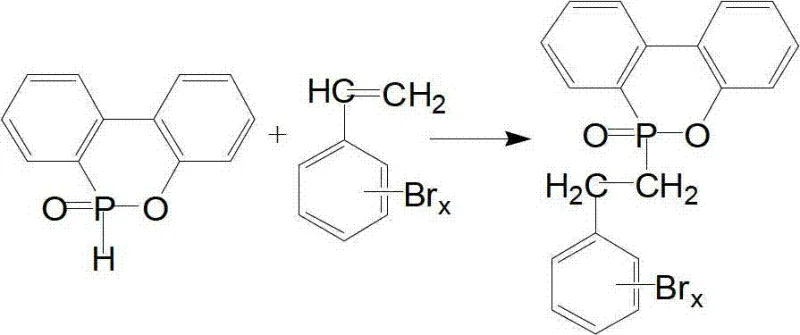
Mechanistic Insights into Solvent-Free P-H Addition
The core chemical transformation driving this technology is a thermal addition reaction across the vinyl group of the brominated styrene, initiated by the nucleophilic character of the P-H bond in the molten DOPO. Operating under solvent-free conditions at temperatures ranging from 125°C to 200°C, the reaction proceeds via a free-radical or polar mechanism depending on the specific thermal activation, effectively grafting the bulky, aromatic bromostyrene unit onto the rigid DOPO backbone. This solvent-less approach is particularly advantageous for industrial scale-up as it eliminates the need for hazardous organic solvents, reduces reactor volume requirements, and simplifies the downstream purification process to a straightforward crystallization step using acetone. The versatility of the reaction is further highlighted by its tolerance to various degrees of bromination on the styrene reactant, enabling the production of a family of derivatives where the bromine content (x=1~5) can be precisely tuned to match specific regulatory and performance requirements without altering the fundamental synthetic protocol.
From an impurity control perspective, the simplicity of the reaction stoichiometry—typically a 1:1 molar ratio between DOPO and the bromostyrene monomer—minimizes the formation of complex by-products that are difficult to separate. The reaction kinetics are governed primarily by temperature and agitation speed, with the patent specifying a broad operational window of 0.5 to 10 hours, providing process engineers with significant flexibility to optimize conversion rates based on batch size and equipment capabilities. The resulting product, characterized as a white or light yellow powder after crystallization, exhibits a well-defined structure where the phosphorus and bromine elements are homogeneously distributed at the molecular level, ensuring consistent flame retardancy throughout the polymer matrix and preventing the blooming or leaching issues often associated with physical blends of separate phosphorus and bromine additives.
How to Synthesize Phosphorus-Bromine Flame Retardant Efficiently
The synthesis protocol outlined in the patent offers a streamlined pathway for manufacturing this high-value intermediate, emphasizing operational simplicity and safety. The process begins by charging the reactor with solid DOPO and heating it under an inert atmosphere until it forms a homogeneous melt, which then serves as the reaction medium for the subsequent addition of the brominated styrene. Detailed standardized operating procedures regarding temperature ramping, stirring regimes, and crystallization parameters are essential for reproducibility and quality control in a commercial setting.
- Charge DOPO into a reactor equipped with stirring and reflux capabilities, then heat to 125-200°C until fully melted.
- Add brominated styrene (mono- to penta-bromo variants) to the molten DOPO while maintaining vigorous stirring.
- Maintain reaction temperature and agitation for 0.5 to 10 hours, followed by crystallization in acetone and drying.
Commercial Advantages for Procurement and Supply Chain Teams
For procurement managers and supply chain leaders, the adoption of this synthetic route offers compelling economic and logistical benefits that directly impact the bottom line. The elimination of organic solvents from the reaction phase not only reduces raw material costs but also drastically cuts down on waste disposal expenses and environmental compliance burdens, aligning perfectly with modern green chemistry initiatives. The ability to produce a dual-action flame retardant in a single step simplifies the supply chain by reducing the number of distinct chemicals that need to be sourced, stored, and handled, thereby minimizing inventory complexity and potential safety hazards associated with managing multiple reactive intermediates.
- Cost Reduction in Manufacturing: The solvent-free nature of this process fundamentally alters the cost structure of flame retardant production by removing the capital and operational expenditures associated with solvent recovery systems. By avoiding the use of volatile organic compounds, manufacturers can significantly reduce energy consumption related to distillation and drying, while also mitigating the risk of solvent loss which traditionally erodes profit margins. Furthermore, the high atom economy of the addition reaction ensures that nearly all input materials are incorporated into the final product, maximizing yield and minimizing the generation of worthless waste streams that require costly treatment.
- Enhanced Supply Chain Reliability: The raw materials required for this synthesis, specifically DOPO and various brominated styrenes, are established commodity chemicals with robust global supply networks, ensuring consistent availability and price stability. Unlike exotic catalysts or specialized reagents that may be subject to geopolitical disruptions or single-source bottlenecks, the inputs for this process are widely produced, allowing procurement teams to negotiate favorable terms and secure long-term contracts with multiple vendors. This raw material accessibility translates directly into reduced lead times for the finished flame retardant, enabling faster response to market demands and more agile production planning.
- Scalability and Environmental Compliance: The thermal addition reaction is inherently scalable, transitioning smoothly from laboratory glassware to large-scale industrial reactors without the need for complex pressure vessels or cryogenic cooling systems. The mild reaction conditions and the absence of toxic catalysts simplify the regulatory approval process for new manufacturing sites, facilitating rapid capacity expansion to meet growing demand. Additionally, the solid nature of the final product simplifies packaging and transportation logistics compared to liquid additives, reducing the risk of leakage and spillage during transit while lowering shipping costs due to higher bulk density.
Frequently Asked Questions (FAQ)
The following questions address common technical and commercial inquiries regarding the implementation of this flame retardant technology, derived directly from the patent specifications and industry best practices. Understanding these details is crucial for technical teams evaluating the feasibility of integrating this intermediate into their existing polymer formulations.
Q: What are the thermal stability advantages of this DOPO-bromostyrene adduct compared to pure DOPO?
A: The covalent bonding of the bromostyrene moiety to the DOPO core significantly raises the initial decomposition temperature, overcoming the limitation of pure DOPO which decomposes at lower temperatures, thereby expanding its application range in high-performance engineering plastics.
Q: Does this synthesis process require organic solvents?
A: No, the patented method utilizes a solvent-free melt reaction where DOPO acts as both reactant and reaction medium initially, drastically reducing VOC emissions and downstream solvent recovery costs.
Q: Can the bromine content be adjusted in the final product?
A: Yes, by varying the degree of bromination on the styrene reactant (using monobromo, dibromo, or pentabromo styrene), manufacturers can precisely tune the phosphorus-to-bromine ratio to meet specific UL-94 V-0 fire safety standards.
Partnering with NINGBO INNO PHARMCHEM: Your Reliable Phosphorus-Bromine Flame Retardant Supplier
At NINGBO INNO PHARMCHEM, we recognize the critical importance of high-performance additives in driving innovation within the polymer and electronics sectors. Our team possesses extensive experience scaling diverse pathways from 100 kgs to 100 MT/annual commercial production, ensuring that the transition from laboratory discovery to full-scale manufacturing is seamless and efficient. We are committed to delivering products with stringent purity specifications and supporting our partners with rigorous QC labs that validate every batch against the highest international standards, guaranteeing the consistency and reliability required for mission-critical applications.
We invite you to collaborate with us to unlock the full potential of this advanced flame retardant technology for your specific product lines. Please contact our technical procurement team to request a Customized Cost-Saving Analysis tailored to your current formulation needs. We are ready to provide specific COA data and comprehensive route feasibility assessments to demonstrate how our manufacturing capabilities can enhance your supply chain resilience and drive sustainable growth.