
Advanced Green Synthesis of Epoxiconazole: A Scalable Route for Global Fungicide Production
Advanced Green Synthesis of Epoxiconazole: A Scalable Route for Global Fungicide Production
The global demand for high-efficacy triazole fungicides continues to surge, driving the need for robust, environmentally compliant manufacturing processes for key active ingredients like Epoxiconazole. Patent CN108164514B, published in early 2021, introduces a transformative preparation method that addresses critical bottlenecks in traditional synthesis. This innovative approach leverages a modified Corey epoxidation strategy, utilizing a sulfonium ylide generated in situ to construct the crucial epoxide ring with high stereoselectivity. For R&D directors and procurement leaders in the agrochemical sector, this patent represents a significant leap forward, offering a pathway to cost reduction in fungicide manufacturing while adhering to increasingly stringent environmental regulations. By replacing hazardous reagents like methylsulfonyl chloride and avoiding the generation of high-salt wastewater, this technology aligns perfectly with the goals of sustainable chemical production.
The Limitations of Conventional Methods vs. The Novel Approach
The Limitations of Conventional Methods
Historically, the industrial synthesis of Epoxiconazole has been plagued by significant safety and environmental challenges that hinder efficient commercial scale-up of complex agrochemical intermediates. Early methodologies, such as those described in US5268517, relied heavily on Grignard reagents. These processes impose rigorous demands on moisture and oxygen control, creating substantial safety risks and complicating reactor operations on a multi-ton scale. Furthermore, alternative routes like the Horner-Wadsworth-Emmons (HWE) reaction disclosed in US20110295019 introduce severe ecological liabilities; they utilize methyl nitrite, which forms explosive mixtures with air, and generate large volumes of phosphorus-containing wastewater that require expensive treatment protocols. Even more recent attempts, such as the route in CN106279067A, suffer from excessive synthetic steps and the mandatory use of hypertoxic methylsulfonyl chloride, a reagent that poses acute handling hazards and contributes to a heavy three-waste burden, making it increasingly untenable for modern green chemistry standards.
The Novel Approach
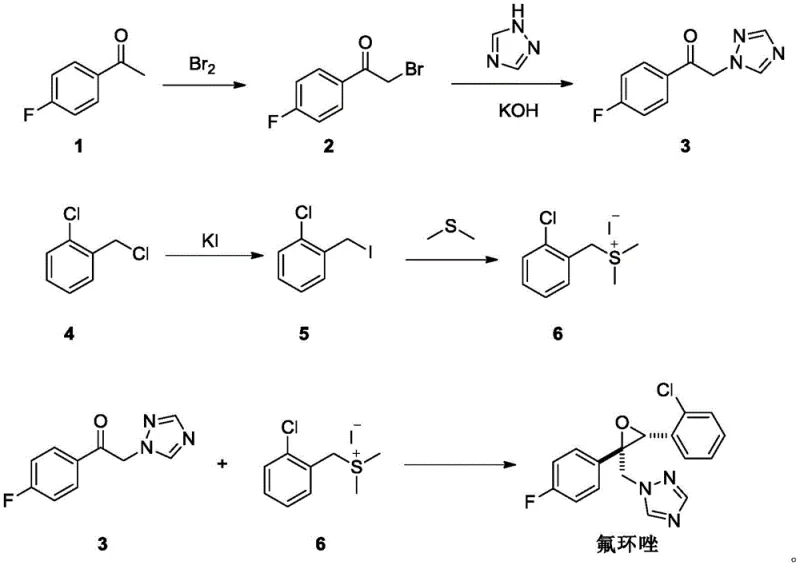
In stark contrast, the methodology outlined in CN108164514B offers a streamlined, five-step sequence that prioritizes safety and atom economy without compromising yield. The core innovation lies in the construction of the epoxide moiety via the reaction of a triazole-substituted ketone with a sulfonium salt derived from o-chlorobenzyl chloride. This route eliminates the need for dangerous phosphorus reagents or moisture-sensitive organometallics. Instead, it utilizes readily available commodity chemicals like p-fluoroacetophenone and dimethyl sulfide. The process operates under relatively mild conditions, with the critical epoxidation step occurring between 80°C and 150°C, ensuring high conversion rates. By integrating these improvements, the patent delivers a synthesis path that is not only chemically elegant but also commercially viable, providing a reliable agrochemical intermediate supplier with the tools to produce high-purity epoxiconazole efficiently.
Mechanistic Insights into Corey Epoxidation via Sulfonium Ylide
The heart of this synthetic breakthrough is the application of Corey-Chaykovsky epoxidation logic, adapted here for industrial scalability. The mechanism begins with the formation of a sulfonium salt (Compound 6) by reacting o-chlorobenzyl iodide (Compound 5) with dimethyl sulfide. This quaternization step is highly efficient and proceeds cleanly at temperatures between 0°C and 50°C. In the subsequent key step, this sulfonium salt acts as a precursor for the sulfur ylide. Upon treatment with a strong base such as sodium hydroxide, potassium hydroxide, or sodium hydride in a polar aprotic solvent like DMF or DMSO, the sulfonium salt undergoes deprotonation to generate the reactive ylide species in situ.
This nucleophilic ylide then attacks the carbonyl carbon of the triazole ketone (Compound 3), which is prepared separately via the nucleophilic substitution of alpha-bromo-p-fluoroacetophenone with triazole. The attack leads to the formation of a betaine intermediate, which rapidly collapses to form the oxirane (epoxide) ring while expelling dimethyl sulfide as a byproduct. This intramolecular displacement is stereoselective, favoring the formation of the desired cis-epoxide configuration essential for biological activity. The use of the sulfonium salt strategy avoids the harsh conditions associated with other epoxidation methods, thereby minimizing side reactions and impurity formation. This mechanistic clarity allows for precise control over the reaction profile, ensuring that the final product meets the rigorous purity specifications required for agricultural applications.
How to Synthesize Epoxiconazole Efficiently
Implementing this synthesis requires careful attention to reaction parameters, particularly temperature control during the bromination and epoxidation stages. The process is divided into two parallel convergent lines: the preparation of the triazole ketone fragment and the synthesis of the sulfonium salt fragment, which are finally coupled. The following guide outlines the standardized operational framework derived from the patent examples, designed to maximize yield and minimize waste generation.
- Brominate p-fluoroacetophenone with liquid bromine in an inert solvent at -10 to 50°C to obtain alpha-bromo ketone (Compound 2).
- React Compound 2 with triazole and a base (e.g., KOH) in organic solvent at 100-120°C to form the triazole ketone (Compound 3).
- Convert o-chlorobenzyl chloride to the corresponding iodide (Compound 5) using potassium iodide in acetonitrile or DMF.
- React Compound 5 with excess dimethyl sulfide to generate the sulfonium salt intermediate (Compound 6).
- Perform Corey epoxidation by reacting Compound 3 and Compound 6 with a strong base at 80-150°C to yield Epoxiconazole.
Commercial Advantages for Procurement and Supply Chain Teams
For procurement managers and supply chain heads, the transition to this novel synthesis route offers tangible strategic benefits beyond mere technical feasibility. The primary advantage lies in the drastic simplification of the supply chain for raw materials. By relying on bulk commodities like p-fluoroacetophenone and o-chlorobenzyl chloride, manufacturers can mitigate the risks associated with sourcing specialized or hazardous reagents. This shift directly translates to enhanced supply chain reliability, as the feedstock market for these precursors is deep and stable, reducing the likelihood of production stoppages due to material shortages. Furthermore, the elimination of toxic reagents like methylsulfonyl chloride removes a significant regulatory hurdle, simplifying logistics and storage requirements.
- Cost Reduction in Manufacturing: The economic impact of this process is profound, driven primarily by the reduction in waste treatment costs and the optimization of raw material usage. Traditional routes often incur hidden costs related to the disposal of phosphorus waste or the neutralization of acidic byproducts from Grignard reactions. This new method generates no high-salt wastewater and avoids the use of expensive phosphorus reagents entirely. Additionally, the high stereoselectivity of the Corey epoxidation step reduces the need for costly chiral resolution or extensive purification downstream. The overall atom economy is superior, meaning more of the input mass ends up in the final product, effectively lowering the cost per kilogram of the active ingredient produced.
- Enhanced Supply Chain Reliability: Stability in production is paramount for meeting global agricultural demand. This synthesis route enhances reliability by removing steps that are sensitive to ambient conditions, such as the strict anhydrous requirements of Grignard chemistry. The reactions can be performed in common solvents like toluene, DMF, and acetonitrile, which are widely available and easy to recover. The robustness of the sulfonium salt formation and the subsequent epoxidation ensures consistent batch-to-batch quality. This predictability allows supply chain planners to forecast production timelines with greater accuracy, reducing lead time for high-purity agrochemical intermediates and ensuring timely delivery to formulation partners.
- Scalability and Environmental Compliance: As environmental regulations tighten globally, the ability to scale production without escalating the environmental footprint is a critical competitive advantage. This process is inherently greener, avoiding the generation of explosive gas mixtures and toxic effluents. The absence of heavy metal catalysts or persistent organic pollutants simplifies the permitting process for new production facilities. Moreover, the solvent systems used are amenable to standard distillation and recovery techniques, facilitating a circular approach to solvent management. This alignment with green chemistry principles not only future-proofs the manufacturing asset but also enhances the brand value of the end-product in markets that prioritize sustainability.
Frequently Asked Questions (FAQ)
The following questions address common technical and commercial inquiries regarding the implementation of this Epoxiconazole synthesis route. These insights are derived directly from the experimental data and comparative analysis provided in the patent documentation, offering clarity on how this method outperforms legacy technologies in terms of safety, yield, and environmental impact.
Q: How does this new method improve environmental compliance compared to prior art?
A: Unlike previous methods utilizing Grignard reagents or Horner-Wadsworth-Emmons reactions which generate phosphorus-containing wastewater or require strict anhydrous conditions, this patent employs a Corey epoxidation route that avoids high-salt wastewater and toxic methylsulfonyl chloride, significantly reducing the environmental footprint.
Q: What are the key advantages regarding raw material availability?
A: The process utilizes cheap and easily obtained starting materials such as p-fluoroacetophenone and o-chlorobenzyl chloride. This contrasts with older routes requiring difficult-to-synthesize precursors or hazardous reagents like methyl nitrite, ensuring a more stable and cost-effective supply chain.
Q: Is this synthesis route suitable for large-scale industrial production?
A: Yes, the method features simple operational steps, high stereoselectivity, and excellent atom economy. The avoidance of explosive mixtures and hypersensitive reagents makes it highly suitable for commercial scale-up of complex agrochemical intermediates with consistent quality.
Partnering with NINGBO INNO PHARMCHEM: Your Reliable Epoxiconazole Supplier
At NINGBO INNO PHARMCHEM, we recognize that the adoption of advanced synthetic routes like the one described in CN108164514B requires a partner with deep technical expertise and proven manufacturing capabilities. As a leading CDMO, we possess extensive experience scaling diverse pathways from 100 kgs to 100 MT/annual commercial production. Our facilities are equipped to handle the specific solvent systems and reaction conditions required for this sulfonium ylide chemistry, ensuring that the transition from lab to plant is seamless. We maintain stringent purity specifications and operate rigorous QC labs to guarantee that every batch of Epoxiconazole meets the highest international standards for agrochemical actives.
We invite you to collaborate with us to leverage this cutting-edge technology for your supply chain. Our team is ready to provide a Customized Cost-Saving Analysis tailored to your specific volume requirements, demonstrating exactly how this green synthesis route can improve your margins. Please contact our technical procurement team today to request specific COA data and route feasibility assessments. Let us help you secure a sustainable, cost-effective supply of high-quality Epoxiconazole for the global market.