
Advanced Red Phosphorescent Iridium Complexes for High-Efficiency OLED Manufacturing
The landscape of organic electroluminescent display technology is constantly evolving, driven by the relentless demand for higher efficiency and longer device lifetimes. A significant breakthrough in this domain is documented in Chinese Patent CN109593105B, which introduces a novel class of metal complexes specifically engineered to overcome the limitations of traditional red phosphorescent materials. Historically, red phosphorescent emitters have struggled with lower external quantum efficiency, often hovering around 15%, primarily due to the inherent difficulties in designing ligands for heavy metal complexes with narrow bandgaps. This patent addresses these critical challenges by proposing a molecular architecture defined by the formula M(LA)m-n(LC)n, where M represents Iridium. The innovation lies not just in the metal center, but in the sophisticated design of the ancillary ligands, particularly the modified 1,3-diketone structures that impart exceptional rigidity to the overall complex.
For R&D directors and procurement specialists in the electronic chemicals sector, understanding the structural nuances of this invention is paramount. The patent details a systematic approach to enhancing the photophysical properties of iridium-based emitters. By integrating specific cyclized ligand systems, the inventors have achieved a material that not only emits in the desirable red spectrum but does so with an external quantum efficiency approaching 20%. This represents a substantial leap forward in performance metrics, promising to extend the operational life of OLED panels while reducing power consumption. The following analysis delves into the mechanistic advantages and commercial implications of adopting this advanced material chemistry in large-scale manufacturing environments.
The Limitations of Conventional Methods vs. The Novel Approach
The Limitations of Conventional Methods
Traditional red phosphorescent materials have long been plagued by efficiency roll-off and thermal instability issues that compromise the longevity of organic light-emitting devices. The fundamental problem stems from the flexibility of conventional ligand structures, which allows for significant intramolecular rotation and vibration. These non-radiative decay pathways dissipate excited state energy as heat rather than light, directly lowering the external quantum efficiency. Furthermore, the synthesis of narrow bandgap emitters often involves complex, multi-step routes that yield products difficult to purify to the stringent standards required for display applications. Impurities in the emissive layer can act as quenching sites, drastically reducing device performance and leading to premature failure. Consequently, manufacturers have faced a trade-off between color purity, efficiency, and the cost of goods sold associated with difficult purification processes.
The Novel Approach
The methodology outlined in patent CN109593105B offers a transformative solution by introducing a rigid, cyclized 1,3-diketone ligand system. Unlike traditional linear beta-diketones, these modified ligands form a robust ring structure upon coordination with the iridium center. This structural rigidity effectively locks the molecular conformation, minimizing energy loss through internal rotation. 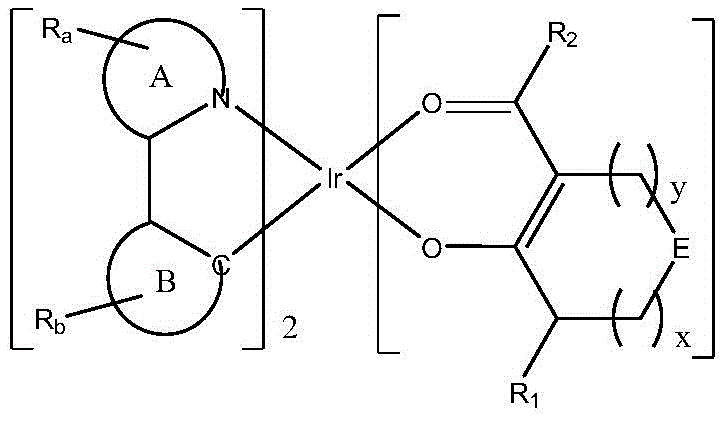 As illustrated in the general structural formula, the combination of the main ligand LA and the ancillary ligand LC creates a sterically hindered environment that protects the metal center. This design not only enhances the thermal stability of the material, allowing it to withstand the rigors of vacuum deposition, but also ensures that a higher proportion of excitons decay radiatively. The result is a red emitter with superior color purity and significantly improved efficiency metrics compared to prior art.
Mechanistic Insights into Rigid Ligand Coordination
The core mechanism driving the performance enhancement of these complexes is the suppression of non-radiative decay channels through steric confinement. In the excited state, molecules naturally seek to relax to the ground state. In flexible systems, this relaxation often occurs via vibrational modes that generate heat. However, the cyclized nature of the LC ligand in this invention creates a 'steel-like' spatial stereostructure, as described in the patent text. This rigidity restricts the degrees of freedom for the molecule, forcing the energy to be released as photons. The coordination involves the nitrogen atom on ring A and the sp2 hybridized carbon atom on ring B of the LA ligand, along with the oxygen atoms of the LC ligand, forming a stable octahedral geometry around the iridium atom. This precise geometric arrangement is critical for tuning the HOMO-LUMO gap to achieve the target red emission wavelength of 590nm to 675nm.
Furthermore, the versatility of the ligand design allows for fine-tuning of the electronic properties without sacrificing stability. The patent specifies that Ring A and Ring B can be varied among five or six-membered aromatic or heteroaromatic rings, and substituents Ra and Rb can be extensively modified. 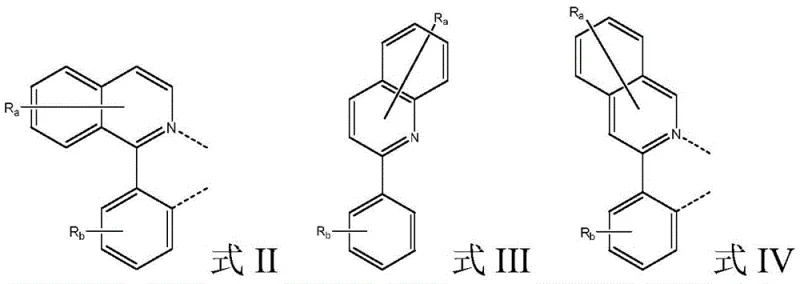 As shown in the specific structural variants like Formula II, III, and IV, chemists can introduce electron-donating or electron-withdrawing groups to shift the emission peak or improve solubility and processability. This modularity is essential for creating a library of materials that can be optimized for specific host-guest systems in OLED stacks. The ability to maintain high thermal stability while adjusting the emission color ensures that these materials can be integrated into existing manufacturing workflows without requiring significant changes to the deposition equipment or thermal profiles.
How to Synthesize High-Efficiency Red Emitters Efficiently
The synthesis of these advanced iridium complexes follows a logical progression that balances chemical complexity with manufacturability. The process generally begins with the preparation of the main ligand LA, which can be achieved through palladium-catalyzed coupling reactions or copper-catalyzed cyclization depending on the specific skeleton chosen. For instance, substituted isoquinoline ligands can be synthesized from o-iodobenzonitrile precursors, while quinoline derivatives may be accessed via oxidative cyclization of anilines and acetophenones. Following the isolation of the main ligand, it is coordinated with an iridium source, typically iridium chloride hydrate, to form a chloro-bridged dimer intermediate. This intermediate is then reacted with the pre-synthesized cyclized 1,3-diketone ligand LC in the presence of a base to yield the final neutral complex. The detailed standardized synthesis steps are provided in the guide below.
- Preparation of substituted isoquinoline or quinoline ligands (LA) via palladium-catalyzed coupling or copper-catalyzed cyclization.
- Synthesis of rigid cyclized 1,3-diketone ligands (LC) through enolate formation and acylation reactions.
- Coordination of ligands to Iridium(III) chloride followed by final complexation with the diketone ligand under reflux conditions.
Commercial Advantages for Procurement and Supply Chain Teams
From a supply chain and procurement perspective, the adoption of this novel metal complex technology offers several strategic advantages that extend beyond mere performance metrics. The primary benefit lies in the simplification of the purification process. The patent explicitly notes that the materials are easy to sublime and purify, which is a critical factor in the production of electronic grade chemicals. High-purity requirements for OLED materials often necessitate expensive and time-consuming purification steps such as multiple recrystallizations or train sublimations. By designing a molecule that inherently possesses high thermal stability and volatility suitable for sublimation, the overall cost of goods sold can be significantly reduced. This efficiency in downstream processing translates directly into better margins for manufacturers and more competitive pricing for end-users.
- Cost Reduction in Manufacturing: The structural design of these complexes eliminates the need for excessive stabilization additives or complex encapsulation strategies that are often required for less stable red emitters. Because the material itself is thermally robust, the yield during the vacuum thermal evaporation process is likely to be higher, with less material degradation occurring in the crucible. This reduction in waste material during the deposition phase contributes to substantial cost savings in high-volume production lines. Additionally, the synthetic routes described utilize relatively common starting materials and standard catalytic systems, avoiding the need for exotic reagents that could introduce supply chain bottlenecks or price volatility.
- Enhanced Supply Chain Reliability: The scalability of the synthesis pathway is a key consideration for securing long-term supply. The methods described, such as the use of palladium or copper catalysis in standard solvents like toluene or DMSO, are well-established in the fine chemical industry. This familiarity means that contract manufacturing organizations can scale these reactions from kilogram to tonne quantities with minimal technical risk. The robustness of the intermediates also implies a longer shelf life and reduced sensitivity to storage conditions, further enhancing supply chain resilience. Procurement managers can rely on a more stable supply of high-quality precursors, reducing the risk of production delays caused by material shortages.
- Scalability and Environmental Compliance: The synthesis protocols outlined in the patent demonstrate a commitment to efficient chemical transformations. For example, the use of catalytic amounts of metals and the ability to recover solvents align with modern green chemistry principles. The high yield reported in the examples, such as the 96% yield in the initial coupling step for ligand synthesis, indicates an atom-economical process that generates less waste. This efficiency not only lowers disposal costs but also simplifies regulatory compliance regarding hazardous waste management. As environmental regulations become stricter globally, having a manufacturing process that minimizes waste output provides a significant competitive advantage and ensures long-term operational continuity.
Frequently Asked Questions (FAQ)
The following questions address common technical and commercial inquiries regarding the implementation of these novel iridium complexes in OLED manufacturing. These answers are derived directly from the technical specifications and experimental data provided in the patent documentation, ensuring accuracy and relevance for decision-makers evaluating this technology for adoption.
Q: What is the primary advantage of the cyclized 1,3-diketone ligand in this patent?
A: The cyclized structure provides rigidity that prevents energy loss through internal molecular rotation, significantly improving thermal stability and external quantum efficiency compared to conventional linear diketones.
Q: What is the emission wavelength range of these new complexes?
A: The metal complexes exhibit red electroluminescence with a wavelength range of 590nm to 675nm, suitable for high-purity red display applications.
Q: Are these materials suitable for vacuum deposition processes?
A: Yes, the patent explicitly states that the complexes are easy to prepare and easy to sublime and purify, making them highly compatible with standard vacuum thermal evaporation manufacturing lines.
Partnering with NINGBO INNO PHARMCHEM: Your Reliable Iridium Complex Supplier
The development of high-performance red phosphorescent materials like those described in CN109593105B represents a significant opportunity for display manufacturers to enhance product quality. NINGBO INNO PHARMCHEM stands ready to support this transition with our extensive experience scaling diverse pathways from 100 kgs to 100 MT/annual commercial production. Our facility is equipped with rigorous QC labs capable of meeting the stringent purity specifications required for electronic materials, ensuring that every batch of iridium complex delivered meets the highest standards of performance and consistency. We understand the critical nature of supply continuity in the electronics industry and have established robust protocols to maintain uninterrupted delivery schedules.
We invite you to engage with our technical procurement team to discuss how these advanced materials can be integrated into your specific device architectures. By requesting a Customized Cost-Saving Analysis, you can gain deeper insights into the potential economic benefits of switching to this new generation of emitters. Our team is prepared to provide specific COA data and route feasibility assessments tailored to your production needs, ensuring a smooth and successful transition to higher efficiency OLED manufacturing.