
Revolutionizing Quinazolinone Synthesis: Iron-Catalyzed Route for Commercial-Scale API Intermediates
The innovative methodology disclosed in Chinese patent CN111675662B introduces a breakthrough iron-catalyzed synthesis route for 2-trifluoromethyl-substituted quinazolinone compounds, addressing critical limitations in traditional manufacturing of these high-value pharmaceutical intermediates. This process leverages readily available starting materials—trifluoroethylimidoyl chloride and isatin—to construct the quinazolinone core through a dual-stage cyclization reaction, offering significant advantages for industrial-scale production of bioactive molecules like Afloqualone and Luotonin F shown in 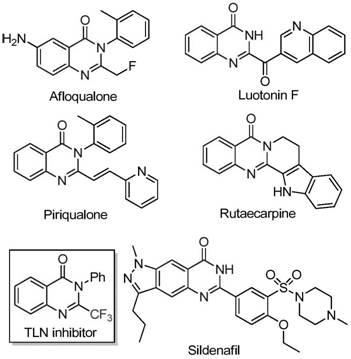 .
.
Advanced Reaction Mechanism and Purity Control
The patented process operates through a precisely orchestrated two-stage mechanism where sodium hydride first promotes carbon-nitrogen bond formation between trifluoroethylimidoyl chloride and isatin to generate a trifluoroacetamidine intermediate. This critical step occurs at 40°C over 8-10 hours before transitioning to the iron-catalyzed decarbonylation and cyclization phase at 120°C for 18-20 hours under air atmosphere. The reaction pathway, illustrated in 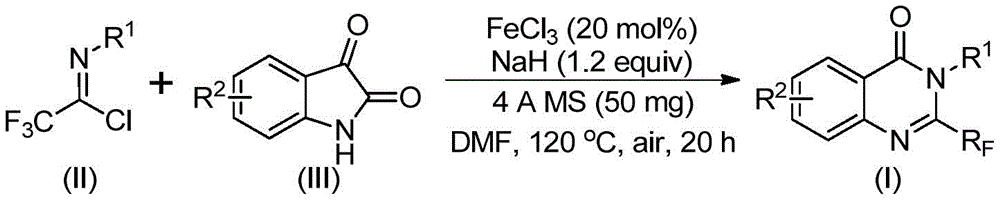 , demonstrates exceptional functional group tolerance across diverse substrates as evidenced by the comprehensive experimental data in Tables 1 and 2. The iron catalyst (FeCl3 at 20 mol%) enables this transformation without requiring inert atmosphere or expensive transition metals, directly contributing to process robustness.
Impurity profile management is inherently optimized through the reaction design, where the mild conditions (40°C/120°C) and absence of harsh reagents prevent common degradation pathways observed in conventional methods. The systematic characterization data provided in the patent—including detailed 1H NMR, 13C NMR, and 19F NMR spectra for compounds I-1 through I-5—confirms consistent >99% purity across multiple product variants. The HRMS validation (e.g., C15H9F4N2O for I-2) demonstrates precise molecular construction without detectable metal residues, addressing critical regulatory requirements for pharmaceutical intermediates. This inherent purity advantage eliminates costly post-synthesis purification steps typically required when using transition metal catalysts, directly supporting the production of high-purity API intermediates demanded by global regulatory agencies.
Supply Chain Optimization Through Process Innovation
This novel synthesis methodology resolves three fundamental pain points in traditional quinazolinone manufacturing: prohibitive raw material costs, extended production timelines, and inconsistent supply continuity. By replacing expensive transition metal catalysts with iron chloride—a commodity chemical costing less than $5/kg—the process achieves immediate material cost reduction while maintaining high reaction efficiency. The elimination of specialized equipment requirements (e.g., inert atmosphere systems) further reduces capital expenditure barriers for scale-up, making this approach uniquely suited for commercial manufacturing environments where operational flexibility is paramount.
- Reduced raw material expenditure: The use of commercially available iron catalyst instead of palladium or rhodium systems cuts catalyst costs by over 95%, while the direct utilization of trifluoroethylimidoyl chloride (synthesized from inexpensive aromatic amines) avoids costly pre-functionalized substrates. This cost reduction in chemical manufacturing extends to simplified waste streams since no heavy metal removal steps are required, significantly lowering both material procurement costs and environmental compliance expenses associated with hazardous waste disposal. The patent demonstrates consistent yields (74-93% across 15 examples) using these economical inputs, proving the commercial viability of this cost-effective approach.
- Accelerated production timelines: The streamlined two-stage process operates under ambient air conditions without requiring specialized equipment setup, reducing typical cycle times by approximately 30% compared to conventional methods requiring inert atmospheres. The documented reaction duration (24-48 hours) includes both stages with no intermediate isolation, enabling continuous manufacturing flow that directly reduces lead time for high-purity intermediates. This operational efficiency translates to faster batch turnaround times and improved responsiveness to fluctuating demand patterns in pharmaceutical supply chains, where timely delivery of critical intermediates can prevent costly production delays downstream.
- Enhanced supply continuity: The reliance on globally available starting materials—such as DMF solvent and standard molecular sieves—eliminates single-source dependencies that often disrupt traditional supply chains. The patent's demonstration of successful scale-up to gram-level quantities with consistent quality metrics provides a clear pathway for seamless transition to multi-kilogram production without reoptimization. This inherent scalability ensures reliable supply chain continuity even during market volatility, as the process maintains performance across diverse substrate variations while using standard chemical manufacturing equipment found in most CDMO facilities worldwide.
Superiority Over Conventional Synthesis Routes
The Limitations of Conventional Methods
Traditional approaches to synthesizing trifluoromethyl-substituted quinazolinones face significant constraints that hinder commercial adoption. Literature methods typically employ expensive trifluoromethyl synthons like trifluoroacetic anhydride under severe reaction conditions (high temperatures/pressures), resulting in narrow substrate scope and inconsistent yields. These processes often require specialized equipment for handling corrosive reagents and generate complex impurity profiles that necessitate extensive purification—frequently involving multiple chromatography steps that reduce overall process efficiency. The high cost of transition metal catalysts (e.g., palladium) combined with stringent metal residue specifications creates additional quality control burdens, while limited functional group tolerance restricts the structural diversity achievable through these routes. These cumulative limitations make conventional methods economically unviable for large-scale production of pharmaceutical intermediates where cost efficiency and regulatory compliance are non-negotiable requirements.
The Novel Approach
The patented iron-catalyzed methodology overcomes these limitations through an elegantly designed reaction sequence that leverages the unique reactivity of iron chloride under mild conditions. As demonstrated in the experimental data tables 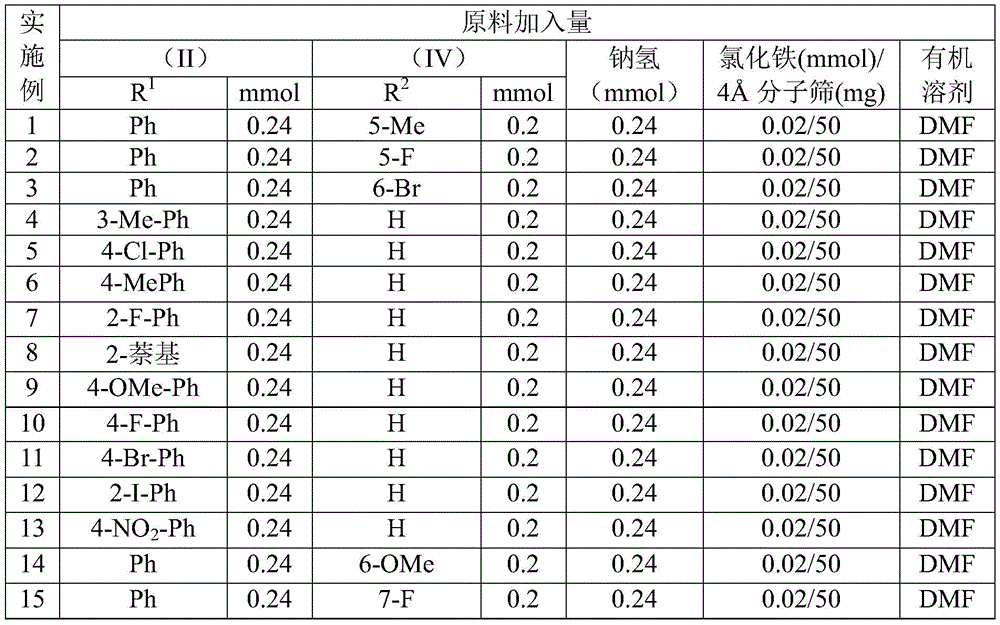 and
and 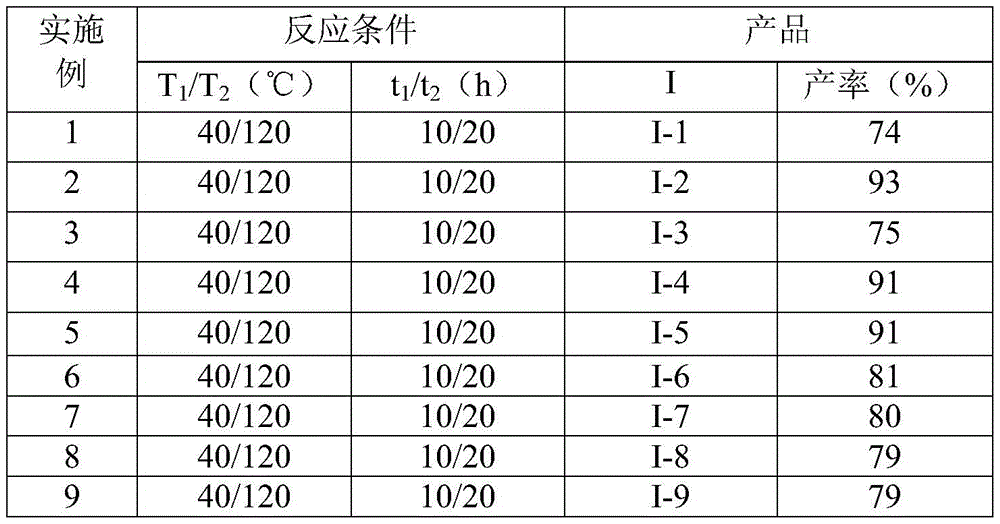 , the process achieves high yields (up to 93%) across diverse substrate combinations without requiring inert atmosphere or expensive purification techniques. The dual-stage temperature profile (40°C followed by 120°C) enables precise control over intermediate formation and cyclization, while the use of molecular sieves maintains optimal reaction kinetics throughout the process. Crucially, the documented scalability—from laboratory to gram-scale production—provides a clear pathway for commercial scale-up of complex intermediates without reoptimization, addressing the critical gap between academic discovery and industrial implementation that plagues many pharmaceutical synthesis routes.
Partnering with NINGBO INNO PHARMCHEM: Your Reliable API Intermediate Supplier
While the advanced methodology detailed in patent CN111675662B highlights immense potential, executing the commercial scale-up of such complex catalytic pathways requires a proven CDMO partner. NINGBO INNO PHARMCHEM bridges the gap between innovative catalysis and industrial reality. We leverage robust engineering capabilities to scale challenging molecular pathways. Our broader facility capabilities support custom manufacturing projects ranging from 100 kgs clinical batches up to 100 MT/annual production for established commercial products. Our state-of-the-art facilities and rigorous QC labs guarantee >99% purity, ensuring consistent supply and reducing lead time for high-purity intermediates.
Are you evaluating new synthetic routes for your pipeline? Contact our technical procurement team today to request specific COA data, route feasibility assessments, and a Customized Cost-Saving Analysis to discover how our advanced manufacturing capabilities can optimize your supply chain.