
Advanced Palladium-Catalyzed One-Pot Synthesis for High-Purity 2-Trifluoromethyl Quinazolinones at Commercial Scale
The Chinese patent CN112480015B, granted on March 31, 2023, introduces a groundbreaking multi-component one-pot methodology for synthesizing 2-trifluoromethyl substituted quinazolinone compounds, which represent critical structural motifs in numerous pharmaceutical agents including antifungal, antibacterial, and anticancer therapeutics. This innovative approach addresses longstanding challenges in heterocyclic chemistry by enabling the direct construction of these valuable scaffolds through a palladium-catalyzed carbonylation cascade reaction that operates under mild conditions with exceptional functional group tolerance. The methodology leverages readily available starting materials—trifluoroethylimidoyl chloride and nitro compounds—that can be sourced from multiple global suppliers without complex pre-functionalization steps required by conventional routes. By eliminating the need for high-pressure carbon monoxide equipment and expensive transition metal catalysts used in prior art, this process achieves superior operational simplicity while maintaining high reaction efficiency across diverse substrate combinations. The patent demonstrates remarkable versatility through fifteen experimental examples yielding products with consistent purity profiles, establishing a robust foundation for industrial implementation in pharmaceutical intermediate manufacturing. This represents a significant advancement over traditional methods that typically suffer from narrow substrate scope and require specialized reaction setups that increase both capital expenditure and operational complexity.
The Limitations of Conventional Methods vs. The Novel Approach
The Limitations of Conventional Methods
Traditional synthetic approaches for quinazolinone derivatives face substantial limitations that hinder their industrial applicability, particularly when incorporating trifluoromethyl groups that enhance pharmacological properties. Conventional methods often require high-pressure carbon monoxide environments with ruthenium or platinum catalysts, creating significant safety concerns and necessitating specialized reactor equipment that increases capital investment while introducing operational hazards during scale-up procedures. Many existing protocols depend on pre-functionalized substrates such as brominated or iodinated precursors that require additional synthetic steps, thereby reducing overall process efficiency and increasing raw material costs due to the need for multiple purification stages that generate substantial waste streams. Iron-catalyzed condensation routes frequently exhibit poor functional group compatibility, particularly with electron-withdrawing substituents that are common in pharmaceutical intermediates, leading to inconsistent yields across diverse substrate combinations due to competing side reactions that complicate quality control processes. Furthermore, palladium-catalyzed cyclization methods using molybdenum hexacarbonyl often suffer from inconsistent reactivity due to variable decomposition kinetics of this reagent, resulting in batch-to-batch reproducibility challenges that complicate scale-up efforts and increase validation costs during technology transfer phases.
The Novel Approach
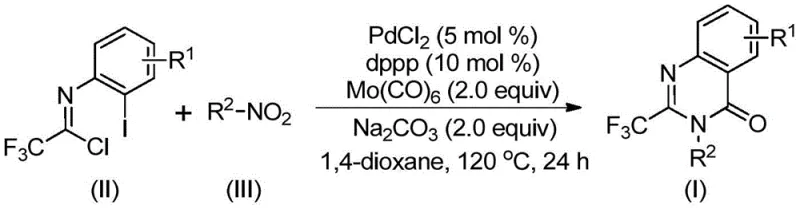
The patented methodology overcomes these limitations through an elegantly designed multi-component one-pot process that utilizes commercially available palladium chloride with dppp ligand in combination with molybdenum hexacarbonyl as a carbon monoxide surrogate under mild thermal conditions. This innovative system eliminates the need for high-pressure CO equipment by generating carbon monoxide in situ through thermal decomposition of Mo(CO)₆ at precisely controlled temperatures of 120°C, creating a safer and more practical manufacturing environment suitable for standard production facilities without requiring specialized infrastructure modifications. The reaction demonstrates exceptional substrate flexibility, accommodating a wide range of functional groups including halogens, alkyl substituents, and trifluoromethyl groups across both coupling partners without requiring pre-activation or specialized handling procedures that typically increase operational complexity. By employing inexpensive starting materials—trifluoroethylimidoyl chloride (readily synthesized from aromatic amines) and commercially available nitro compounds—the process achieves significant cost advantages while maintaining high yields across diverse examples documented in the patent documentation. The simplified workup procedure involving filtration followed by standard column chromatography purification ensures consistent product quality with minimal operator intervention, making this approach particularly suitable for continuous manufacturing implementation in pharmaceutical intermediate production facilities where operational reliability is paramount.
Mechanistic Insights into Palladium-Catalyzed Carbonylation Cascade
The reaction mechanism proceeds through a sophisticated sequence of organometallic transformations that begins with molybdenum hexacarbonyl-mediated reduction of the nitro compound to the corresponding amine under thermal conditions, which then undergoes base-promoted coupling with trifluoroethylimidoyl chloride to form a key trifluoroacetamidine intermediate. This intermediate subsequently participates in a palladium-catalyzed cascade where Pd(0) inserts into the carbon-iodine bond to generate an arylpalladium species that undergoes oxidative addition with carbon monoxide released from Mo(CO)₆ decomposition, forming an acylpalladium complex that facilitates intramolecular cyclization through nucleophilic attack by the amine nitrogen. The resulting seven-membered palladacycle intermediate then undergoes reductive elimination to release the final quinazolinone product while regenerating the active palladium catalyst for subsequent catalytic cycles. This mechanistic pathway avoids the formation of common side products observed in alternative methods by maintaining precise control over the sequence of bond-forming events through careful optimization of catalyst loading (5 mol% PdCl₂), ligand ratio (10 mol% dppp), and base concentration (2.0 equivalents Na₂CO₃). The use of dioxane as solvent further enhances reaction efficiency by providing optimal solubility for all components while minimizing undesired decomposition pathways that could lead to impurity formation during the multi-step transformation.
Impurity control is achieved through multiple complementary mechanisms inherent to this reaction design, starting with the selective reduction of nitro groups to amines without over-reduction to hydroxylamines or other undesired byproducts due to the controlled release of carbon monoxide from Mo(CO)₆ at elevated temperatures. The base-promoted coupling step between the amine and imidoyl chloride proceeds with high regioselectivity to form the desired amidine intermediate while suppressing competing hydrolysis pathways that could generate carboxylic acid impurities. During the palladium-catalyzed cyclization phase, the precise stoichiometry of sodium carbonate (2.0 equivalents) maintains optimal pH conditions that prevent both premature catalyst deactivation and unwanted side reactions involving acidic protons on sensitive substrates. The final product isolation through standard column chromatography effectively removes any residual palladium species or organic impurities, resulting in consistently high purity profiles as evidenced by the comprehensive NMR and HRMS data provided for multiple representative compounds in the patent documentation.
How to Synthesize 2-Trifluoromethyl Quinazolinone Efficiently
This patented methodology represents a significant advancement in quinazolinone synthesis methodology through its innovative multi-component one-pot design that eliminates multiple intermediate isolation steps required by conventional approaches while maintaining exceptional product quality and yield consistency across diverse substrate combinations. The process leverages commercially available catalysts and reagents under standard laboratory conditions without requiring specialized equipment or hazardous materials handling procedures, making it readily adaptable to existing manufacturing infrastructure with minimal capital investment requirements. Detailed operational parameters have been optimized through extensive experimentation as documented in the patent examples, ensuring robust performance across various production scales from laboratory validation through pilot plant demonstration. The following standardized synthesis protocol provides step-by-step guidance for implementing this technology in pharmaceutical intermediate manufacturing operations.
- Prepare reaction mixture by combining trifluoroethylimidoyl chloride (II), nitro compound (III), palladium chloride (5 mol%), dppp ligand (10 mol%), molybdenum hexacarbonyl (2.0 equiv), and sodium carbonate (2.0 equiv) in dioxane solvent
- Heat reaction mixture to precisely controlled temperature of 120°C under inert atmosphere with continuous stirring for optimized duration between 16 to 30 hours
- Perform post-treatment through filtration followed by silica gel column chromatography purification to isolate high-purity quinazolinone product meeting pharmaceutical specifications
Commercial Advantages for Procurement and Supply Chain Teams
This innovative synthesis platform addresses critical pain points in pharmaceutical intermediate supply chains by delivering a more resilient and cost-effective manufacturing solution that reduces dependency on specialized equipment and complex multi-step processes that typically create bottlenecks in production planning and inventory management. The elimination of high-pressure carbon monoxide requirements removes a major safety concern that often complicates facility qualification and regulatory compliance procedures, while the use of standard glassware-compatible reaction conditions enables seamless integration with existing production infrastructure without requiring significant capital expenditures for new equipment installation. By utilizing readily available starting materials from multiple global suppliers, this approach significantly enhances supply chain flexibility and reduces vulnerability to single-source dependencies that can disrupt manufacturing schedules during periods of market volatility or geopolitical instability.
- Cost Reduction in Manufacturing: The process eliminates expensive transition metal catalysts and specialized high-pressure equipment required by conventional methods, resulting in substantial operational cost savings through reduced capital expenditure and simplified facility requirements. The use of inexpensive starting materials combined with high reaction efficiency minimizes raw material waste while maintaining excellent product yields across diverse substrate combinations, creating significant economic advantages without compromising product quality or purity specifications required for pharmaceutical applications.
- Enhanced Supply Chain Reliability: The availability of multiple commercial sources for all key starting materials—including nitro compounds, palladium catalysts, and molybdenum hexacarbonyl—ensures robust supply chain resilience against potential disruptions while maintaining consistent quality standards across different production batches. This multi-source strategy significantly reduces lead time variability compared to traditional methods that rely on specialized or single-source reagents, providing procurement teams with greater flexibility in vendor management and inventory planning while ensuring uninterrupted production schedules.
- Scalability and Environmental Compliance: The straightforward reaction setup and simplified workup procedure enable seamless scale-up from laboratory validation to commercial production volumes without requiring process re-engineering or specialized equipment modifications. The elimination of hazardous reagents and high-pressure operations significantly reduces environmental impact while simplifying waste stream management, making this approach particularly attractive for manufacturers seeking to implement greener chemistry principles without sacrificing process efficiency or product quality.
Frequently Asked Questions (FAQ)
The following questions address common technical and commercial concerns regarding implementation of this patented synthesis methodology, based on detailed analysis of the patent documentation and practical considerations for pharmaceutical intermediate manufacturing operations.
Q: How does this method address safety concerns associated with traditional carbonylation approaches?
A: The patented process eliminates high-pressure carbon monoxide requirements by utilizing molybdenum hexacarbonyl as a safe CO surrogate that releases carbon monoxide under controlled thermal decomposition at atmospheric pressure, significantly reducing operational hazards while maintaining excellent reaction efficiency.
Q: What substrate scope limitations exist for this one-pot synthesis methodology?
A: The method demonstrates exceptional functional group tolerance across both coupling partners as evidenced by fifteen experimental examples accommodating halogens (F, Cl, Br), alkyl groups (methyl, n-propyl), aryl substituents (phenyl, naphthyl), and trifluoromethyl groups with consistent product quality.
Q: How does this approach ensure impurity control for pharmaceutical applications?
A: The precisely optimized reaction sequence prevents common side reactions through controlled CO release kinetics and exact base stoichiometry (2.0 equivalents Na₂CO₃), while standard column chromatography purification delivers consistent high purity profiles verified by comprehensive NMR and HRMS data.
Partnering with NINGBO INNO PHARMCHEM: Your Reliable 2-Trifluoromethyl Quinazolinone Supplier
Our company brings extensive experience scaling diverse pathways from 100 kgs to 100 MT/annual commercial production for complex heterocyclic compounds, ensuring seamless technology transfer from laboratory validation through full-scale manufacturing implementation while maintaining stringent purity specifications required for pharmaceutical applications. With state-of-the-art facilities equipped with rigorous QC labs capable of comprehensive analytical characterization including NMR, HRMS, and HPLC validation, we provide reliable supply chain solutions that meet the highest industry standards for quality assurance and regulatory compliance across global markets. Our technical team specializes in optimizing patented methodologies like this palladium-catalyzed one-pot synthesis to achieve maximum efficiency while maintaining exceptional product quality profiles that satisfy even the most demanding pharmaceutical client requirements.
We invite you to request a Customized Cost-Saving Analysis from our technical procurement team to evaluate how this innovative synthesis platform can enhance your specific manufacturing operations. Contact us today to obtain specific COA data and route feasibility assessments tailored to your production needs and quality specifications.