
Advanced Palladium-Catalyzed Carbonylation for Scalable 1,2,4-Triazole-3-one Production
Advanced Palladium-Catalyzed Carbonylation for Scalable 1,2,4-Triazole-3-one Production
The pharmaceutical and fine chemical industries are constantly seeking more efficient pathways to access bioactive heterocyclic scaffolds. A significant breakthrough in this domain is detailed in Chinese Patent CN112538054B, which discloses a highly efficient preparation method for 1,2,4-triazole-3-one compounds. This specific class of five-membered nitrogen-containing heterocycles is ubiquitous in medicinal chemistry, serving as the core structure for a wide array of biologically active molecules exhibiting antifungal, anti-inflammatory, antitumor, antiviral, and anticonvulsant properties. As illustrated in the structural diversity of known bioactive agents, the ability to rapidly construct this core with various substituents is critical for drug discovery pipelines. The patent introduces a transition metal palladium-catalyzed carbonylation tandem cyclization reaction that utilizes inexpensive chlorohydrazones and sodium azide as starting materials, marking a substantial departure from legacy synthetic routes.
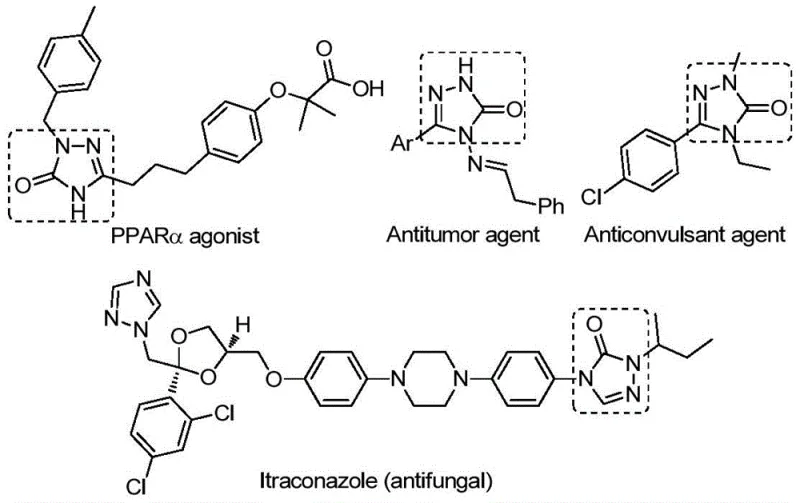
This technological advancement addresses the growing demand for reliable pharmaceutical intermediate suppliers who can deliver complex heterocycles with high purity and consistency. By leveraging a robust catalytic system involving Pd2(dba)3 and Xantphos, the method achieves high reaction efficiency and excellent substrate compatibility. For R&D directors and process chemists, this represents a viable strategy for cost reduction in API manufacturing, as it eliminates the need for hazardous gaseous carbon monoxide cylinders by employing a solid CO surrogate, TFBen. The operational simplicity and the ability to tolerate diverse functional groups make this protocol particularly attractive for the commercial scale-up of complex pharmaceutical intermediates.
The Limitations of Conventional Methods vs. The Novel Approach
The Limitations of Conventional Methods
Historically, the synthesis of 1,2,4-triazole-3-one derivatives has been plagued by significant synthetic challenges that hinder efficient production. Traditional methodologies often rely on the cyclization of benzoyl hydrazide with urea under the action of potassium hydroxide, or the tandem cyclization of hydrazides with isocyanates. These classical approaches frequently suffer from harsh reaction conditions, requiring extreme temperatures or strong bases that can degrade sensitive functional groups. Furthermore, many existing protocols necessitate the pre-activation of reaction substrates, adding extra steps to the synthetic sequence and increasing the overall material cost and waste generation. Another critical bottleneck is the narrow substrate scope; many conventional methods fail when applied to sterically hindered or electronically diverse substrates, leading to low yields and difficult purification processes. These limitations create substantial barriers for procurement managers seeking cost-effective sources and supply chain heads concerned with batch-to-batch reproducibility.
The Novel Approach
In stark contrast to these legacy techniques, the method described in CN112538054B offers a streamlined, one-pot solution that dramatically simplifies the synthetic landscape. The novel approach utilizes readily available chlorohydrazones and sodium azide as the primary building blocks, reacting them in the presence of a palladium catalyst and a solid carbon monoxide source. This strategy bypasses the need for pre-activated isocyanates or harsh basic conditions, operating instead at a moderate temperature of 100 °C in 1,4-dioxane. The reaction proceeds through an elegant tandem sequence involving oxidative addition, CO insertion, and intramolecular cyclization, delivering the target 1,2,4-triazole-3-one core in high yields. This methodology not only widens the applicability of the synthesis to include a broad range of substituted aryl and alkyl groups but also enhances the safety profile of the operation by avoiding the direct handling of toxic CO gas. For industrial applications, this translates to a more robust and scalable process capable of meeting stringent quality specifications.
Mechanistic Insights into Pd-Catalyzed Carbonylation Tandem Cyclization
The success of this transformation relies on a sophisticated catalytic cycle orchestrated by the palladium complex. The reaction initiates with the oxidative addition of the Pd(0) species into the carbon-chlorine bond of the chlorohydrazone substrate, generating a reactive divalent palladium intermediate. Simultaneously, the solid CO surrogate, TFBen (1,3,5-tricarboxylic acid phenol ester), undergoes thermal decomposition to release carbon monoxide in situ. This generated CO then inserts into the carbon-palladium bond, forming a key acyl palladium intermediate. This step is crucial as it introduces the carbonyl functionality required for the triazolone ring without the logistical hazards of high-pressure CO gas. The subsequent interaction with sodium azide leads to the formation of an acyl azide species, which spontaneously undergoes a Curtius rearrangement to generate an isocyanate intermediate. Finally, an intramolecular nucleophilic addition of the hydrazine nitrogen to the isocyanate carbon closes the ring, yielding the final 1,2,4-triazole-3-one product and regenerating the active catalyst.
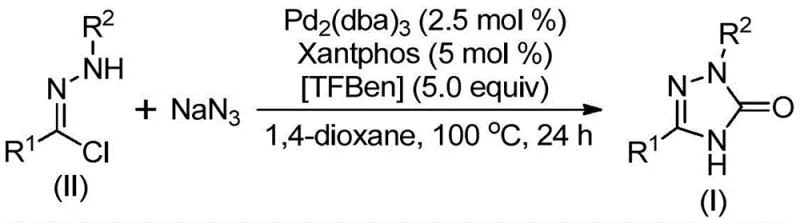
From an impurity control perspective, this mechanism offers distinct advantages over traditional condensation reactions. The specificity of the palladium-catalyzed insertion and the driving force of the Curtius rearrangement minimize the formation of side products often associated with non-selective thermal cyclizations. The use of Xantphos as a bidentate ligand stabilizes the palladium center, preventing premature catalyst decomposition and ensuring consistent turnover numbers throughout the reaction duration of 16 to 30 hours. Furthermore, the choice of 1,4-dioxane as the solvent is critical; protic solvents or polar aprotic solvents like DMF were found to be less effective, highlighting the importance of solvent-solute interactions in maintaining the integrity of the catalytic cycle. This deep understanding of the mechanistic pathway allows process chemists to fine-tune reaction parameters, such as the molar ratio of chlorohydrazone to sodium azide (optimized at 1:2.5), to maximize conversion and minimize residual starting materials, thereby ensuring high-purity pharmaceutical intermediates.
How to Synthesize 1,2,4-Triazole-3-one Efficiently
Implementing this synthesis in a laboratory or pilot plant setting requires strict adherence to the optimized conditions outlined in the patent to achieve the reported high yields. The procedure involves charging a reaction vessel with the palladium catalyst system, the solid CO source, and the specific chlorohydrazone derivative dissolved in dry 1,4-dioxane. The reaction is then heated to reflux conditions, typically around 100 °C, and maintained for a period sufficient to drive the tandem cyclization to completion. Detailed standard operating procedures regarding reagent grades, atmosphere control, and workup protocols are essential for reproducibility. For a comprehensive guide on the exact stoichiometry and purification steps validated across multiple substrate examples, please refer to the standardized synthesis steps provided below.
- Combine Pd2(dba)3 catalyst, Xantphos ligand, TFBen carbon monoxide source, chlorohydrazone substrate, and sodium azide in 1,4-dioxane solvent.
- Heat the reaction mixture to 100 °C and maintain stirring for 16 to 30 hours to ensure complete conversion.
- Upon completion, filter the mixture, mix with silica gel, and purify via column chromatography to isolate the target 1,2,4-triazole-3-one compound.
Commercial Advantages for Procurement and Supply Chain Teams
For procurement managers and supply chain directors, the adoption of this novel synthetic route offers compelling economic and logistical benefits that extend beyond simple yield improvements. The shift from complex, multi-step traditional syntheses to this direct carbonylation protocol significantly streamlines the manufacturing process. By utilizing cheap and commercially available starting materials like chlorohydrazones and sodium azide, the raw material cost base is substantially lowered compared to methods requiring specialized isocyanates or activated hydrazides. Moreover, the operational simplicity reduces the burden on manufacturing facilities, allowing for faster batch turnover and reduced labor costs. This efficiency is critical for maintaining competitive pricing in the global market for pharmaceutical intermediates while ensuring a steady supply of high-quality materials for downstream drug production.
- Cost Reduction in Manufacturing: The elimination of hazardous gaseous carbon monoxide cylinders in favor of the solid surrogate TFBen removes the need for specialized high-pressure equipment and extensive safety infrastructure, leading to significant capital expenditure savings. Additionally, the high atom economy of the tandem reaction minimizes waste generation, reducing the costs associated with waste disposal and environmental compliance. The robust nature of the catalyst system allows for high conversion rates, meaning less raw material is wasted in unreacted feedstock, directly improving the overall cost efficiency of the production line.
- Enhanced Supply Chain Reliability: The reliance on commodity chemicals such as sodium azide and common organic solvents like 1,4-dioxane ensures that the supply chain is not vulnerable to the bottlenecks often associated with exotic or custom-synthesized reagents. The broad substrate tolerance of the reaction means that a single manufacturing platform can be adapted to produce a wide variety of 1,2,4-triazole-3-one derivatives simply by changing the chlorohydrazone input. This flexibility allows suppliers to respond rapidly to changing market demands and custom synthesis requests without the need for extensive process re-validation, thereby reducing lead time for high-purity pharmaceutical intermediates.
- Scalability and Environmental Compliance: The reaction conditions are mild and utilize standard heating and stirring equipment, making the transition from gram-scale laboratory synthesis to multi-kilogram or ton-scale production straightforward and low-risk. The use of a solid CO source inherently improves the safety profile of the process, aligning with increasingly stringent global regulations regarding worker safety and hazardous material handling. Furthermore, the simplified workup procedure, involving filtration and standard chromatography, facilitates easier purification and reduces the consumption of silica and solvents during the isolation phase, contributing to a greener and more sustainable manufacturing footprint.
Frequently Asked Questions (FAQ)
The following questions address common technical and commercial inquiries regarding the implementation of this palladium-catalyzed technology. These insights are derived directly from the experimental data and beneficial effects reported in the patent documentation, providing clarity on the practical aspects of the synthesis. Understanding these details is vital for technical teams evaluating the feasibility of integrating this route into their existing manufacturing portfolios.
Q: What are the key advantages of this palladium-catalyzed method over traditional synthesis routes?
A: Unlike traditional methods that require harsh conditions, pre-activation of substrates, or suffer from low yields, this novel approach utilizes cheap chlorohydrazones and sodium azide under mild conditions (100 °C) with excellent functional group tolerance and high efficiency.
Q: What is the role of TFBen in this reaction mechanism?
A: TFBen (1,3,5-tricarboxylic acid phenol ester) acts as a solid carbon monoxide substitute. Under heating conditions, it releases CO which inserts into the carbon-palladium bond, facilitating the formation of the acyl palladium intermediate essential for the subsequent cyclization.
Q: Is this process suitable for large-scale industrial production?
A: Yes, the patent explicitly states the method is simple to operate, uses commercially available raw materials, and has been demonstrated to be scalable. The use of standard solvents like 1,4-dioxane and robust catalytic systems supports potential commercial scale-up.
Partnering with NINGBO INNO PHARMCHEM: Your Reliable 1,2,4-Triazole-3-one Supplier
At NINGBO INNO PHARMCHEM, we recognize the critical role that efficient synthetic methodologies play in accelerating drug development and commercialization. Our team of expert process chemists has extensively evaluated the technology disclosed in CN112538054B and possesses the capability to implement this advanced palladium-catalyzed carbonylation route at scale. We boast extensive experience scaling diverse pathways from 100 kgs to 100 MT/annual commercial production, ensuring that your supply needs are met with unwavering consistency. Our state-of-the-art facilities are equipped with rigorous QC labs and adhere to stringent purity specifications, guaranteeing that every batch of 1,2,4-triazole-3-one intermediate meets the highest industry standards for pharmaceutical applications.
We invite you to collaborate with us to leverage this cutting-edge technology for your next project. By partnering with our technical procurement team, you can obtain a Customized Cost-Saving Analysis tailored to your specific volume requirements. We encourage you to reach out today to request specific COA data and route feasibility assessments, allowing us to demonstrate how our expertise in complex heterocycle synthesis can drive value and efficiency in your supply chain.