
Scalable Iron-Catalyzed Synthesis of 2-Trifluoromethyl Quinazolinones for Advanced Drug Discovery
Scalable Iron-Catalyzed Synthesis of 2-Trifluoromethyl Quinazolinones for Advanced Drug Discovery
The landscape of modern pharmaceutical research is increasingly defined by the demand for complex heterocyclic scaffolds that offer enhanced metabolic stability and bioavailability. Among these, quinazolinone derivatives stand out as privileged structures found in numerous bioactive natural products and synthetic drug candidates, exhibiting a broad spectrum of therapeutic activities including anticancer, anticonvulsant, and anti-inflammatory properties. The strategic introduction of a trifluoromethyl group into these heterocyclic cores further amplifies their pharmacological potential by improving lipophilicity and electronegativity, crucial factors for membrane permeability and receptor binding affinity. A groundbreaking advancement in this domain is detailed in patent CN111675662B, which discloses a highly efficient preparation method for 2-trifluoromethyl substituted quinazolinone compounds. This novel approach leverages a cost-effective iron-catalyzed cyclization strategy, marking a significant departure from traditional synthetic routes that often rely on prohibitively expensive reagents and harsh conditions.
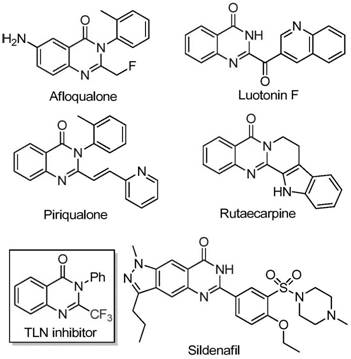
The significance of this technological breakthrough extends beyond mere academic interest; it addresses critical pain points in the supply chain for reliable pharmaceutical intermediate suppliers. By utilizing readily available starting materials such as isatin and trifluoroethylimidoyl chloride, the process democratizes access to these high-value building blocks. For R&D directors and procurement managers alike, the ability to source high-purity 2-trifluoromethyl quinazolinones through a streamlined, scalable process represents a tangible opportunity for cost reduction in API manufacturing. The method's robustness allows for the synthesis of diverse derivatives, enabling medicinal chemists to rapidly explore structure-activity relationships without being bottlenecked by material availability or exorbitant synthesis costs.
The Limitations of Conventional Methods vs. The Novel Approach
The Limitations of Conventional Methods
Historically, the synthesis of quinazolinones bearing trifluoromethyl functionalities has been fraught with significant technical and economic challenges. Conventional literature reports predominantly describe cyclization reactions involving synthons like trifluoroacetic anhydride or ethyl trifluoroacetate reacting with substrates such as anthranilamide or isatoic anhydride. While chemically feasible, these traditional pathways are severely limited by their operational complexity and economic inefficiency. The reaction conditions are often severe, requiring stringent control over temperature and pressure, which complicates scale-up efforts and increases safety risks in a production environment. Furthermore, the substrates employed in these legacy methods are frequently expensive and difficult to procure in bulk quantities, leading to inflated production costs that are ultimately passed down the supply chain. The narrow substrate scope of these older methods also restricts the chemical diversity accessible to researchers, hindering the optimization of lead compounds in drug discovery programs.
The Novel Approach
In stark contrast, the methodology outlined in the patent introduces a paradigm shift by employing a tandem reaction sequence catalyzed by abundant and inexpensive iron salts. This novel approach utilizes trifluoroethylimidoyl chloride and isatin as the primary building blocks, both of which are commercially accessible and economically viable for large-scale operations. The reaction proceeds through a sophisticated yet operationally simple mechanism where an initial alkali-promoted carbon-nitrogen bond formation is followed by an iron-catalyzed decarbonylation and cyclization. This dual-step transformation occurs in a single pot, drastically simplifying the workflow and minimizing waste generation. The use of ferric chloride as the catalyst is particularly noteworthy; as a base metal, it offers a sustainable alternative to precious metal catalysts, aligning with green chemistry principles while simultaneously driving down the cost of goods sold. This method demonstrates excellent functional group tolerance, allowing for the synthesis of a wide array of substituted derivatives without the need for extensive protecting group strategies.
Mechanistic Insights into FeCl3-Catalyzed Cyclization
The core of this synthetic innovation lies in the elegant mechanistic pathway facilitated by the iron catalyst. The reaction initiates with the interaction between the trifluoroethylimidoyl chloride and isatin in the presence of a base, typically sodium hydride. This initial step promotes the formation of a carbon-nitrogen bond, generating a transient trifluoroacetamidine intermediate. Subsequently, the ferric chloride catalyst activates this intermediate, triggering a decarbonylation event that is critical for the structural rearrangement. This decarbonylation step is the key differentiator from traditional methods, as it allows for the direct incorporation of the trifluoromethyl group at the 2-position of the quinazolinone ring without requiring pre-functionalized trifluoromethyl synthons that are often unstable or reactive. The cyclization then proceeds to close the heterocyclic ring, yielding the final 2-trifluoromethyl substituted quinazolinone product with high regioselectivity.
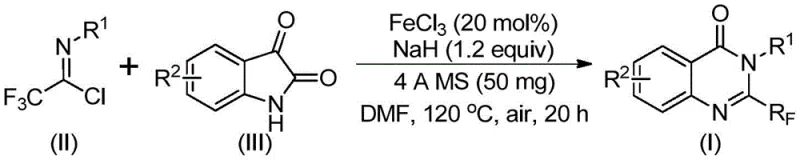
From an impurity control perspective, this mechanism offers distinct advantages. The use of 4A molecular sieves in the reaction mixture plays a crucial role in scavenging moisture, which could otherwise hydrolyze the sensitive imidoyl chloride starting material or interfere with the sodium hydride base. By maintaining anhydrous conditions, the reaction minimizes the formation of hydrolysis byproducts, thereby simplifying the downstream purification process. The high conversion rates observed, often exceeding 90% for various substrates as demonstrated in the experimental data, indicate that the reaction equilibrium strongly favors the product formation. This high efficiency reduces the burden on purification teams, as the crude reaction mixture contains fewer side products, allowing for simpler column chromatography or crystallization techniques to achieve the stringent purity specifications required for pharmaceutical applications.
How to Synthesize 2-Trifluoromethyl Quinazolinone Efficiently
The practical execution of this synthesis is designed for reproducibility and ease of handling, making it an ideal candidate for technology transfer from the laboratory to the pilot plant. The standard protocol involves charging a reaction vessel with ferric chloride, sodium hydride, and activated 4A molecular sieves, followed by the addition of the organic solvent, preferably DMF, which has been shown to provide superior solubility and reaction kinetics. The trifluoroethylimidoyl chloride and isatin are then introduced, and the mixture is subjected to a two-stage temperature profile: an initial period at 40°C to facilitate the coupling, followed by heating to 120°C to drive the cyclization and decarbonylation to completion. Detailed standardized synthetic steps see the guide below.
- Mix ferric chloride, sodium hydride, 4A molecular sieves, trifluoroethylimidoyl chloride, and isatin in an organic solvent like DMF.
- React the mixture at 40°C for 8-10 hours, then heat to 120°C and continue reacting for 18-20 hours under air.
- Filter the reaction mixture, mix with silica gel, and purify via column chromatography to obtain the final product.
Commercial Advantages for Procurement and Supply Chain Teams
For procurement managers and supply chain heads, the adoption of this iron-catalyzed methodology translates into immediate and long-term strategic benefits. The primary advantage lies in the drastic simplification of the raw material portfolio. By shifting away from exotic and costly trifluoroacetylating agents to commodity chemicals like isatin and aromatic amines (precursors to the imidoyl chloride), companies can significantly mitigate supply risk. The reliance on iron, one of the most abundant metals on earth, eliminates the volatility associated with precious metal pricing and availability, ensuring a stable cost structure for the final intermediate. Furthermore, the operational simplicity of the one-pot procedure reduces the requirement for specialized reactor configurations, allowing existing manufacturing assets to be utilized more effectively without the need for capital-intensive retrofitting.
- Cost Reduction in Manufacturing: The economic impact of replacing precious metal catalysts or expensive anhydrides with ferric chloride cannot be overstated. This substitution alone drives a substantial reduction in the direct material costs associated with the synthesis. Additionally, the high yields reported across a broad substrate scope mean that less raw material is wasted, improving the overall atom economy of the process. The elimination of complex multi-step sequences in favor of a direct cyclization further reduces labor costs, energy consumption, and solvent usage, collectively contributing to a leaner and more competitive manufacturing cost base.
- Enhanced Supply Chain Reliability: The robustness of this synthetic route enhances supply chain resilience. Since the starting materials are widely available from multiple global suppliers, the risk of single-source dependency is minimized. The tolerance of the reaction to various functional groups implies that a single manufacturing line can potentially produce a library of different quinazolinone derivatives simply by swapping the starting amine or isatin derivative. This flexibility allows for agile responses to changing market demands or clinical trial requirements, reducing lead time for high-purity pharmaceutical intermediates and ensuring continuity of supply even during periods of market fluctuation.
- Scalability and Environmental Compliance: From an environmental and regulatory standpoint, this process aligns well with modern sustainability goals. The use of a base metal catalyst avoids the stringent regulatory hurdles and disposal costs associated with heavy metal residues in pharmaceutical products. The reaction conditions, while requiring elevated temperatures, do not necessitate extreme pressures or cryogenic conditions, simplifying the engineering controls required for safe scale-up. The ability to scale this reaction from gram levels in the lab to multi-kilogram or tonne scales in production ensures that the supply chain can grow seamlessly alongside the clinical development of the drug candidate, preventing bottlenecks during critical phases of commercialization.
Frequently Asked Questions (FAQ)
The following questions address common technical and commercial inquiries regarding the implementation of this synthesis technology. These insights are derived directly from the experimental data and beneficial effects described in the patent documentation, providing a clear picture of the method's capabilities and limitations for potential partners and licensees.
Q: What are the primary advantages of this iron-catalyzed method over traditional synthesis?
A: This method utilizes inexpensive and readily available starting materials like isatin and trifluoroethylimidoyl chloride, avoiding the severe reaction conditions and expensive substrates often required by conventional trifluoroacetic anhydride routes.
Q: Is this process suitable for large-scale industrial production?
A: Yes, the patent explicitly states the method can be expanded to the gram level and provides possibilities for industrial scale application due to its simple operation and high functional group tolerance.
Q: What represents the key mechanistic step in this transformation?
A: The reaction involves an alkali-promoted carbon-nitrogen bond formation followed by an iron-catalyzed decarbonylation and cyclization reaction to isomerize into the final quinazolinone structure.
Partnering with NINGBO INNO PHARMCHEM: Your Reliable 2-Trifluoromethyl Quinazolinone Supplier
At NINGBO INNO PHARMCHEM, we recognize the pivotal role that advanced heterocyclic intermediates play in the development of next-generation therapeutics. Our technical team has thoroughly analyzed the FeCl3-catalyzed cyclization pathway and is fully prepared to leverage this chemistry for your specific project needs. We possess extensive experience scaling diverse pathways from 100 kgs to 100 MT/annual commercial production, ensuring that your transition from discovery to market is seamless. Our state-of-the-art facilities are equipped with rigorous QC labs capable of meeting stringent purity specifications, guaranteeing that every batch of 2-trifluoromethyl quinazolinone delivered meets the highest international standards for pharmaceutical grade materials.
We invite you to engage with our technical procurement team to discuss how this innovative synthesis route can be integrated into your supply chain. By partnering with us, you gain access to a Customized Cost-Saving Analysis tailored to your specific volume requirements and quality targets. We encourage you to request specific COA data and route feasibility assessments to validate the potential of this technology for your pipeline. Let us collaborate to accelerate your drug development timeline while optimizing your manufacturing economics through superior chemical engineering and supply chain management.