
Advanced Palladium-Catalyzed Synthesis of 2-Trifluoromethyl Quinazolinones for Pharmaceutical Applications
The pharmaceutical and fine chemical industries are constantly seeking robust methodologies to access nitrogen-containing heterocycles, particularly quinazolinones, which serve as privileged scaffolds in medicinal chemistry. Patent CN113045503B discloses a groundbreaking preparation method for 2-trifluoromethyl substituted quinazolinone compounds, addressing critical limitations in existing synthetic routes. As illustrated in the structural diversity of known bioactive molecules like Methaqualone and Afloqualone, the quinazolinone core is ubiquitous in drugs exhibiting antifungal, antiviral, and anticancer properties. The introduction of a trifluoromethyl group further enhances metabolic stability and lipophilicity, making these derivatives highly desirable for modern drug discovery programs. This patent provides a transition metal palladium-catalyzed carbonylation cascade reaction that utilizes cheap and readily available trifluoroethylimidoyl chloride and amines as starting materials, offering a significant leap forward in synthetic efficiency.
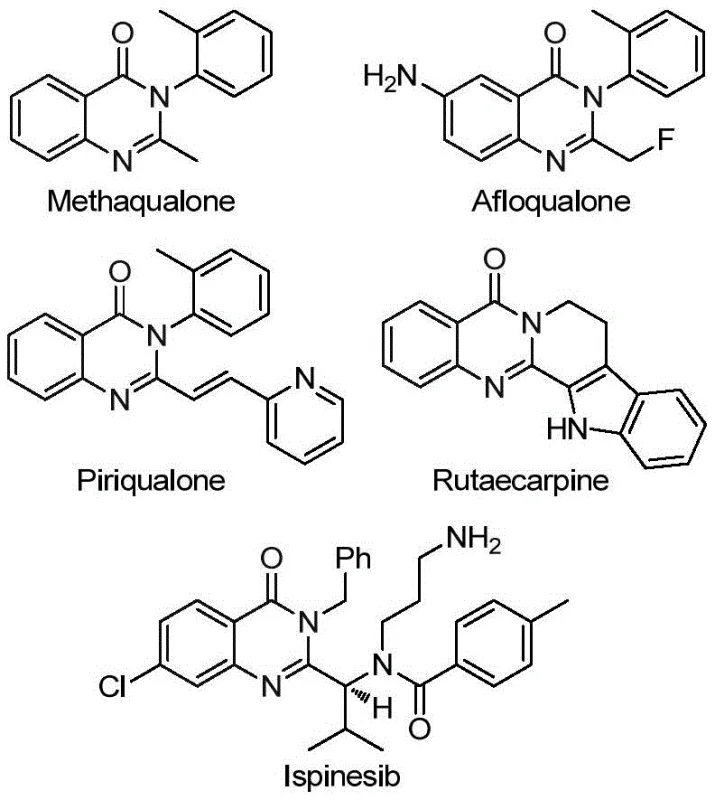
This technological advancement positions our organization as a reliable pharmaceutical intermediate supplier capable of delivering high-purity building blocks for next-generation therapeutics. By leveraging this novel catalytic system, we can offer cost reduction in API manufacturing through the use of inexpensive reagents and mild reaction conditions. The method's compatibility with various functional groups ensures that complex molecular architectures can be constructed without extensive protecting group strategies, thereby streamlining the supply chain for high-purity pharmaceutical intermediates. Furthermore, the scalability of this process from gram-scale laboratory synthesis to commercial production underscores its viability for meeting global demand.
The Limitations of Conventional Methods vs. The Novel Approach
The Limitations of Conventional Methods
Historically, the synthesis of 2-trifluoromethyl-substituted quinazolinone compounds has been fraught with significant challenges that hinder large-scale production and economic feasibility. Conventional literature methods often rely on the cyclization of anthranilamides with ethyl trifluoroacetate, trifluoroacetic anhydride, or trifluoroacetic acid, which typically require harsh reaction conditions and generate substantial acidic waste. Alternative approaches involving isatoic anhydride or T3P-promoted cascade reactions suffer from the use of expensive pre-activated substrates and limited substrate scope, leading to lower overall yields and higher production costs. These traditional pathways frequently necessitate rigorous purification steps to remove stubborn impurities, complicating the commercial scale-up of complex heterocycles and extending lead times for high-purity intermediates. Consequently, the pharmaceutical industry has long sought a more atom-economical and operationally simple alternative to overcome these bottlenecks.
The Novel Approach
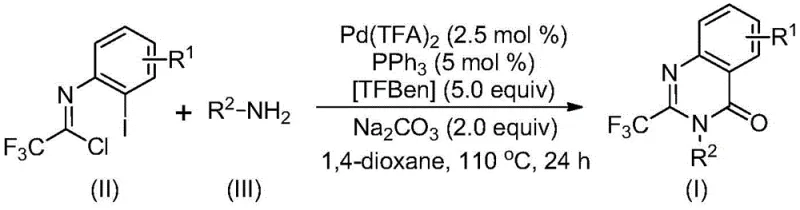
The methodology described in patent CN113045503B represents a paradigm shift by employing a palladium-catalyzed carbonylation strategy that bypasses the need for hazardous carbon monoxide gas. Instead, the process utilizes TFBen (1,3,5-tricarboxylic acid phenol ester) as a safe and effective solid carbon monoxide substitute, which releases CO in situ under heating conditions. This innovation allows for the direct coupling of trifluoroethylimidoyl chloride and various amines in the presence of a palladium catalyst and a phosphine ligand, resulting in high-yielding formation of the target quinazolinone core. The reaction proceeds smoothly in common organic solvents like 1,4-dioxane at moderate temperatures, demonstrating exceptional functional group tolerance across a wide range of substrates. This novel approach not only simplifies the operational workflow but also significantly enhances the safety profile of the manufacturing process, making it ideal for industrial applications.
Mechanistic Insights into Pd-Catalyzed Carbonylative Cyclization
The catalytic cycle proposed for this transformation involves a sophisticated sequence of organometallic steps that ensure high selectivity and efficiency. Initially, a base-promoted intermolecular carbon-nitrogen bond coupling occurs between the imidoyl chloride and the amine to generate a trifluoroacetamidine derivative intermediate. Subsequently, the palladium catalyst inserts into the carbon-iodine bond of the aromatic ring, forming a reactive divalent palladium species. As the temperature rises, TFBen decomposes to release carbon monoxide, which then inserts into the carbon-palladium bond to create an acyl-palladium intermediate. This key step is followed by intramolecular nucleophilic attack promoted by the base, leading to the formation of a seven-membered palladacycle intermediate. Finally, reductive elimination releases the final 2-trifluoromethyl-substituted quinazolinone product and regenerates the active palladium catalyst for the next cycle.
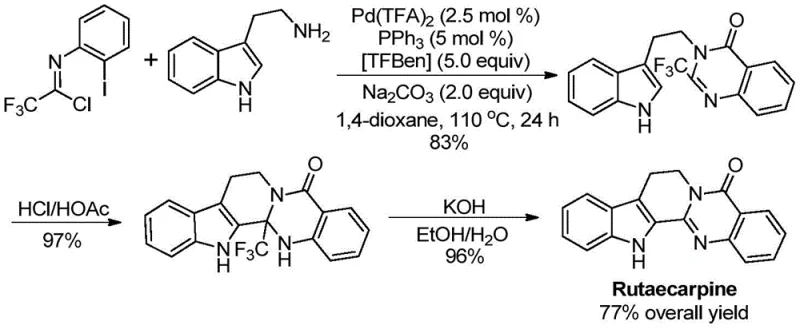
Understanding this mechanism is crucial for controlling impurity profiles and optimizing reaction parameters for commercial production. The mild conditions employed prevent the decomposition of sensitive functional groups, ensuring that the final product meets stringent purity specifications required for pharmaceutical applications. The use of triphenylphosphine as a ligand stabilizes the palladium center, preventing aggregation and maintaining catalytic activity throughout the extended reaction time of 16 to 30 hours. This mechanistic robustness allows for the synthesis of complex drug molecules such as Rutaecarpine, where the method achieves an impressive overall yield through a concise three-step sequence involving cyclization, acid-mediated deprotection, and base-induced aromatization. The ability to construct such intricate polycyclic systems highlights the versatility of this catalytic platform.
How to Synthesize 2-Trifluoromethyl Quinazolinones Efficiently
The practical implementation of this synthesis route is designed for ease of execution in both laboratory and pilot plant settings. The protocol involves charging a reaction vessel with the specified molar ratios of palladium trifluoroacetate, triphenylphosphine, sodium carbonate, TFBen, trifluoroethylimidoyl chloride, and the chosen amine in an aprotic solvent. The detailed standardized synthesis steps for replicating this high-efficiency route are provided in the guide below, ensuring consistent quality and reproducibility for our partners.
- Combine palladium trifluoroacetate, triphenylphosphine, sodium carbonate, TFBen, trifluoroethylimidoyl chloride, and the desired amine in an organic solvent such as 1,4-dioxane.
- Heat the reaction mixture to 110°C and stir for 16 to 30 hours to allow the carbonylation cascade reaction to proceed to completion.
- Filter the reaction mixture, mix with silica gel, and purify via column chromatography to isolate the high-purity 2-trifluoromethyl-substituted quinazolinone product.
Commercial Advantages for Procurement and Supply Chain Teams
For procurement managers and supply chain directors, the adoption of this patented synthesis method offers tangible benefits that directly impact the bottom line and operational resilience. By shifting away from traditional high-pressure carbonylation or expensive coupling reagents, manufacturers can achieve significant cost savings in raw material procurement and waste disposal. The use of commercially available amines and stable imidoyl chlorides reduces dependency on specialized custom synthesis, thereby enhancing supply chain reliability and reducing lead times for high-purity intermediates. Furthermore, the elimination of gaseous carbon monoxide removes the need for specialized high-pressure reactors, lowering capital expenditure requirements for facility upgrades.
- Cost Reduction in Manufacturing: The economic advantage of this process stems primarily from the replacement of hazardous and expensive reagents with affordable, shelf-stable alternatives. The use of TFBen as a CO surrogate eliminates the logistical costs and safety infrastructure associated with handling toxic carbon monoxide gas. Additionally, the high conversion rates and minimal byproduct formation reduce the burden on downstream purification processes, leading to substantial cost savings in solvent usage and chromatography media. This streamlined workflow translates to a more competitive pricing structure for the final API intermediates without compromising on quality standards.
- Enhanced Supply Chain Reliability: Sourcing stability is a critical factor for continuous pharmaceutical production, and this method leverages widely available commodity chemicals. The starting materials, including various substituted anilines and alkyl amines, are produced on a multi-ton scale globally, ensuring a steady supply even during market fluctuations. The robustness of the reaction conditions means that production schedules are less likely to be disrupted by sensitive parameter deviations, providing a predictable and reliable output for long-term contracts. This reliability is essential for maintaining uninterrupted manufacturing lines for critical medications.
- Scalability and Environmental Compliance: From an environmental and regulatory perspective, this green chemistry approach aligns with modern sustainability goals. The reaction generates fewer hazardous wastes compared to traditional anhydride-based methods, simplifying effluent treatment and reducing the environmental footprint of the manufacturing site. The process has been successfully demonstrated on a gram scale with clear pathways for expansion to kilogram and tonne scales, proving its readiness for commercial scale-up of complex heterocycles. Compliance with strict environmental regulations is easier to achieve, mitigating regulatory risks for our partners.
Frequently Asked Questions (FAQ)
The following questions address common technical and commercial inquiries regarding the implementation of this synthesis technology. These answers are derived directly from the experimental data and beneficial effects reported in the patent documentation, providing clarity on the method's capabilities and limitations. Understanding these details helps stakeholders make informed decisions about integrating this chemistry into their development pipelines.
Q: What are the advantages of using TFBen over traditional CO gas sources?
A: TFBen (1,3,5-tricarboxylic acid phenol ester) acts as a solid carbon monoxide substitute, eliminating the need for high-pressure CO gas equipment. This significantly enhances operational safety and simplifies the reaction setup for industrial scale-up.
Q: Can this method be applied to the synthesis of complex drug molecules?
A: Yes, the patent explicitly demonstrates the successful application of this method in the efficient total synthesis of Rutaecarpine, a complex bioactive alkaloid, achieving a high overall yield through a streamlined three-step sequence.
Q: What is the substrate scope regarding the amine component?
A: The method exhibits excellent functional group tolerance, accommodating various amines including alkyl amines (n-Bu, t-Bu), benzyl amines, and aryl amines with substituents like halogens, methyl, and methoxy groups, ensuring broad applicability.
Partnering with NINGBO INNO PHARMCHEM: Your Reliable 2-Trifluoromethyl Quinazolinone Supplier
At NINGBO INNO PHARMCHEM, we recognize the strategic value of advanced synthetic methodologies in accelerating drug development timelines. Our team of expert chemists possesses extensive experience scaling diverse pathways from 100 kgs to 100 MT/annual commercial production, ensuring that the transition from benchtop discovery to full-scale manufacturing is seamless. We are committed to delivering products that meet stringent purity specifications through our rigorous QC labs, utilizing state-of-the-art analytical instrumentation to verify every batch. Our capability to implement complex palladium-catalyzed transformations allows us to offer customized solutions for challenging molecular targets.
We invite you to collaborate with us to leverage this cutting-edge technology for your specific project needs. Our technical procurement team is ready to provide a Customized Cost-Saving Analysis tailored to your volume requirements and quality expectations. Please contact us to request specific COA data for our catalog compounds or to discuss route feasibility assessments for your proprietary molecules. Together, we can drive innovation and efficiency in the global pharmaceutical supply chain.