
Advanced Pd-Catalyzed Synthesis of Carbonyl-Bridged Biheterocyclic Compounds for Commercial Pharmaceutical Applications
Advanced Pd-Catalyzed Synthesis of Carbonyl-Bridged Biheterocyclic Compounds for Commercial Pharmaceutical Applications
The pharmaceutical industry continuously seeks efficient pathways to construct complex heterocyclic scaffolds that serve as the core backbone for bioactive molecules. Patent CN115353511A introduces a groundbreaking multi-component methodology for synthesizing carbonyl-bridged biheterocyclic compounds, specifically targeting the fusion of indolinone and imidazole motifs. This technical breakthrough addresses critical challenges in modern organic synthesis by enabling the one-pot assembly of these privileged structures under remarkably mild conditions. The significance of this invention lies not only in its chemical elegance but also in its practical applicability for reliable pharmaceutical intermediate supplier networks aiming to streamline their production pipelines. By leveraging a palladium-catalyzed cascade reaction, the process bypasses the need for hazardous gaseous reagents while maintaining high atom economy and structural diversity.
Furthermore, the ability to incorporate trifluoromethyl groups directly into the biheterocyclic framework adds substantial value, as fluorine atoms are known to enhance the metabolic stability and lipophilicity of drug candidates. This patent represents a pivotal shift from stepwise, labor-intensive protocols to a convergent strategy that maximizes resource efficiency. For research and development teams, this offers a robust platform for generating diverse libraries of potential therapeutic agents without the burden of complex protection-deprotection sequences. The underlying chemistry facilitates the rapid construction of molecular complexity from simple, commercially accessible building blocks, thereby accelerating the lead optimization phase in drug discovery programs.
The Limitations of Conventional Methods vs. The Novel Approach
The Limitations of Conventional Methods
Historically, the construction of biheterocyclic systems has relied heavily on strategies that are often plagued by inefficiencies and safety concerns. Traditional approaches typically involve the direct coupling of two pre-formed heterocyclic substrates, which frequently suffers from low regioselectivity and poor yields due to steric hindrance and electronic mismatches between the coupling partners. Alternatively, oxidative cyclization reactions utilizing activated methyl-substituted heterocycles require harsh oxidizing agents and elevated temperatures, leading to significant waste generation and potential safety hazards in a manufacturing environment. Moreover, classical carbonylation reactions necessitate the use of toxic carbon monoxide gas, which demands specialized high-pressure equipment and rigorous safety protocols, thereby inflating capital expenditure and operational complexity for chemical manufacturers.
These conventional limitations create substantial bottlenecks in the supply chain, particularly when scaling up for commercial production. The multi-step nature of older syntheses increases the cumulative loss of material at each stage, driving up the cost of goods sold and extending the overall lead time for high-purity intermediates. Additionally, the narrow substrate scope of many legacy methods restricts the chemical space available for medicinal chemists, forcing them to compromise on ideal molecular properties. The reliance on expensive transition metal catalysts without efficient recycling mechanisms further exacerbates the economic burden, making these processes less attractive for cost-sensitive generic drug manufacturing or large-scale agrochemical applications where margin compression is a constant pressure.
The Novel Approach
In stark contrast, the methodology disclosed in CN115353511A utilizes a sophisticated palladium-catalyzed carbonylation cascade that seamlessly integrates three distinct components into a single reaction vessel. This novel approach employs trifluoroethylimidoyl chloride, propargylamine, and acrylamide derivatives as starting materials, reacting them in the presence of a palladium catalyst and a ligand system to forge multiple bonds simultaneously. A key innovation is the replacement of gaseous carbon monoxide with a safe liquid mixture of formic acid and acetic anhydride, which generates the necessary carbonyl species in situ under ambient pressure. This modification drastically simplifies the reactor setup and eliminates the risks associated with handling toxic gases, making the process inherently safer for operators and the environment.
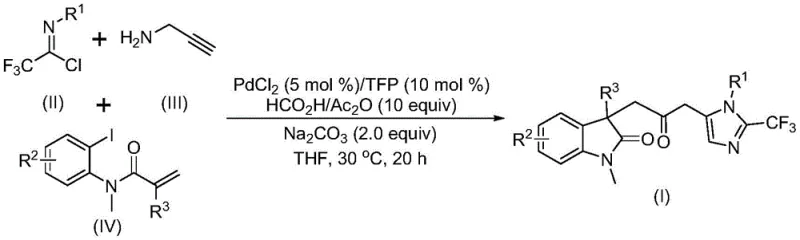
The reaction proceeds efficiently at a mild temperature of 30°C, demonstrating exceptional functional group tolerance that allows for the incorporation of diverse substituents such as halogens, alkyl groups, and electron-withdrawing moieties. This mildness preserves sensitive functional groups that might otherwise decompose under harsher thermal conditions, thereby expanding the utility of the method for synthesizing complex drug candidates. The one-pot nature of the transformation reduces solvent consumption and purification steps, directly contributing to cost reduction in pharmaceutical intermediate manufacturing. By consolidating what would traditionally be a multi-step sequence into a single operational unit, this technology offers a compelling value proposition for supply chain heads looking to optimize throughput and minimize waste disposal costs.
Mechanistic Insights into Pd-Catalyzed Carbonylation Cascade
The mechanistic pathway of this transformation is a testament to the power of modern organometallic catalysis in orchestrating complex molecular assemblies. The cycle initiates with the oxidative addition of a zero-valent palladium species into the carbon-iodine bond of the acrylamide substrate, generating a reactive organopalladium intermediate. This is followed by an intramolecular Heck-type reaction where the palladium center inserts into the proximal alkene, forming a cyclic alkyl-palladium species that establishes the indolinone core. Subsequently, the carbon monoxide generated from the decomposition of the formic acid/acetic anhydride mixture inserts into the palladium-carbon bond, creating an acyl-palladium intermediate that serves as the electrophilic hub for the subsequent cascade steps.
Concurrently, the base-promoted reaction between trifluoroethylimidoyl chloride and propargylamine generates a trifluoroacetamidine species, which undergoes isomerization to a more reactive form. This nucleophilic species then intercepts the acyl-palladium intermediate, facilitating a final cyclization event that closes the imidazole ring and releases the active catalyst to restart the cycle. This intricate dance of bond formations ensures high regioselectivity and minimizes the formation of side products, resulting in a clean impurity profile that is crucial for regulatory compliance. The choice of trifurylphosphine (TFP) as a ligand is critical, as it stabilizes the palladium center and modulates its electronic properties to favor the desired carbonylation over competing beta-hydride elimination pathways.
How to Synthesize Carbonyl-Bridged Biheterocyclic Compounds Efficiently
Implementing this synthesis requires precise control over reaction parameters to maximize yield and purity. The protocol dictates the use of tetrahydrofuran (THF) as the preferred solvent due to its ability to solubilize all reactants effectively while supporting the catalytic cycle. Operators must carefully monitor the stoichiometry, typically employing a slight excess of propargylamine and acrylamide relative to the imidoyl chloride to drive the equilibrium forward. The detailed standardized synthesis steps see the guide below for specific molar ratios and workup procedures tailored for laboratory and pilot-scale execution.
- Combine palladium chloride catalyst, TFP ligand, sodium carbonate base, and the formic acid/acetic anhydride mixture in an organic solvent such as THF.
- Add the substrates including trifluoroethylimidoyl chloride, propargylamine, and the specific acrylamide derivative to the reaction mixture under stirring.
- Maintain the reaction at 30°C for 12 to 20 hours, followed by filtration, silica gel treatment, and column chromatography purification to isolate the final product.
Commercial Advantages for Procurement and Supply Chain Teams
From a commercial perspective, this patented technology offers transformative benefits that align perfectly with the strategic goals of procurement managers and supply chain directors. The shift towards safer, in situ CO generation removes the need for specialized high-pressure infrastructure, representing a significant capital expenditure saving for manufacturing facilities. Furthermore, the use of commodity chemicals like propargylamine and acrylamide derivatives ensures a stable and resilient supply chain, reducing the risk of raw material shortages that can plague specialty chemical markets. The operational simplicity of the one-pot process translates to reduced labor hours and lower utility consumption, driving down the overall cost of production without compromising on quality.
- Cost Reduction in Manufacturing: The elimination of toxic gas handling systems and the reduction of synthetic steps lead to substantial operational cost savings. By avoiding the need for expensive high-pressure reactors and complex safety monitoring equipment, manufacturers can allocate resources more efficiently. Additionally, the high atom economy of the multi-component reaction minimizes raw material waste, ensuring that a greater proportion of input costs are converted into valuable product rather than discarded byproducts. This efficiency is critical for maintaining competitive pricing in the global market for fine chemical intermediates.
- Enhanced Supply Chain Reliability: The reliance on widely available, off-the-shelf starting materials mitigates the risk of supply disruptions. Unlike proprietary reagents that may have single-source suppliers, the key inputs for this reaction are produced by multiple vendors globally, fostering a competitive purchasing environment. The robustness of the reaction conditions, which tolerate moisture and air better than many sensitive organometallic processes, further enhances reliability by reducing batch failures due to minor environmental fluctuations. This stability ensures consistent delivery schedules for downstream customers relying on these intermediates for their own production lines.
- Scalability and Environmental Compliance: The patent explicitly demonstrates the viability of this method on a gram scale, providing a clear pathway for expansion to kilogram and metric ton quantities. The mild reaction temperature of 30°C reduces energy consumption for heating and cooling, contributing to a lower carbon footprint for the manufacturing process. Moreover, the simplified workup involving filtration and chromatography reduces the volume of organic solvents required for purification, aiding in compliance with increasingly stringent environmental regulations regarding volatile organic compound emissions and waste disposal.
Frequently Asked Questions (FAQ)
The following questions address common technical inquiries regarding the implementation and scope of this synthesis method. These answers are derived directly from the experimental data and claims within the patent documentation to provide accurate guidance for technical teams evaluating this technology for adoption. Understanding these nuances is essential for assessing the feasibility of integrating this route into existing manufacturing portfolios.
Q: How does this method improve safety compared to traditional carbonylation?
A: Unlike conventional methods requiring toxic carbon monoxide gas cylinders, this protocol utilizes a formic acid and acetic anhydride mixture to generate CO in situ, significantly enhancing operational safety and eliminating high-pressure gas handling requirements.
Q: What is the substrate compatibility for this biheterocyclic synthesis?
A: The reaction demonstrates excellent functional group tolerance, accommodating various substituents on the aryl rings including alkyl, alkoxy, halogens, trifluoromethyl, and nitro groups, allowing for the diverse design of drug-like scaffolds.
Q: Is this process suitable for large-scale industrial production?
A: Yes, the patent explicitly validates the method's scalability through successful gram-scale reactions, utilizing cheap and commercially available starting materials which supports potential expansion to metric ton production levels.
Partnering with NINGBO INNO PHARMCHEM: Your Reliable Carbonyl-Bridged Biheterocyclic Compounds Supplier
As the demand for complex heterocyclic scaffolds continues to rise in the pharmaceutical sector, partnering with an experienced CDMO is essential for successful commercialization. NINGBO INNO PHARMCHEM possesses extensive experience scaling diverse pathways from 100 kgs to 100 MT/annual commercial production, ensuring that your project transitions smoothly from benchtop discovery to full-scale manufacturing. Our facility is equipped with state-of-the-art rigorous QC labs capable of meeting stringent purity specifications required by global regulatory bodies, guaranteeing that every batch of carbonyl-bridged biheterocyclic compounds meets the highest standards of quality and consistency.
We invite you to engage with our technical procurement team to discuss how this innovative Pd-catalyzed technology can be leveraged for your specific drug development programs. By requesting a Customized Cost-Saving Analysis, you can gain deeper insights into the economic benefits of adopting this route for your supply chain. We encourage potential partners to contact us directly to obtain specific COA data and route feasibility assessments, allowing you to make informed decisions that drive efficiency and value in your pharmaceutical manufacturing operations.