
Scalable NBS-Promoted C-S Bond Cleavage for High-Purity Asymmetric Disulfide Manufacturing
Scalable NBS-Promoted C-S Bond Cleavage for High-Purity Asymmetric Disulfide Manufacturing
The landscape of fine chemical synthesis is continuously evolving to meet the rigorous demands of the pharmaceutical and agrochemical industries, particularly regarding the construction of complex sulfur-containing motifs. A pivotal advancement in this domain is documented in Chinese Patent CN114853648B, which discloses a highly efficient method for preparing asymmetric disulfides by promoting the breakage of thioether C-S bonds using N-bromosuccinimide (NBS). Asymmetric disulfides are not merely academic curiosities; they are fundamental structural elements found in a vast array of bioactive natural products, therapeutic drugs, and functional materials. The versatility of proteins with complex three-dimensional structures often relies heavily on the precise construction of disulfide (S-S) bonds, making the development of robust synthetic methodologies a critical priority for modern process chemistry. This patent introduces a transformative approach that utilizes readily available thioethers and symmetrical disulfides as raw materials, leveraging NBS as a crucial additive to drive the reaction forward under remarkably mild conditions.
The significance of this technology extends beyond simple molecule construction; it represents a strategic shift towards greener, more sustainable manufacturing processes that align with global regulatory trends. By operating at ambient temperature (25°C) in acetonitrile, this method circumvents the energy-intensive requirements of traditional protocols. For R&D directors and process chemists, the ability to access diverse asymmetric disulfide derivatives in a single step with high yields and excellent functional group tolerance opens new avenues for lead optimization and scale-up. The methodology effectively bypasses the logistical and safety challenges associated with handling volatile and malodorous mercaptans, which have historically been the standard precursors for disulfide synthesis. Instead, it utilizes stable thioether precursors, thereby enhancing operational safety and simplifying inventory management for large-scale production facilities.
The Limitations of Conventional Methods vs. The Novel Approach
The Limitations of Conventional Methods
Historically, the synthesis of asymmetric disulfides via C-S bond cleavage has been fraught with significant technical and economic hurdles that impede efficient commercialization. Traditional strategies predominantly rely on the use of transition metal catalysts to facilitate the activation of the C-S bond and subsequent reaction with nucleophiles. While effective in some contexts, the reliance on transition metals introduces severe complications, including the potential for heavy metal contamination in the final active pharmaceutical ingredient (API). Removing trace metal residues to meet stringent regulatory limits often necessitates additional, costly purification steps such as scavenging or recrystallization, which drastically reduce overall process yield and increase manufacturing costs. Furthermore, previous attempts to utilize fluorinating reagents like NFSI (N-fluorobisbenzenesulfonamide) to achieve similar transformations have demonstrated limited practical utility due to harsh reaction conditions.
Specifically, prior art methods utilizing NFSI require elevated reaction temperatures, typically around 80°C, which increases energy consumption and poses thermal safety risks during scale-up. Moreover, these older methodologies exhibit poor substrate scope, often restricted to specific structures like 3-methylthio-N-phenylpropanamide, and frequently suffer from mediocre yields. The inability to tolerate a broad range of functional groups limits the applicability of these conventional methods in the synthesis of complex drug candidates. Additionally, the classical approach of oxidizing mixed thiols is often plagued by the formation of symmetrical disulfide byproducts due to scrambling reactions, leading to difficult separations and reduced atom economy. These cumulative inefficiencies create a compelling need for a more robust, metal-free, and mild alternative that can deliver high-purity products with minimal environmental impact.
The Novel Approach
The methodology described in patent CN114853648B offers a paradigm shift by employing N-bromosuccinimide (NBS) as a promoter for C-S bond cleavage, enabling the direct coupling of thioethers with symmetrical disulfides. This novel approach operates under exceptionally mild conditions, specifically at 25°C in acetonitrile, which significantly reduces the energy footprint of the reaction compared to high-temperature alternatives. The use of NBS acts as a powerful yet selective activator, facilitating the exchange of sulfur moieties without the need for toxic transition metals. This metal-free characteristic is a substantial advantage for pharmaceutical manufacturing, as it inherently simplifies the purification workflow and ensures the final product is free from heavy metal contaminants. The reaction demonstrates remarkable efficiency, converting substrates to target asymmetric disulfides in as little as 2 hours with high conversion rates.
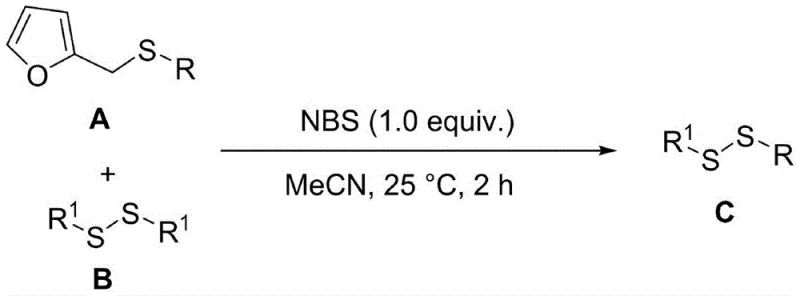
Furthermore, this new strategy exhibits exceptional substrate compatibility, accommodating a wide variety of functional groups including esters, nitriles, carboxylic acids, and diverse aromatic systems. The ability to utilize furfuryl thioethers and various symmetrical disulfides allows for the rapid generation of structural diversity, which is invaluable for medicinal chemistry campaigns. Experimental data indicates that the reaction proceeds smoothly with a 1.0:1.0:2.0 molar ratio of NBS, thioether, and disulfide, achieving yields such as 85% for model compound C1. Crucially, control experiments confirm that the reaction does not proceed in the absence of NBS, highlighting the specific and indispensable role of the brominating agent in activating the C-S bond. This specificity ensures that side reactions are minimized, leading to cleaner reaction profiles and easier downstream processing.
Mechanistic Insights into NBS-Promoted C-S Bond Activation
The mechanistic underpinning of this transformation involves the electrophilic activation of the sulfur atom within the thioether substrate by NBS. N-bromosuccinimide serves as a source of electrophilic bromine, which interacts with the lone pair electrons on the sulfur atom of the thioether. This interaction generates a reactive sulfonium intermediate or a hypervalent sulfur species that significantly weakens the adjacent C-S bond. Once the C-S bond is activated, it becomes susceptible to nucleophilic attack by the symmetrical disulfide or a transient thiyl species generated in situ. This cleavage and subsequent recombination allow for the scrambling of the sulfur centers, ultimately resulting in the formation of the thermodynamically stable asymmetric disulfide product. The mildness of NBS ensures that sensitive functional groups on the substrate remain intact, preventing degradation or unwanted side reactions that are common with harsher oxidants or strong acids.
From an impurity control perspective, the mechanism favors the formation of the desired cross-coupled product over symmetrical byproducts due to the stoichiometric control and the specific reactivity of the intermediates. The use of an excess of symmetrical disulfide (2.0 equivalents) drives the equilibrium towards the formation of the asymmetric product, effectively suppressing the reformation of the starting symmetrical disulfide. Additionally, the choice of acetonitrile as the solvent plays a critical role in stabilizing the polar transition states and intermediates involved in the halogen-mediated process. Comparative studies show that solvents like THF or 1,4-dioxane result in significantly lower yields (16% and 23% respectively), underscoring the importance of solvent polarity in facilitating the ionization or polarization steps required for efficient C-S bond breaking. This deep understanding of the reaction parameters allows for precise tuning of the process to maximize yield and purity.
How to Synthesize Asymmetric Disulfide Derivatives Efficiently
The synthesis of these valuable intermediates is streamlined into a straightforward protocol that minimizes operational complexity while maximizing output. The process begins with the precise weighing of reagents to maintain the optimal stoichiometric balance identified during process development. By adhering to the specified concentrations and temperatures, manufacturers can ensure reproducible results across different batch sizes. The simplicity of the workup procedure, involving only concentration and column chromatography, makes this method highly attractive for both laboratory-scale discovery and pilot-scale production. For detailed operational parameters and safety considerations, the standardized synthesis steps are outlined below.
- Prepare the reaction mixture by adding acetonitrile solvent, thioether substrate (0.2 mmol), symmetrical disulfide (0.4 mmol), and NBS (0.2 mmol) into a sealed tube.
- Maintain the reaction temperature strictly at 25°C and stir vigorously for 2 hours to ensure complete conversion.
- Upon completion, concentrate the reaction liquid and perform column chromatography separation to isolate the target asymmetric disulfide derivative.
Commercial Advantages for Procurement and Supply Chain Teams
For procurement managers and supply chain leaders, the adoption of this NBS-promoted synthesis route offers tangible strategic benefits that directly impact the bottom line and operational resilience. The elimination of transition metal catalysts removes a major cost driver associated with both the purchase of expensive noble metals and the subsequent removal processes required to meet regulatory standards. This simplification of the purification train translates into significant cost reduction in fine chemical manufacturing, as fewer unit operations and less specialized equipment are needed. Furthermore, the avoidance of malodorous thiols improves the working environment and reduces the need for specialized containment infrastructure, lowering capital expenditure requirements for new production lines.
- Cost Reduction in Manufacturing: The replacement of expensive transition metal catalysts with commodity chemicals like NBS drastically lowers the raw material cost profile of the synthesis. Since NBS is a widely available and inexpensive reagent, the overall cost of goods sold (COGS) is significantly optimized. Additionally, the mild reaction conditions (25°C) eliminate the need for energy-intensive heating or cooling systems, further reducing utility costs. The high selectivity of the reaction minimizes the formation of difficult-to-remove impurities, which reduces solvent consumption during purification and increases the overall throughput of the manufacturing facility.
- Enhanced Supply Chain Reliability: The reliance on commercially available and stable starting materials such as furfuryl thioethers and symmetrical disulfides ensures a robust supply chain that is less susceptible to disruptions. Unlike specialized catalysts that may have long lead times or single-source dependencies, NBS and the requisite solvents are commodity chemicals with multiple global suppliers. This diversification of the supply base mitigates the risk of production stoppages due to raw material shortages. The stability of the reagents also allows for longer shelf-life and easier storage, reducing inventory write-offs and improving warehouse management efficiency.
- Scalability and Environmental Compliance: The metal-free nature of this process aligns perfectly with increasingly stringent environmental regulations regarding heavy metal discharge and waste treatment. By avoiding toxic metals, the waste stream is easier to treat and dispose of, reducing environmental compliance costs and liability. The reaction's scalability is demonstrated by its robustness in sealed tubes and its tolerance to standard workup procedures, making the commercial scale-up of complex pharmaceutical intermediates feasible without extensive re-engineering. This green chemistry profile enhances the corporate sustainability metrics of any organization adopting this technology.
Frequently Asked Questions (FAQ)
The following questions address common technical and commercial inquiries regarding the implementation of this NBS-promoted disulfide synthesis technology. These insights are derived directly from the experimental data and comparative studies presented in the patent literature, providing a clear picture of the method's capabilities and limitations. Understanding these details is crucial for making informed decisions about process adoption and integration into existing manufacturing workflows.
Q: Why is NBS preferred over transition metal catalysts for disulfide synthesis?
A: NBS eliminates the need for expensive and toxic transition metals, simplifying downstream purification and ensuring the final product meets stringent heavy metal specifications required for pharmaceutical applications.
Q: What are the optimal reaction conditions for this NBS-promoted method?
A: The optimal conditions involve using acetonitrile (MeCN) as the solvent at a concentration of 0.1 mol/L for the thioether, with a molar ratio of NBS:Thioether:Disulfide at 1.0:1.0:2.0, reacting at 25°C for 2 hours.
Q: Does this method support diverse functional groups on the substrate?
A: Yes, the method demonstrates excellent functional group compatibility, successfully tolerating esters, nitriles, carboxylic acids, and various aromatic substituents without requiring protective group strategies.
Partnering with NINGBO INNO PHARMCHEM: Your Reliable Asymmetric Disulfide Supplier
At NINGBO INNO PHARMCHEM, we recognize the critical importance of high-quality sulfur-containing intermediates in the development of next-generation therapeutics and advanced materials. Our technical team has thoroughly analyzed the potential of the NBS-promoted C-S bond cleavage technology and is fully prepared to leverage this methodology for your specific project needs. We possess extensive experience scaling diverse pathways from 100 kgs to 100 MT/annual commercial production, ensuring that your transition from benchtop discovery to full-scale manufacturing is seamless and efficient. Our state-of-the-art facilities are equipped with rigorous QC labs capable of meeting stringent purity specifications, guaranteeing that every batch of asymmetric disulfide delivered meets the highest industry standards.
We invite you to collaborate with us to explore how this innovative synthesis route can optimize your supply chain and reduce your overall production costs. By partnering with our expert technical procurement team, you can request a Customized Cost-Saving Analysis tailored to your specific molecule and volume requirements. We encourage you to reach out today to obtain specific COA data for our available catalog compounds or to discuss route feasibility assessments for your custom synthesis projects. Let us help you accelerate your development timeline with our reliable Asymmetric Disulfide Supplier capabilities and commitment to technical excellence.