
Revolutionizing Amide Bond Formation: A Metal-Free Visible Light Strategy for Commercial Scale-Up
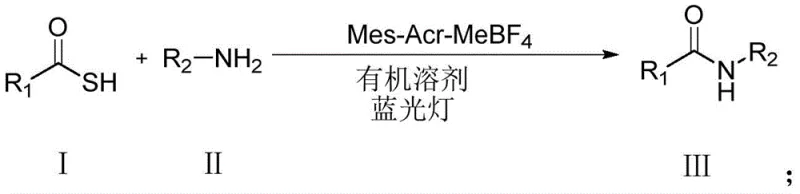
The landscape of organic synthesis is undergoing a paradigm shift towards greener, more sustainable methodologies, particularly in the construction of the ubiquitous amide bond. Patent CN110698360A introduces a groundbreaking visible-light-induced method for preparing amides without the participation of metals, addressing critical pain points in modern pharmaceutical manufacturing. This technology leverages 9-mesityl-10-methylacridinium tetrafluoroborate (Mes-Acr-MeBF4) as a potent organic photosensitizer to catalyze the coupling of thioacids and amines under mild conditions. Unlike traditional approaches that rely on harsh thermal activation or toxic transition metals, this protocol operates efficiently at room temperature under blue light irradiation. For R&D directors and process chemists, this represents a significant advancement in developing robust, scalable routes for complex API intermediates. The reported yields range from 71% to 96%, demonstrating high efficiency across a broad substrate scope. By eliminating the need for exogenous bases or additives, this method not only simplifies the reaction setup but also drastically reduces the generation of chemical waste, aligning perfectly with the principles of green chemistry and sustainable industrial practices.
The Limitations of Conventional Methods vs. The Novel Approach
The Limitations of Conventional Methods
Traditionally, the formation of amide bonds has relied heavily on the activation of carboxylic acids using stoichiometric coupling reagents such as carbodiimides (e.g., DCC, EDC) or via the formation of acid chlorides using thionyl chloride. These conventional pathways are fraught with significant drawbacks that impact both cost and environmental sustainability. The use of coupling reagents generates substantial amounts of urea byproducts that are often difficult to remove, necessitating complex purification steps that lower overall throughput. Furthermore, methods involving acid chlorides require strictly anhydrous conditions and often involve hazardous reagents that pose safety risks on a large scale. Perhaps most critically for the pharmaceutical industry, many catalytic amide formation strategies utilize transition metals like palladium, copper, or ruthenium. While effective, these metals leave residues that must be rigorously removed to meet stringent ICH Q3D guidelines, adding expensive scavenging steps and extending production lead times. The cumulative effect is a process that is energy-intensive, wasteful, and costly.
The Novel Approach
The methodology described in CN110698360A offers a transformative alternative by utilizing visible light photoredox catalysis to drive the reaction between thioacids and amines. This approach completely bypasses the need for stoichiometric activating agents or transition metal catalysts. Instead, it employs an organic acridinium salt which, upon excitation by blue LED light, facilitates a single-electron transfer process that activates the thioacid species. This radical-mediated pathway proceeds under ambient air and room temperature, eliminating the energy costs associated with heating and the safety hazards of high-pressure reactors. The reaction demonstrates remarkable chemoselectivity, tolerating sensitive functional groups such as hydroxyls, phenols, and halides without the need for protection-deprotection sequences. This inherent selectivity streamlines the synthetic workflow, allowing for the direct conversion of complex building blocks into high-value amide intermediates. By shifting from thermal/chemical activation to photochemical activation, this method provides a cleaner, safer, and more economically viable route for the commercial production of fine chemicals.
Mechanistic Insights into Mes-Acr-MeBF4 Photoredox Catalysis
The core of this innovation lies in the unique photophysical properties of the Mes-Acr-MeBF4 catalyst, which acts as a strong oxidative photocatalyst in its excited state. Upon absorption of blue light photons, the ground state catalyst is promoted to a high-energy excited state capable of oxidizing the thioacid substrate via a single-electron transfer (SET) mechanism. This oxidation generates a sulfur-centered radical intermediate, which subsequently undergoes fragmentation or further reaction to form an acyl radical species. This highly reactive acyl radical then couples with the nucleophilic amine to forge the new carbon-nitrogen bond, ultimately yielding the desired amide product after proton transfer and catalyst regeneration. The catalytic cycle is closed as the reduced form of the photocatalyst is re-oxidized, likely by oxygen from the air or through radical chain propagation, ensuring that only catalytic amounts of the organic salt are required. This mechanism avoids the formation of stable metal-ligand complexes that often plague transition metal catalysis, thereby preventing catalyst deactivation and metal contamination.
From an impurity control perspective, this radical mechanism offers distinct advantages over ionic pathways. Traditional coupling methods often suffer from racemization of chiral centers adjacent to the carbonyl group due to the formation of oxazolone intermediates under basic conditions. In contrast, the neutral, mild conditions of this photoredox system minimize the risk of epimerization, preserving the stereochemical integrity of chiral pharmaceutical intermediates. Additionally, the absence of strong bases prevents side reactions such as ester hydrolysis or elimination reactions that can occur with sensitive substrates. The high functional group tolerance observed in the patent data—where alcohols, phenols, and heterocycles remain intact—confirms that the radical species generated are sufficiently selective to target the thioacid moiety specifically. This selectivity reduces the formation of structurally related impurities, simplifying the purification profile and enhancing the overall purity of the final API intermediate, which is a critical quality attribute for regulatory approval.
How to Synthesize N-phenylacetamide Efficiently
The practical implementation of this visible-light induced amidation is straightforward and adaptable to standard laboratory and pilot plant equipment. The protocol typically involves dissolving the amine substrate in a polar aprotic solvent such as acetonitrile, followed by the addition of the thioacid and the Mes-Acr-MeBF4 catalyst. The reaction vessel is then irradiated with a standard 36W blue LED source while stirring at room temperature. Detailed operational parameters, including specific molar ratios and workup procedures, are critical for maximizing yield and reproducibility. For process chemists looking to implement this technology, understanding the precise stoichiometry and light intensity requirements is essential for successful translation from bench to kilo-lab scale. The standardized synthesis steps outlined below provide a foundational framework for optimizing this green chemistry approach.
- Dissolve the amine substrate in an organic solvent such as acetonitrile under air atmosphere.
- Add the photosensitizer Mes-Acr-MeBF4 (2 mol%) and the thioacid compound (2.0 equivalents) to the reaction mixture.
- Irradiate the mixture with a 36W blue LED lamp at room temperature for 5 hours, followed by standard aqueous workup and purification.
Commercial Advantages for Procurement and Supply Chain Teams
For procurement managers and supply chain leaders, the adoption of this metal-free photoredox technology translates into tangible strategic benefits beyond mere technical novelty. The primary value driver is the drastic simplification of the supply chain for raw materials. By eliminating the need for precious metal catalysts like palladium or rhodium, manufacturers are no longer subject to the volatile pricing and geopolitical supply risks associated with these critical minerals. Furthermore, the removal of stoichiometric coupling reagents reduces the volume of raw materials required per kilogram of product, directly lowering the bill of materials. The mild reaction conditions also imply lower energy consumption, as there is no need for prolonged heating or cryogenic cooling, contributing to a reduced carbon footprint and lower utility costs. These factors combine to create a more resilient and cost-efficient manufacturing process that is less susceptible to external market shocks.
- Cost Reduction in Manufacturing: The elimination of expensive transition metal catalysts and stoichiometric coupling agents results in substantial cost savings. Traditional methods often require costly metal scavengers to meet regulatory limits, a step that is entirely rendered obsolete by this organic photocatalytic system. Additionally, the simplified workup procedure, which avoids complex extractions to remove metal salts, reduces solvent consumption and labor hours. The overall process mass intensity (PMI) is significantly improved, leading to a leaner, more economical production model that enhances profit margins without compromising product quality.
- Enhanced Supply Chain Reliability: Relying on abundant organic catalysts and simple thioacid precursors mitigates the risk of supply disruptions common with specialized organometallic reagents. The robustness of the reaction under air atmosphere further simplifies logistics, as there is no need for inert gas blanketing or specialized anhydrous solvents during transport and storage. This operational simplicity ensures consistent production schedules and shorter lead times, allowing supply chain teams to respond more agilely to fluctuating market demands. The ability to source materials from a broader vendor base enhances negotiation leverage and secures long-term supply continuity.
- Scalability and Environmental Compliance: The scalability of photochemical reactions has historically been a concern, but advancements in flow chemistry and LED technology have made large-scale implementation feasible. This method generates minimal hazardous waste, as it avoids the production of heavy metal sludge and urea byproducts typical of coupling reagents. This aligns with increasingly strict environmental regulations and corporate sustainability goals. The ease of waste treatment and the potential for solvent recycling make this process highly attractive for facilities aiming to reduce their environmental impact while maintaining high production volumes.
Frequently Asked Questions (FAQ)
The following questions address common technical and commercial inquiries regarding the implementation of this visible-light amide synthesis technology. These insights are derived directly from the experimental data and beneficial effects reported in the patent literature, providing a clear understanding of the method's capabilities and limitations. Understanding these details is crucial for evaluating the feasibility of integrating this green chemistry approach into existing manufacturing workflows.
Q: What are the advantages of using visible light catalysis over traditional thermal methods for amide synthesis?
A: Visible light catalysis operates at room temperature, eliminating the need for high-energy thermal inputs and harsh reaction conditions. Furthermore, the metal-free nature of the Mes-Acr-MeBF4 system avoids toxic metal residues, simplifying downstream purification and ensuring compliance with strict pharmaceutical regulatory standards regarding heavy metal limits.
Q: Does this photoredox method tolerate sensitive functional groups?
A: Yes, the method exhibits excellent functional group selectivity. It successfully tolerates alcohols, phenols, ethers, esters, halogens, and heterocycles without requiring protective group strategies, thereby streamlining the synthetic route and improving overall atom economy.
Q: Is this process scalable for industrial production of pharmaceutical intermediates?
A: The process utilizes mild conditions and commercially available reagents, making it highly suitable for scale-up. The absence of expensive transition metals and stoichiometric coupling agents significantly reduces raw material costs and waste generation, supporting sustainable large-scale manufacturing.
Partnering with NINGBO INNO PHARMCHEM: Your Reliable Amide Intermediates Supplier
At NINGBO INNO PHARMCHEM, we recognize the transformative potential of visible-light photoredox catalysis in modernizing the synthesis of complex pharmaceutical intermediates. As a dedicated CDMO partner, we possess extensive experience scaling diverse pathways from 100 kgs to 100 MT/annual commercial production, ensuring that innovative laboratory methods are successfully translated into robust industrial processes. Our state-of-the-art facilities are equipped with advanced photochemical reactors and rigorous QC labs capable of meeting stringent purity specifications required by global regulatory bodies. We are committed to delivering high-quality amide intermediates that adhere to the highest standards of safety and efficacy, leveraging cutting-edge technologies to drive value for our partners.
We invite you to collaborate with us to explore how this metal-free synthesis route can optimize your specific project requirements. Our technical team is ready to provide a Customized Cost-Saving Analysis tailored to your target molecules, demonstrating the economic benefits of switching to this greener methodology. Please contact our technical procurement team to request specific COA data and route feasibility assessments. Let us help you accelerate your development timeline and secure a sustainable supply chain for your critical drug candidates.